
10 of the Best Websites for Electrical Contracting
Find a Qualified Electrical Contractor for Your Project
To find a dependable electrical contractor in Indianapolis, Beech Grove, Franklin, Whiteland, Southport, or Mooresville, start by confirming three essentials:
- Active licensing, insurance, and bonding for the work and location.
- Relevant project experience, whether you need a panel upgrade, commercial buildout, lighting retrofit, standby generator, EV charger, SPAN smart panel, or low-voltage system.
- A clear written scope and estimate that explains the work, permits, timeline, safety steps, and warranty.
Electrical contracting covers far more than basic wiring. A qualified electrical contractor manages the entire project lifecycle, coordinates skilled tradespeople, strictly adheres to the National Electrical Code and local municipal requirements, and keeps project cost, safety, and schedules on track. Throughout Central Indiana and the southern Indianapolis suburbs, volatile weather and seasonal shifts bring heavy spring storms, power surges, and severe grid fluctuations. Having a dedicated, licensed contractor ensures that your residential or commercial infrastructure remains resilient, safe, and up to code.
This comprehensive guide explores the structural standards of professional electrical contracting, essential verification platforms, and specialized power systems designed to safeguard your home or commercial enterprise.
I am Clay Hamilton, President of Grounded Solutions, with more than 20 years of hands-on experience in excavation, electrical, and mechanical systems. My background in electrical contracting, maintenance, repair, and project leadership helps homeowners and commercial property managers make informed, confident decisions before work begins.
Must-know electrical contracting terms:
Understanding Electrical Contracting: Roles, Classifications, and Standards
Navigating modern electrical power requires a firm grasp of how professional contracting operations are structured. The industry is segmented into distinct tiers based on voltage levels, project scale, and physical environment. Understanding these operational boundaries helps property owners, general contractors, and facility directors in Marion County, Johnson County, Morgan County, and Hendricks County choose the right partner for their specific architectural and power demands.
| Contractor Classification | Primary Scope & Voltage Level | Core Systems Installed | Typical Project Types |
|---|---|---|---|
| Outside / Line Contractors | High-voltage transmission and distribution (>600V to hundreds of kV) | Overhead power lines, substations, utility poles, grid infrastructure | Utility buildouts, power grid expansions, storm disaster recovery |
| Inside Electrical Contractors | Medium to low voltage (<600V building power) | Main switchgear, distribution panels, branch circuits, conduit runs, lighting | Commercial offices, retail centers, modern homes, manufacturing |
| Integrated Building Systems (IBS) | Low voltage & specialized communications (<50V/signaling) | Smart automation, telecommunications, fiber optics, life safety, security | Smart buildings, data rooms, medical tech, enterprise controls |
Every classification must adhere to stringent national and local ordinances. While outside line contractors manage the raw energy traversing utility corridors, inside and systems contractors take that power from the utility drop, step it down safely, and distribute it throughout the interior living or working spaces.
Electrical Contractor Companies vs. Individual Electricians
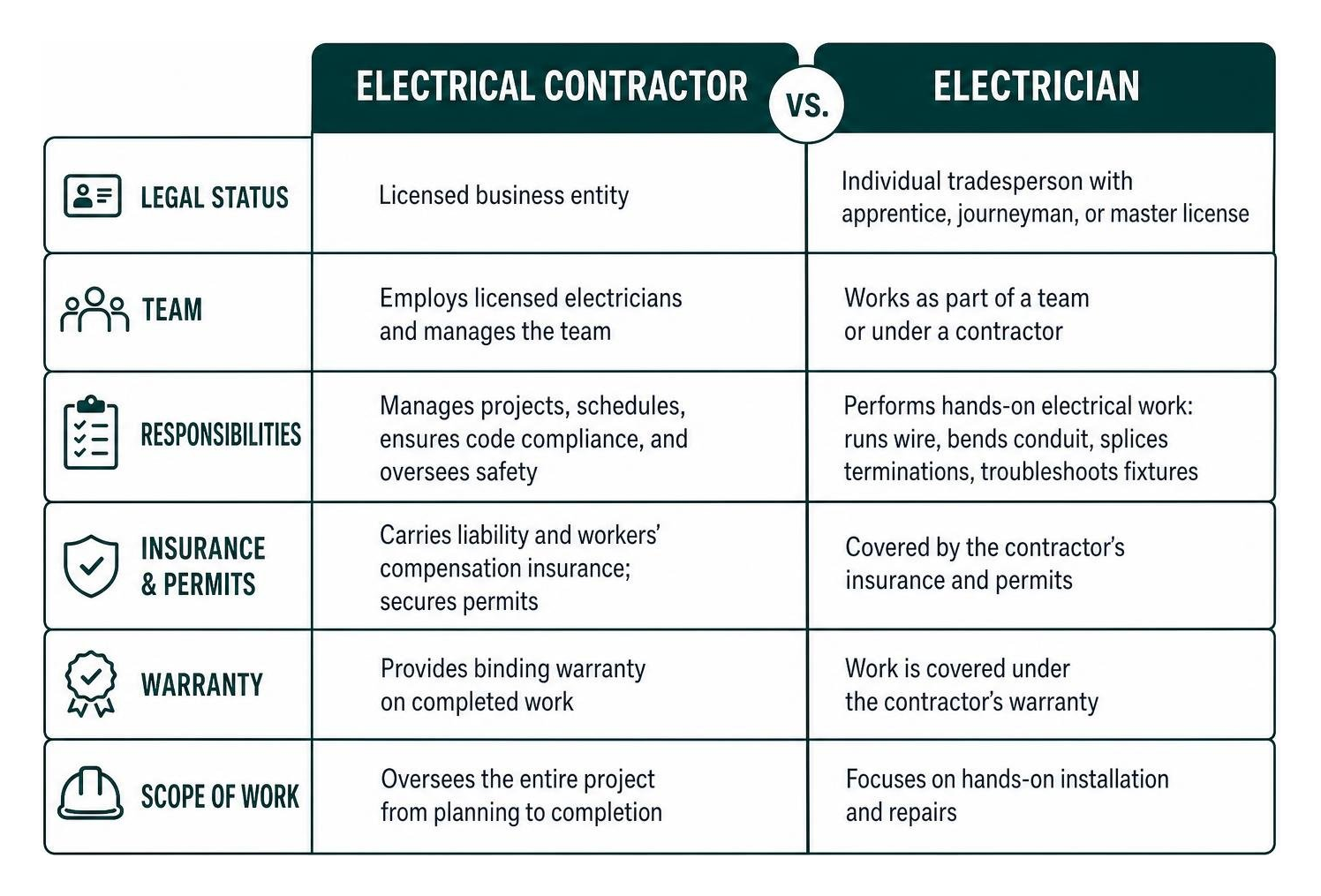
A frequent point of confusion is the distinction between an individual tradesperson and an electrical contracting firm. While they collaborate closely on job sites, their legal standing, operational capabilities, and scopes of responsibility differ substantially.
An electrician is an individual tradesperson—holding an apprentice, journeyman, or master license—who physically runs wire, bends conduit, splices terminations, and troubleshoots fixtures. In contrast, an electrical contractor is a fully licensed, bonded, and insured corporate entity. The contracting firm employs licensed electricians, maintains comprehensive liability and workers’ compensation insurance policies, secures municipal permits, manages project scheduling, and provides binding warranties on completed work.
To explore these trade differences in greater depth, review our commercial residential electrician guide. When you contract with an established firm like Grounded Solutions, you receive the full backing of an organized enterprise that oversees safety programs, project liability, engineering compliance, and code adherence across every phase of construction.
Understanding Inside and Line Electrical Contracting Work
The operational division between inside wiring and outside utility work determines how electrical energy reaches and energizes your property. Outside line contractors focus on the exterior utility infrastructure carrying electricity from generation facilities to local neighborhoods across Indianapolis, Franklin, Whiteland, Southport, Mooresville, and Beech Grove.
Once power reaches the property boundary or exterior transformer, the inside electrical contractor takes over. Inside work involves routing feeder conduits, setting main service panels, balancing three-phase loads, running branch wiring behind drywall, and installing weather-rated (WR) outdoor receptacles. In facilities needing advanced automation or complex conduit pathways, inside contractors deliver robust commercial building wiring designed to handle intense electrical demand while remaining resilient against spring storm power surges and seasonal grid fluctuations.
Alongside inside power, integrated building systems contractors deploy structured data cabling, intelligent lighting controls, and dedicated fire alarm networks that allow modern properties to operate efficiently and securely.
Organizational Structure and Project Leadership
A well-structured electrical contracting business operates with dedicated professional roles designed to eliminate errors, streamline schedules, and maintain safety:
- Master Electricians: Serve as technical leaders, holding the top-tier licensing required to pull permits, review schematics, calculate structural loads, and ensure designs strictly adhere to code.
- Project Managers: Oversee budgets, supply chain logistics, long-lead equipment procurement, and trade coordination across dynamic job sites.
- Electrical Estimators: Analyze architectural drawings, perform takeoffs, and provide detailed scopes of work so clients understand cost parameters upfront.
- Field Supervisors and Lead Journeymen: Direct on-site crews, enforce quality control benchmarks, inspect connections, and verify installation blueprints daily.
- Safety Coordinators: Conduct on-site audits, enforce OSHA compliance, oversee personal protective equipment (PPE) protocols, and ensure arc-flash mitigation practices are followed without exception.
The 10 Best Websites and Platforms to Find Trusted Electrical Contractors
Finding an electrical contractor equipped to manage complex residential and commercial projects requires dependable resources. Below are 10 of the best websites, directories, and industry platforms to locate vetted, certified, and established electrical contractors.
National Trade Association Contractor Locators
Trade associations represent the highest tier of professional standards, continuing education, and workforce development in the electrical contracting industry.
1. National Electrical Contractors Association (NECA) Directory
The NECA contractor directory connects property owners with premier contractors across North America. Representing thousands of member firms, NECA sets the benchmark for electrical excellence, labor cooperation, and technical skill. Searching via their portal helps you find companies with substantial bonding capacity, structured safety initiatives, and seasoned project management teams.
2. Independent Electrical Contractors (IEC) Directory
The IEC platform features top merit shop contractors across the United States. IEC contractors are known for rigorous 4-year apprentice training programs, workforce innovation, and deep expertise in residential, commercial, and industrial electrical applications. Using their search tool verifies that your project is handled by an organization committed to structured technical education.
National Cooperative and Alliance Platforms
When tackling specialized installations, energy transformations, or enterprise-scale facilities, industry network platforms provide direct access to vetted contractors.
3. Federated Electrical Contractors (FEC) Network
The FEC network unites leading independent electrical contractors with extensive industry experience. This platform connects owners and facility directors with top-tier firms that possess significant design-build engineering capabilities, strong equipment sourcing channels, and proven track records on enterprise facilities.
4. The Electric Vehicle Infrastructure Training Program (EVITP) Locator
For commercial fleets, retail parking structures, and home EV chargers, the EVITP website provides an authoritative directory of certified contractors. EVITP-certified contractors have completed specialized technical training focused on high-amperage continuous loads, utility load management, and rigorous safety compliance for Level 2 and DC Fast Charging systems.
5. National Fire Protection Association (NFPA) Directory & Code Hub
The NFPA platform provides access to industry specialists who hold verified credentials in electrical safety and fire protection standards. Sourcing contractors through this framework ensures code-level proficiency with NFPA 70 (NEC) and NFPA 70E arc-flash safety protocols.
6. Lutron Certified Pro Portal
Smart lighting and automated shading require precise low-voltage engineering, clean RF network design, and reliable wireless integration. Rather than attempting a complex automation setup without guidance, clients should select an experienced smart lighting partner. Grounded Solutions is Caséta and RadioRA 3 Certified, giving clients in Franklin, Whiteland, Mooresville, Southport, and Beech Grove seamless control over architectural lighting scenes, customized scheduling, and automated energy conservation.
7. SPAN Authorized Installer Directory
As Central Indiana homeowners and businesses prepare for volatile weather and severe spring thunderstorms, the SPAN directory connects consumers with factory-trained smart panel experts. Spring storms frequently cause utility drop spikes, tree limb impacts, and localized blackouts. Grounded Solutions installs SPAN smart panels to deliver granular, circuit-level monitoring, remote load control, and intelligent battery-storage shedding, keeping essential medical equipment, refrigeration, and sump pumps operating safely during severe weather events.
Verified Consumer Review and Regional Service Portals
Local compliance, consumer reviews, and municipal records round out the essential platforms for vetting a prospective contractor.
8. Better Business Bureau (BBB) Platform
The BBB directory helps you review an electrical firm’s business ethics, consumer resolution history, and operational longevity. Checking a contractor’s BBB profile provides transparency regarding customer satisfaction, dispute resolution, and honest business practices.
9. Indiana Professional Licensing Agency (IPLA) & Municipal Portals
Before signing any proposal in Central Indiana, verify credentials using the IPLA database alongside local municipal portals such as the City of Indianapolis Department of Business and Neighborhood Services. These platforms confirm that the master electrician holds active licensing and that the contracting firm possesses required surety bonds and county-level permits across Marion, Hamilton, Hendricks, Morgan, and Johnson Counties.
10. Grounded Solutions
For clients seeking transparent, family-owned electrical services across Central Indiana and the southern Indianapolis suburbs, our website offers educational resources and service overviews. If you are finding the best electrical service contractor near you, our team delivers comprehensive technical capabilities, prompt communication, and personal accountability.
Critical Standards for Vetting and Selecting a Qualified Contractor
Hiring an electrical contractor requires more than picking the first online search result or accepting the lowest bid. High-voltage power demands precision, verified credentials, and strong safety protocols. A poorly executed installation can lead to hidden arc faults, equipment failure, and structural fires.
When reviewing estimates, consider the overall value rather than seeking the lowest bid. For standard residential panel upgrades or dedicated EV charging circuits, professional installations generally range from $1,500 to $4,500+ depending on service capacity, panel condition, trenching requirements, and home layout. Commercial buildouts and heavy distribution retrofits vary widely depending on square footage, engineering requirements, and switchgear specs. Investing in a professional installation ensures long-term reliability, compliant permitting, and lasting safety.
For specialized industrial challenges and creative engineering methods, explore our breakdown of 5 unique solutions to commercial electrical services.
Licensing, Bonding, and Insurance Verification
Never allow an unverified crew to touch your property’s wiring. A qualified contractor must maintain three non-negotiable protections:
- Trade Licensing: Verifies the contractor has passed rigorous state and local code examinations, understands structural load calculations, and is legally recognized to perform electrical installations.
- Surety Bonding: Protects the property owner financially if a contractor fails to complete the contracted work, pull necessary municipal permits, or pay material suppliers.
- Comprehensive Insurance: Includes at least $1,000,000 to $2,000,000 in General Liability coverage alongside active Workers’ Compensation insurance, shielding the property owner from any financial liability should an on-site injury or accidental property damage occur.
Always hire a verified, licensed bonded insured electrician to safeguard your building, your occupants, and your financial investment.
National Electrical Code (NEC) Compliance and Safety Record
The National Electrical Code (NFPA 70) is updated every three years to reflect advancing technologies, safety research, and emerging electrical hazards. A reputable electrical contractor must strictly adhere to the current NEC editions adopted by the State of Indiana, along with specific local county and municipal amendments.
Key safety indicators to evaluate include:
- Experience Modification Rate (EMR): A numerical metric reflecting a contractor’s past safety record and worker injury claims. An EMR under 1.0 indicates a safer-than-average jobsite environment.
- OSHA 10 / OSHA 30 Certifications: Proves field supervisors and wiremen have completed comprehensive training in electrical fall protection, lockout/tagout (LOTO) protocols, personal protective equipment (PPE), and hazardous material handling.
- Arc Flash Safety Compliance: Strict adherence to NFPA 70E standards, ensuring that maintenance technicians utilize proper thermal-rated clothing, insulated tools, and established safety boundaries when working near live equipment.
- Zero-Accident Safety Programs: Formal company initiatives that encourage safety reporting, mandatory morning safety huddles, and regular equipment inspections.
Comprehensive Services and Specialized Sector Capabilities
Modern electrical contracting extends far beyond pulling standard wire through wood studs or ceiling grids. Technological convergence requires modern electrical contractors to serve as comprehensive energy systems integrators.

Commercial, Industrial, and Residential System Integration
Full-service electrical contractors provide integrated power, safety, and control services across multiple disciplines:
- Power Distribution Upgrades: Installing heavy switchgear, transformers, subpanels, and busways to support manufacturing machinery, server rooms, and commercial kitchens.
- Smart Energy Management Panels: Retrofitting outdated fuse boxes and breaker panels with modern SPAN smart panels that allow dynamic circuit-level control and automated load shedding during peak utility demand or weather-related grid failures.
- Intelligent Lighting Control Systems: Installing precision Lutron Caséta and RadioRA 3 lighting architectures that integrate occupancy sensing, daylight harvesting, and automated scheduling for energy savings and enhanced security.
- Clean Energy & EV Infrastructure: Designing and installing commercial Level 2 dual-port stations and DC fast chargers for vehicle fleets, paired with smart solar and battery storage systems.
- Emergency Standby Generators & Whole-Home Surge Protection: Providing turnkey automatic transfer switches (ATS) and whole-facility backup generators to protect commercial inventory and residential life-safety circuits from severe spring storm outages, loose meter base disconnects, and utility spikes.
- HVAC & Motor Control Wiring: Powering industrial chillers, variable frequency drives (VFDs), ventilation fans, and smart commercial thermostats.
- Safety & Compliance Audits: Conducting arc-flash hazard analyses, thermal imaging panel scans, GFCI testing, weather-rated (WR) receptacle inspections, and thorough energy efficiency assessments.
Evaluating Modern Electrical Contracting for High-Demand Sectors
Different industries require specialized electrical engineering:
- Healthcare Facilities: Hospitals, surgical clinics, and radiology labs require isolated power systems, redundant backup power sources, specialized ground-fault circuit interrupters (GFCI), and strict compliance with NEC Article 517 to protect life-saving equipment.
- Data Centers & Tech Facilities: Mission-critical facilities require clean power, uninterruptible power supply (UPS) banks, precision environmental control wiring, and structured fiber-optic cabling with zero tolerance for downtime.
- Educational Institutions & Multi-Family Housing: Large residential and educational campuses require high-durability conduit networks, energy-efficient architectural LED conversions, unified life-safety alarms, and secure access-control wiring.
Safety Protocols, Prefabrication, and Cost Efficiency
Modern electrical contractors utilize advanced construction methodologies to lower costs, improve precision, and accelerate project delivery:
- Building Information Modeling (BIM) & VDC: Creating detailed 3D digital models of electrical conduit runs, cable trays, and switchgear rooms before breaking ground. This prevents spatial clashes with HVAC ducts and plumbing lines.
- Off-Site Prefabrication: Assembling conduit bends, bracket assemblies, and pre-wired rough-in boxes in a controlled workshop environment. Prefabrication reduces on-site labor hours, minimizes jobsite waste, and speeds up field installation.
- Value Engineering: Analyzing system designs to identify cost savings without sacrificing safety, quality, or NEC compliance.
- Predictive Maintenance: Using infrared thermal imaging and ultrasonic testing to identify loose lugs, overheating breakers, and failing bus connections before they cause catastrophic power outages.
Frequently Asked Questions About Electrical Contracting
What is the primary difference between an electrical contractor and an electrician?
An electrician is an individual licensed tradesperson who installs, repairs, and maintains wiring. An electrical contractor is a fully licensed, bonded, and insured business entity that employs electricians, manages large-scale projects, pulls permits, and assumes legal and financial liability for the work.
How do trade association affiliations benefit a construction project?
Trade associations such as NECA and IEC provide structured multi-year apprentice programs, ongoing code education, and safety certifications. Hiring a contractor aligned with these industry bodies ensures that the workforce on your jobsite is properly trained, safety-conscious, and compliant with current National Electrical Code standards.
What services are included under full-service electrical contracting?
Full-service electrical contracting encompasses turnkey electrical system design, new construction rough-in and trim-out, high-voltage distribution, emergency standby generator integration, EV charging systems, smart energy panels, low-voltage communications, commercial lighting retrofits, and 24/7 preventive maintenance.
Conclusion
Whether you are planning a ground-up commercial buildout in downtown Indianapolis, upgrading the service panel on a historic home in Beech Grove, or retrofitting energy-efficient smart systems across Franklin, Whiteland, Southport, and Mooresville, selecting a qualified electrical contractor is essential. Choosing a licensed, insured, and safety-focused contractor ensures your property remains protected, compliant with the National Electrical Code, and prepared to handle severe spring weather and evolving power demands.
At Grounded Solutions, we take pride in being a family-owned and operated local electrical contractor dedicated to safety, upfront pricing, and lasting craftsmanship. As Caséta and RadioRA 3 Certified Lutron installers and SPAN smart panel experts, our team delivers modern energy control, standby power resilience, and comprehensive electrical installations tailored to your needs.
Explore our comprehensive solutions for full-service electrical contracting or contact Grounded Solutions today to schedule your consultation, request an upfront estimate, and keep your residential or commercial property powered safely.