
Add Power and Mount a Ceiling Fan Safely From Scratch
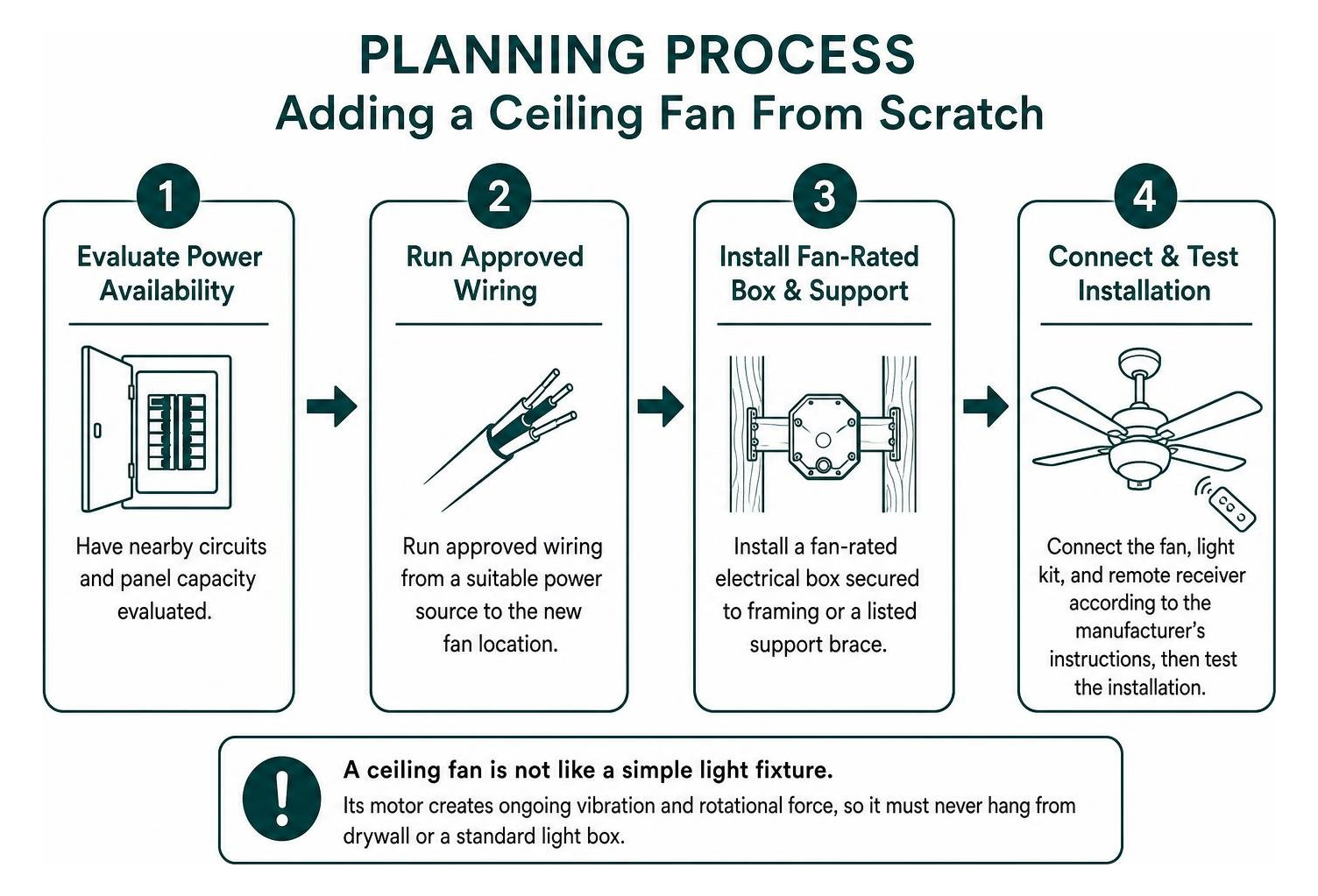
Yes, a ceiling fan can be installed in a room where no overhead wiring currently exists, but doing so demands a newly engineered, code-compliant power connection, dedicated circuit balancing, and robust structural support. The safe, professional procedure entails:
- Evaluating main service panel capacity, branch circuits, and home energy distribution.
- Running code-approved non-metallic sheathed cable from an appropriate continuous power source to the newly designated ceiling location.
- Installing a heavy-duty, dynamic-load-rated electrical junction box anchored directly to building framing or via an expanding steel retrofit brace.
- Assembling and wiring the fan motor, downrod assembly, lighting package, and wireless canopy receiver, followed by thorough load and balance testing.
A ceiling fan is significantly different from a stationary flush-mount lighting fixture. Its rotating motor produces continuous vibrational energy, torque, and downward centrifugal forces, meaning it must never be anchored directly to drywall, plaster, or standard light boxes. For homeowners and light commercial properties across Indianapolis, Beech Grove, Franklin, Whiteland, Southport, and Mooresville, all structural mounting, branch circuit extensions, and equipment grounding should be performed by the licensed electricians at Grounded Solutions.
I am Clay Hamilton, President of Grounded Solutions, with more than two decades of specialized, hands-on experience in residential and commercial electrical systems, modern wiring infrastructure, maintenance, and panel upgrades. In this comprehensive guide on how to install a ceiling fan without existing wiring, I explain the meticulous engineering, structural reinforcement, and safety parameters our team applies before hanging your fixture. For tailored guidance on high-performance ventilation, explore our ceiling fan installation tips or learn about mounting a high ceiling fan in spacious great rooms.
Essential Planning: Professional Considerations for Installing a Ceiling Fan Without Existing Wiring
Introducing balanced airflow and modern illumination into a room that previously lacked overhead wiring elevates comfort, interior aesthetics, and energy efficiency. However, determining how to install a ceiling fan without existing wiring requires extensive electrical planning and architectural assessment before any tools touch your ceiling. A ceiling fan is a dynamic, motor-driven mechanical apparatus that introduces both static weight and continuous rotational stress to overhead framing, while placing steady electrical demand on your home’s distribution panel.
When our certified electricians at Grounded Solutions plan a scratch installation, we evaluate two primary elements: ceiling structural capacity and overall electrical distribution health. Installing a ceiling fan without existing wiring requires creating a safe, insulated electrical pathway where none exists and securing dynamic loads to framing designed primarily for static wallboard.
Our foundational electrical installation 101 guide demonstrates that any new electrical fixture must be balanced within the home’s total electrical footprint. In Central Indiana communities like Southport, Mooresville, Franklin, and Beech Grove, older homes frequently feature legacy panels already operating near capacity. When severe spring storms and extreme weather events sweep across Marion and Johnson counties, utility fluctuations and lightning surges put vulnerable, overburdened electrical systems under severe stress. Upgrading to advanced SPAN smart electrical panels provides real-time circuit-level monitoring, intelligent load management, and automated power shedding during grid outages, ensuring your new ceiling fan circuits and primary home appliances remain reliable and protected.
Evaluating Available Circuits and Power Access
The initial diagnostic step involves identifying a continuous, code-compliant power feed. Electricity cannot simply be tapped into whatever wire is easiest to reach inside a wall cavity. During our professional evaluation, Grounded Solutions verifies:
- Circuit Amperage and Available Capacity: We determine whether nearby branch circuits are 15-amp or 20-amp, calculating existing draw from general-purpose receptacles, lighting, and appliances. Overloading an existing branch circuit causes persistent breaker tripping and dangerous heat buildup.
- Continuous vs. Switched Feeds: Tapping into existing switch loops often supplies intermittent power tied to other luminaires rather than the continuous, unswitched hot and neutral conductors needed for multi-function remote fans.
- Attic vs. Inter-Floor Routing: Homes with accessible attic space directly above the target room allow new NM-B copper cabling to be neatly secured across ceiling joists. In two-story homes in Whiteland or Beech Grove where the room sits beneath a finished upper level, Grounded Solutions uses specialized blind-fishing tools to pull cables through floor joist bays without destructive wall tearing.
- Existing Wiring Condition: Older properties throughout Central Indiana may still house ungrounded conductors or degraded insulation. Knowing how to identify bad electrical wiring is critical before splicing new branch extensions into existing junction enclosures.
Structural Requirements for Fan Support
Standard lighting fixtures mount to lightweight plastic or standard octagonal steel junction boxes rated only for static hanging loads up to 50 pounds. A ceiling fan, by comparison, generates harmonic vibration, rotational torque, and downward drag.
Under National Electrical Code (NEC) standards and UL 507 safety regulations, ceiling fans must attach exclusively to listed outlet boxes explicitly marked as “Acceptable for Fan Support.” These specialized boxes feature heavy-gauge steel construction and reinforced 10-32 threaded steel screw receivers that resist mechanical shearing and vibrational fatigue.
Where no overhead junction box exists, Grounded Solutions installs a heavy-duty steel expansion retrofit brace between adjacent structural joists. Ratcheted into position, steel anchor teeth embed securely into 2×4, 2×6, or 2×8 joist framing to support dynamic operational loads up to 70 pounds, eliminating ceiling plaster cracking, motor humming, fixture wobble, and structural drop hazards.
Professional Installation and Wiring Process
Routing new electrical conductors through finished building envelopes requires professional diagnostic tools, code compliance, and structural expertise. Grounded Solutions performs every ceiling fan addition with minimal disruption to your home, prioritizing safety, cleanliness, and long-term performance.

Executing a clean fan installation involves securing a dynamic-rated ceiling box, routing listed copper conductors from a code-compliant power source, wiring the motor and canopy receiver, and dynamically balancing the blades for quiet, vibration-free operation. Proper execution relies on modern electrical wiring and rewiring practices aligned with Indiana residential codes.
Step-by-Step Electrical Process for Adding a Ceiling Fan
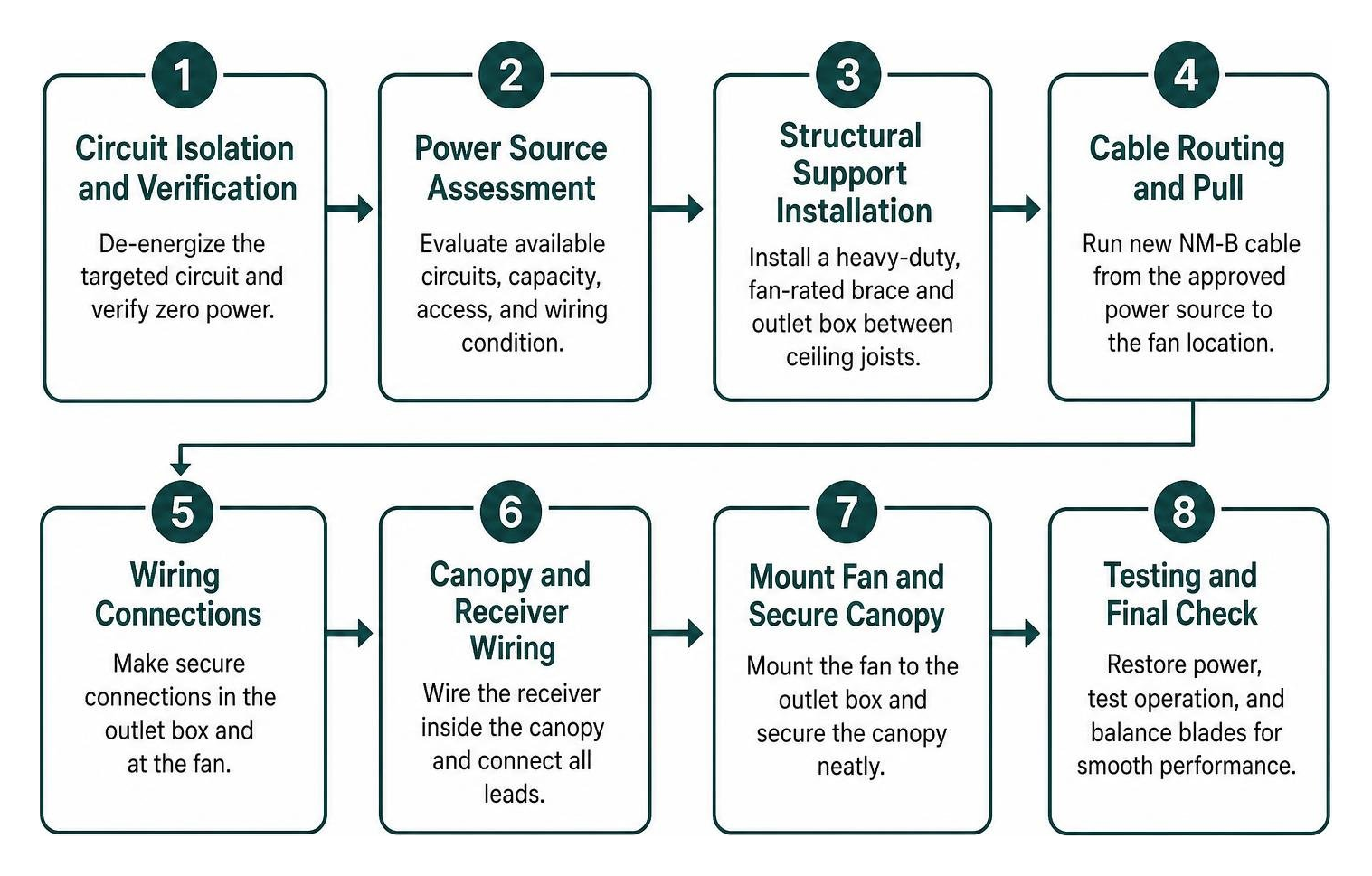
When Grounded Solutions completes a new ceiling fan installation from scratch, our licensed electricians follow a rigorous process:
- Circuit Isolation and Zero-Energy Verification: We de-energize the designated branch circuit at the main service panel, applying lockout/tagout protocols and verifying the absence of voltage with calibrated multimeters.
- Ceiling Layout and Precision Cutout: We locate framing joists using precision wall scanners, align the center point of the room, and cut a circular opening sized for a listed round fan box.
- Expansion Support Brace Installation: We insert a heavy-duty steel retrofit expansion brace through the opening, expanding the threaded shaft until its steel gripping feet penetrate deeply into adjacent joists.
- Cable Pulling and Routing: We pull new 14/2 or 12/2 NM-B copper conductors from an approved continuous power source or run a new home-run circuit back to the panel. For comprehensive property updates, our home rewiring services ensure the entire distribution path meets current safety standards.
- Enclosure Mounting and Ground Bonding: The fan-rated steel box is clamped to the support brace, cable sheathing is secured with listed strain-relief connectors, and equipment grounding conductors are bonded to the box with dedicated grounding screws.
- Mounting Bracket and Mechanical Assembly: The heavy steel hanging bracket is secured to the junction box with high-tensile 10-32 machine screws. The motor assembly, downrod, safety cable, and ball joint are seated in the mounting bracket.
- Conductor and Receiver Termination: All hot, neutral, and ground conductors are joined using listed wire connectors, dressed cleanly within the canopy cavity to eliminate insulation pinching, and tested for continuity.
Wireless Controls and Smart Automation Integration
Modern ceiling fans frequently utilize wireless remote canopy receivers, eliminating the need to tear into finished drywall to install multi-gang wall switches. Canopy receivers allow independent multi-speed motor control and full lighting dimming from a single continuous-power circuit.
When selecting a smart lighting and fan automation installer, homeowners should prioritize certified expertise over basic handymen. Grounded Solutions is proudly Lutron Caséta and RadioRA 3 Certified, providing custom smart control integration that synchronizes your overhead fan with your broader home automation system. Coupled with an intelligent SPAN smart panel, your Lutron smart controls can automatically optimize airflow during peak summer heat, reduce HVAC energy consumption, and manage electrical loads seamlessly during spring storm power fluctuations. Our certified setups eliminate radio frequency interference, prevent motor buzzing caused by incompatible dimmers, and give you intuitive wall, remote, and mobile app control.
Project Costs, Code Compliance, and Safety Requirements
Adding an overhead fixture where no wiring exists requires adhering to local municipal guidelines, National Electrical Code standards, and property-specific structural configurations.
| Installation Scenario | Structural Scope | Electrical Scope | Key Considerations |
|---|---|---|---|
| Open Attic Access (Single Story) | Heavy-duty expansion brace mounted between open ceiling joists | Direct NM-B cable run across attic framing to accessible junction box | Cleanest cable routing; zero drywall modification needed |
| Finished Upper Floor (Multi-Story) | Retrofit fan support brace inserted through ceiling opening | Blind cable fishing through floor joist bays and wall cavities | Requires precision fishing tools; prevents broad drywall repairs |
| Dedicated Home-Run Circuit | Fan-rated box anchored to structural framing | Direct conductor run back to main breaker panel with new AFCI breaker | Essential when existing branch circuits are at capacity; ideal with SPAN smart panels |
| Smart Automation Integration | Heavy-duty fan-rated box with canopy receiver | Lutron Caséta / RadioRA 3 smart switch integration | Grounded Solutions is Caséta and RadioRA 3 Certified for smart programming |
Local Permitting and National Electrical Code Standards
Extending branch circuits or creating new ceiling outlets requires strict adherence to the National Electrical Code (NEC). Throughout Central Indiana—including Greenwood, Franklin, Southport, Mooresville, Beech Grove, and Indianapolis—installing new residential wiring and junction boxes requires proper permitting and safety inspections. Guidelines such as the Electrical Work Permit in Greenwood, IN (2026) exist to ensure that all home modifications protect residents from fire and shock hazards.
Mandatory code requirements include:
- Arc-Fault Circuit-Interrupter (AFCI) Protection: All new branch circuits supplying ceiling fans in living areas, bedrooms, and common spaces must feature AFCI protection to mitigate electrical fire risks caused by damaged insulation or loose connections.
- Equipment Ground Bonding: All metallic junction boxes, mounting plates, downrods, and motor housings must be bonded to the home’s grounding electrode system.
- Blade and Wall Clearances: Building codes and safety standards require at least 7 feet of clearance between the fan blades and the finished floor (8 to 9 feet is optimal for airflow), with at least 30 inches of clearance between blade tips and adjacent walls.
To ensure full compliance with all local codes and manufacturer warranties, Grounded Solutions provides comprehensive, code-certified ceiling fan installation for complete peace of mind.
Key Factors Influencing Project Scope
Project scope varies based on several architectural factors:
- Ceiling and Wall Access: Open attic access simplifies cable routing, whereas vaulted ceilings, multi-story layouts, or historic lath-and-plaster construction require advanced fishing techniques.
- Electrical Panel Health: Older service panels lacking available physical slots or amperage capacity may require subpanel installation, heavy-up service changes, or an upgrade to a modern SPAN smart panel system to manage continuous loads safely during severe weather.
- Smart Lighting Systems: Upgrading to Lutron Caséta or RadioRA 3 wireless control systems provides premium scheduling, lighting scenes, and remote energy management.
Critical Safety Risks and Electrical Hazards
Residential electrical installations carry serious safety risks that cannot be understated. Because ceiling fans combine high electrical current with continuous mechanical motion, uncertified or substandard installations introduce severe, long-term hazards inside your home.
According to data from the National Fire Protection Association (NFPA), electrical distribution systems and lighting equipment remain leading causes of residential structure fires. Splicing conductors into overloaded circuits without performing load calculations, leaving splices unhoused in open wall cavities, or improperly grounding dynamic metal fixtures creates major fire and shock hazards.
When evaluating home electrical projects, our detailed guide on whether to choose diy or call a pro explains why certified electrical expertise is essential for protecting your property and family.
Common Dangers of Uncertified Installations
Non-compliant electrical work frequently produces dangerous structural and electrical failures:
- Junction Box Shearing and Drop Failures: Fastening a vibrating motor to a standard plastic light box or directly to drywall anchors eventually causes mounting screws to strip or shear under dynamic fatigue, resulting in fixture collapse.
- Arc Faults and Concealed Fire Hazards: Wire splices made outside of listed, accessible junction boxes can loosen over time due to building movement and motor vibration, generating electrical arcing that ignites framing and insulation.
- Chassis Electrocution Hazards: Reversing line and neutral conductors or omitting the equipment grounding bond energizes the fan’s exterior metal housing, downrod, and pull chains, posing an immediate shock risk.
- Motor Burnout and Overheating: Pairing fan motors with incompatible solid-state dimmers or undersized conductors causes excessive motor heat, persistent electrical hums, and premature equipment failure.
Before undertaking complex electrical changes, review our guide covering 5 reasons you should never try diy home electrical repair.
Frequently Asked Questions About Ceiling Fan Additions
Can a Ceiling Fan Be Powered From a Nearby Receptacle Circuit?
Yes, a ceiling fan can often draw power from an existing general-purpose receptacle circuit, provided the circuit has sufficient spare amperage capacity and includes an intact, verified equipment grounding conductor. The connection must be completed inside an accessible, code-compliant junction box using properly sized copper cable.
Our certified electricians calculate the continuous and non-continuous load on the prospective branch circuit to verify that the addition of the fan motor and lighting fixture will not trip breakers when everyday household appliances are plugged in.
Why Can’t a Standard Ceiling Light Box Support a Ceiling Fan?
Standard plastic, round, or octagonal light boxes are designed solely to hold static, stationary loads. A ceiling fan generates dynamic loads—meaning its spinning blades exert continuous rotational torque, aerodynamic resistance, and harmonic vibration against its mounting hardware.
Fan-rated boxes are engineered with heavy-gauge steel or impact-resistant structural composites, utilizing heavy 10-32 machine screws threaded into solid steel anchor points to prevent fasteners from shearing or loosening over years of operation.
How Long Does Running New Ceiling Fan Wiring Take?
A professional scratch installation performed by Grounded Solutions typically takes between 2 and 4 hours when direct attic access is available above the room. In multi-story homes or rooms where conductors must be fished across finished ceilings and firebreaks, the installation may require 4 to 6 hours.
Our licensed electricians use specialized long-reach flexible drill bits, fiberglass fish rods, and inspection cameras to route cables cleanly, preserving your drywall, paint, and trim.
Conclusion
Adding a modern, high-performance ceiling fan to a room without existing wiring significantly enhances year-round indoor comfort, energy efficiency, and overhead illumination. However, because this project requires cutting into structural framing, routing new electrical branch circuits, and anchoring a dynamic motor assembly overhead, it must be performed with uncompromising precision, proper permitting, and strict adherence to electrical codes.
At Grounded Solutions, we remove the complexity, physical danger, and guesswork from residential electrical additions. As a trusted, fully licensed electrical contractor serving Indianapolis, Beech Grove, Franklin, Whiteland, Southport, Mooresville, and surrounding Central Indiana communities, our team provides superior craftsmanship, clear communication, and dependable electrical solutions.
Whether you need to install a ceiling fan circuit from scratch, modernize your electrical panel with an advanced SPAN smart system, or integrate Lutron Caséta and RadioRA 3 smart lighting and fan controls, Grounded Solutions is your dedicated local electrical expert.
Ready to upgrade your home with safe, professional overhead airflow and lighting? Contact Grounded Solutions today to schedule your consultation for professional electrical service and repair. Let our licensed electricians handle your installation safely and correctly from start to finish.