
Why Energy Efficient Lighting Design Transforms Indianapolis Homes and Businesses
Energy efficient lighting design blends the right light sources, smart controls, and strategic placement to lower bills while improving comfort and productivity across central Indiana homes and businesses.
Key components:
- LED fixtures that use up to 90% less energy than incandescent bulbs
- Smart controls like motion sensors and daylight harvesting
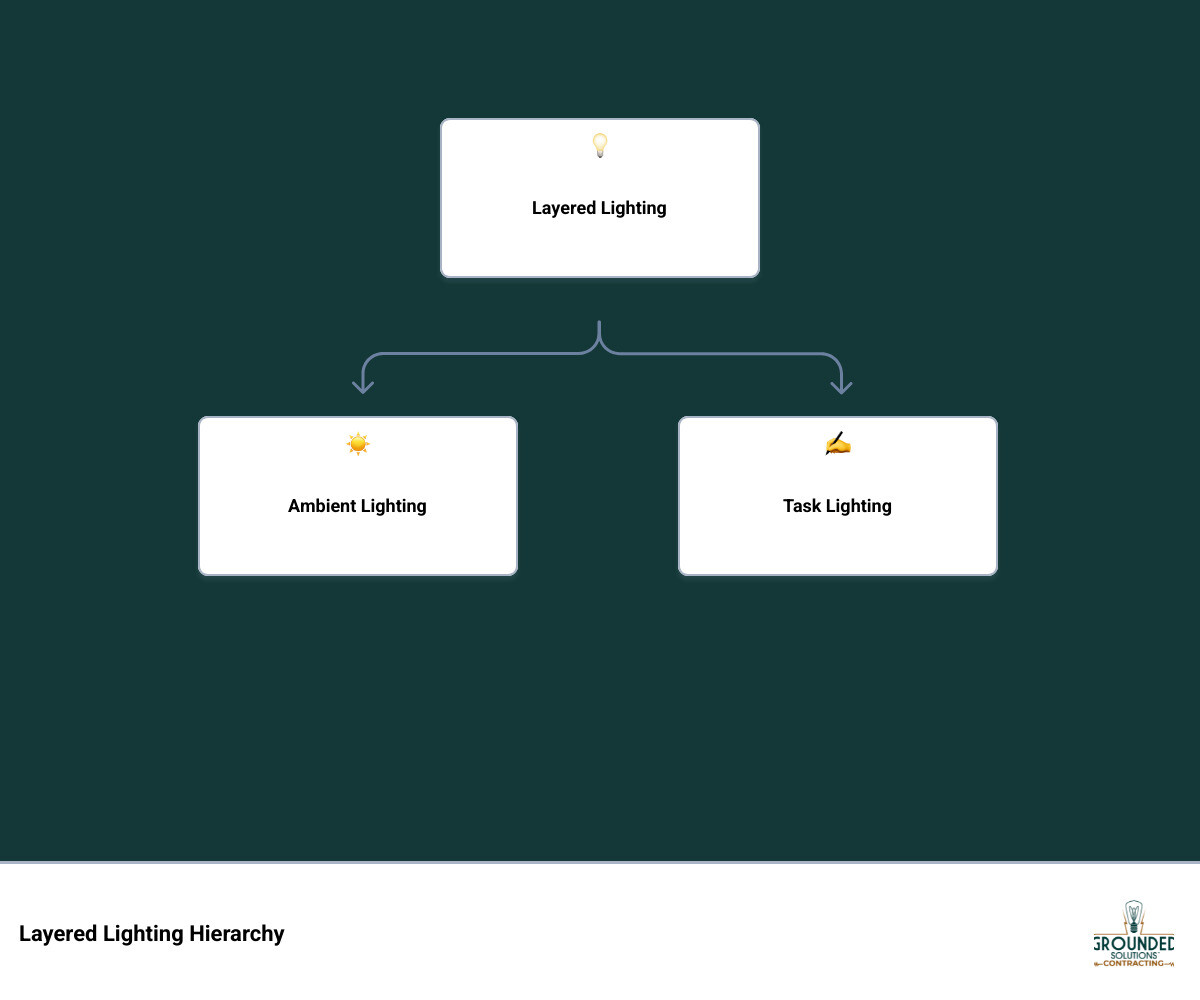
- Layered lighting for ambient, task, and accent illumination
- Thoughtful placement that maximizes natural daylight
Immediate benefits:
- Lower energy bills by dramatically reducing electricity consumption
- Trim lighting’s share of your electricity use, which often accounts for 15% of a home’s total
- Cut lighting energy by up to 75% with modern lamps and smart controls
- Reduce maintenance with bulbs that last up to 25 times longer than traditional options
Lighting consumes about 15% of global energy and drives roughly 5% of greenhouse gas emissions. For Indianapolis, Carmel, Fishers, Greenwood, and surrounding communities, smarter lighting is one of the fastest, most reliable ways to cut energy costs and lift how spaces feel and function.
More light isn’t automatically better—quality, placement, and control matter.
Grounded Solutions’ licensed electricians have decades of experience designing and installing high-performing, energy-efficient lighting systems that reduce operating costs for homes and businesses throughout central Indiana.
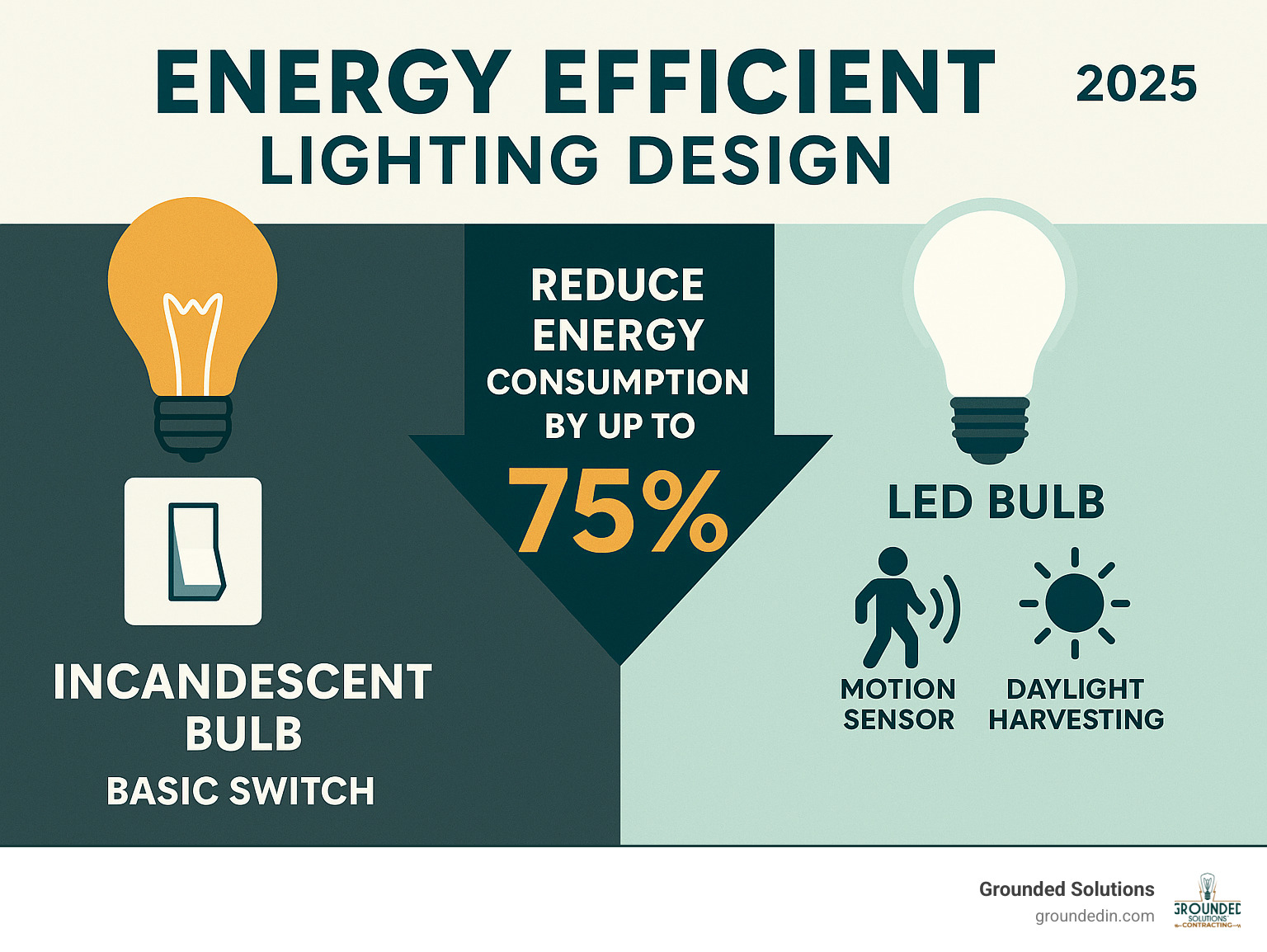
Why This Guide Matters
This guide demystifies energy efficient lighting design so you can make confident, budget-smart decisions. From downtown Indianapolis to neighboring suburbs, a holistic approach—technology, controls, and daylight—consistently delivers better light with less waste.
Energy Efficient Lighting Design 101
Think of energy efficient lighting design as delivering beautiful, functional light with the least energy. It’s more than swapping bulbs—it’s picking efficient technology, placing it well, and using controls that work in the background to save you money.
Look for the ENERGY STAR label. It indicates products that meet strict efficiency standards and makes it easier to choose options that actually lower your electric bill.
The Department of Energy reports that LEDs use up to 90% less energy than incandescent bulbs and last up to 25 times longer. With lighting responsible for a meaningful share of energy and carbon emissions, upgrading is a high-impact step. For selection guidance, see the DOE guidance on efficient bulbs.
| Bulb Type | Energy Use (compared to incandescent) | Lifespan (approx.) | Heat Output (compared to incandescent) |
|---|---|---|---|
| Incandescent | 100% | 750-2,500 hours | High |
| CFL | 70% less | 10,000-15,000 hours | 70% less |
| LED | Up to 90% less | 50,000-100,000 hours | Very Low |
The Evolution of Light Sources
The 2023 DOE efficiency standards effectively ended most incandescent and halogen sales. CFLs reduced energy but had drawbacks (mercury, warm-up time). Today, LEDs provide instant-on performance, long life (often 50,000–100,000 hours), broad color options, and the best efficiency.
Core Metrics That Matter
- Lumens: the real measure of brightness. About 800 lumens equals a classic 60W incandescent.
- Watts/Efficacy: watts show energy used; efficacy (lumens per watt) shows efficiency. Modern LEDs often deliver 80–100+ lm/W.
- Color temperature (K): 2700–3000K feels warm/cozy; 4000–5000K is cooler and crisp for tasks.
- CRI: 80+ suits most spaces; 90+ for artwork or color-critical tasks.
- Power factor: closer to 1.0 means better electrical efficiency and potentially lower utility impact.
Efficient Lighting Technologies & Smart Product Selection

The core of energy efficient lighting design is choosing the right technology for each space and task.
LEDs dominate for their excellent lumens-per-watt and low heat. CFLs still appear in some applications but are steadily being replaced. Linear fluorescents remain common in commercial settings—often upgraded to LED versions. Tunable white LEDs let you shift color temperature during the day, supporting comfort and circadian health. Induction lighting can shine in hard-to-reach locations with long service intervals.
Always look for UL listing and ENERGY STAR certification for safety and performance. Learn more at the ENERGY STAR overview.
How to Read a Light Facts Label
- Lumens: the brightness you’ll actually see. Around 800 lumens replaces a 60W incandescent.
- Light appearance (CCT): 2700K is warm; 4000K+ is cooler and more alerting.
- Energy used (watts): shows real consumption—LEDs often deliver 800 lumens using only 8–12W.
- Rated life: LEDs commonly list 25,000+ hours for long service and fewer replacements.
Picking the Right Lamp for Each Space
- Ambient lighting: your base layer. LED A-lamps and linear fixtures provide even, comfortable illumination.
- Task lighting: focused light for cooking, reading, and detailed work. Use under-cabinet LED strips, desk lamps, and the right beam angles.
- Accent lighting: highlight art or architecture with narrow-beam LED spots.
For older homes, retrofit kits bring existing fixtures into the LED era without major rewiring. See our guide on Differences Between LED and Fluorescent Light Bulbs.
Avoiding Common Pitfalls
- Heat and enclosures: use bulbs rated for enclosed fixtures; choose IC-rated housings for insulated ceilings.
- CFL disposal: recycle—don’t trash—due to mercury content.
- Warranty and quality: verify terms; prioritize reputable, well-supported products for long-term reliability.
Designing Energy-Smart Spaces: Daylighting, Controls, and Indoor Strategies

True energy efficient lighting design coordinates daylight, efficient fixtures, and smart controls so you get the right light, at the right time, with minimal waste.
Start with layered lighting: ambient for general light (around 300 lux for modern offices with screens), task for focused work (often 500–1000 lux), and accent for visual interest. Lighter walls and reflective finishes push light deeper so you can run lower overall levels without sacrificing comfort.
Smart controls—timers, dimmers, occupancy/vacancy sensors—can trim lighting energy by 20–50% while improving usability. For current best practices and trends, see Shedding Light on Efficiency: LED Lighting Tips and Trends.
Integrating Daylight for Maximum Impact
Leverage window orientation: south offers consistent daylight; north is even and glare-free; east/west varies by time of day. Skylights and light shelves bring light deeper into interiors. With daylight dimming, sensors automatically raise or lower electric light to keep levels steady—often cutting lighting energy 20–60%—and supporting occupant comfort and well-being.
Lighting Controls That Pay Back Fast
- Occupancy sensors: lights turn on when you enter, off when you leave—ideal for restrooms, storage, and intermittently used rooms.
- Vacancy sensors: manual on, automatic off—often saves more in homes and offices.
- Time-based scheduling: great for regular hours or exteriors; adjust with seasons.
- Smart-home/building automation: remote control, learning behavior, and system integration can yield savings up to ~35% while enhancing convenience.
Balancing Aesthetics, Function, & Efficiency
High CRI ensures true, vibrant color—important for art, retail, and residential finishes. Select color temperature to suit the task: warmer (2700–3000K) for living and dining; cooler (4000–5000K) for kitchens and work areas. Tunable white LEDs let you shift scenes and support circadian comfort—all without sacrificing efficiency.
Outdoor Applications, Maintenance & Incentives
Smart energy efficient lighting design continues outside—where waste often adds up quickly if fixtures run unnecessarily or spill light where it’s not needed.
Exterior LEDs thrive in Indiana winters and handle moisture and temperature swings. Solar pathway lights can avoid trenching. Use dark-sky shields and cutoff optics to direct light only where needed, reduce glare, and be a good neighbor. Add photosensors for dusk-to-dawn control and motion activation for security lighting that only runs when it’s actually needed.
Security & Way-Finding Without Waste
- Driveway floodlights with motion sensors provide bright light when you arrive—without burning all night.
- Step and path lights improve safety and visibility; LEDs stay compact and efficient.
- Proper cutoff optics reduce glare and improve visibility compared to broad, uncontrolled floodlighting.
Maintaining Performance Over Time
- Clean lenses periodically—dirt can cut output by 20% or more.
- Expect gradual lumen depreciation; LEDs hold light better than legacy lamps but still age.
- Use recycling programs when replacing lamps/fixtures.
Opening up Rebates and Local Incentives
Plan upgrades to leverage utility rebates, Indiana energy programs, and the Section 179D tax deduction for qualifying commercial projects. Details at the IRS 179D lighting deduction. To see how local retrofits pay off, read our guide: LED Lighting Retrofit in Indianapolis: Save Energy & Money.
Grounded Solutions helps central Indiana property owners identify and capture available incentives while designing systems that perform over the long term.

Conclusion & FAQs on Energy Efficient Lighting Design
Energy efficiency isn’t just about saving kilowatts—it’s about creating better, more comfortable spaces that cost less to run. A coordinated plan delivers the biggest gains.
Three high-impact strategies:
- Maximize daylight: place work areas near windows; use light colors to bounce daylight.
- Layer your lighting: ambient, task, and accent—only where and when it’s needed.
- Automate controls: timers, dimmers, occupancy/vacancy sensors, and daylight dimming.
As your licensed, bonded, and insured Indianapolis electrical partner, Grounded Solutions designs and installs code-compliant, energy-smart lighting for homes and businesses across central Indiana. Ready to modernize your lighting? Explore our services and request a consultation at our electrical service & repair page.
What makes energy efficient lighting design different from just using LED bulbs?
Swapping bulbs is a start, but design goes further: right fixtures, right locations, and the right controls. Layered lighting replaces the one-fixture-does-all mindset, and daylighting integration with sensors ensures electric light only supplements what the sun already provides.
How does energy efficient lighting design save money over time?
LEDs cut wattage dramatically, produce far less heat (reducing cooling loads), and last for years—lowering replacement and maintenance. Add occupancy/daylight controls and the savings compound. Incentives and deductions can further improve project economics.
When should I hire a professional for energy efficient lighting design?
Bring in a pro for new builds, major remodels, or projects with daylight harvesting, networked controls, or code/permit requirements—especially in commercial spaces. Early planning helps you avoid rework, meet Indiana energy and electrical codes, and get the best long-term performance.