
Understanding Electrical Box Foam Insulation and Wall Safety
Drafty electrical outlets and switches allow outdoor air to bypass wall cavities and penetrate living spaces, leading to energy loss, noticeable drafts, and higher utility bills. Installing electrical box foam insulation helps block air leakage around wall penetrations, but selecting the right protective barrier depends on the wall assembly. While exterior perimeter walls benefit from foam gaskets to limit air infiltration, outlets in fire-rated partitions require certified intumescent firestop inserts installed to maintain fire separation and building code compliance.
I’m Clay Hamilton, President of Grounded Solutions. My 20-plus years of residential and commercial electrical experience help homeowners across Central Indiana understand when electrical box foam insulation provides an effective draft solution and when critical fire-rating standards call for specialized professional protection.
Explore our related resources:
- Learn about electrical insulation in Indianapolis.
- Connect with our licensed insulation contractor near me team at Grounded Solutions.
- Discover proper methods of insulation for electrical boxes.
Choosing the Right Electrical Box Foam Insulation: Gaskets vs. Intumescent Inserts
When cold outdoor air seeps through an exterior wall receptacle or switch plate, most homeowners immediately look for a quick air sealing solution. However, electrical wall penetrations require careful consideration of both thermal air leakage and fire containment. Standard wall plate gaskets and intumescent firestop box inserts serve very different functions within a home wall assembly.
| Feature / Criteria | Standard Foam Insulating Gasket | Intumescent Firestop Insert |
|---|---|---|
| Primary Purpose | Draft elimination and minor air sealing | Fire containment, smoke blocking, code compliance |
| Placement Location | Between wall plate cover and drywall face | Adhered directly inside the metallic electrical box |
| Material Base | Closed-cell polyethylene foam | Intumescent polymer composite with charring agents |
| Heat Reaction | Melts or degrades under direct flame | Expands dramatically (16x to 100x) into dense char |
| Fire Testing Standards | Basic flammability testing (UL listed plastic) | UL 1479, ASTM E814, UL 263 (Category CLIV) |
| Fire Rating Support | None (does not restore fire partition ratings) | Restores 1-hour and 2-hour fire-rated assemblies |
| Acoustic Dampening | Negligible sound transmission reduction | Certified STC ratings up to STC 62 or STC 64 |
| Typical Application | Exterior wall outlets in non-rated partitions | Multi-family demising walls, garage-to-home walls |
While standard foam gaskets sit directly under the decorative cover to block minor air movement, intumescent inserts mount inside the box itself to maintain structural fire separation between rooms.
Understanding Standard Electrical Box Foam Insulation Gaskets
Standard foam gaskets, such as the Frost King Foam Electrical Outlet and Wall Plate Insulating Kit, are die-cut sheets of thin, closed-cell polyethylene foam. These gaskets fit directly over the face of switches and duplex receptacles, sitting beneath the wall plate cover.
Their primary role is reducing thermal bridging and slowing air infiltration on exterior perimeter walls. In unconditioned wall cavities, cold winter air or humid summer air easily bypasses fiberglass batts, entering the hollow wall space and exiting through small gaps around the switch plate. While learning about stopping drafts with outlet insulation helps homeowners improve comfort, these simple gaskets do not offer fire containment or smoke protection within the wall framing.
Intumescent Fire Barrier Inserts and Expansion Science
Intumescent box inserts use reactive chemical compounds that undergo an active physical transformation when exposed to extreme heat. Solutions like 3M™ Fire Barrier Electrical Box Inserts and the SpecSeal ® EP Powershield™ Electrical Box Insert are engineered specifically for metallic outlet boxes located in fire-resistance-rated assemblies.
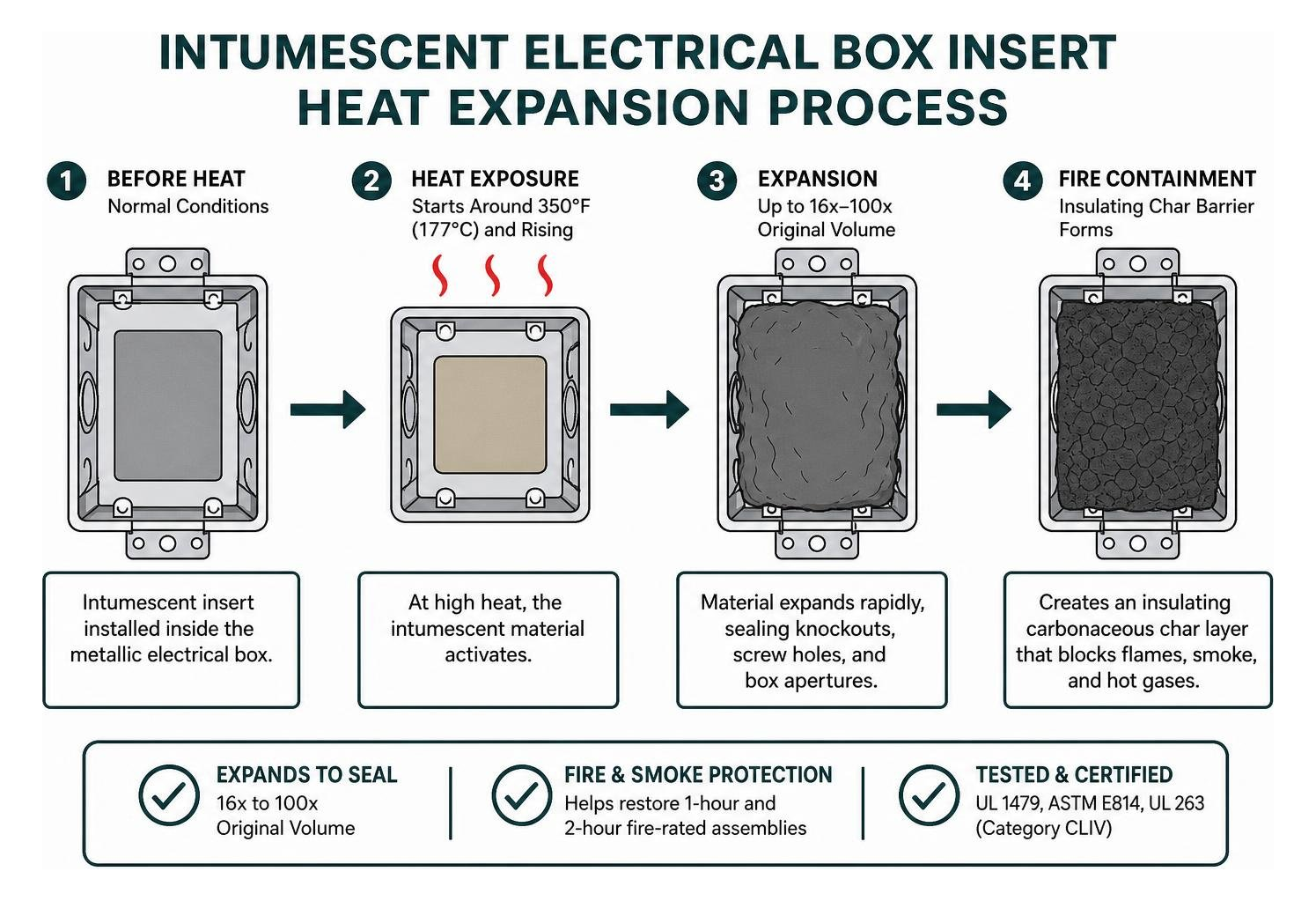
When an intumescent insert encounters temperatures starting around 350°F (177°C) and rising beyond 1,000°F (538°C), hyper-intumescent technology activates. The material expands rapidly, creating an insulating, carbonaceous char layer.
- The 3M Fire Barrier Electrical Box Insert features a nominal thickness of 3/16 inch (5 mm) and can expand up to 100 times its original volume under high heat, carrying a Flame Spread Index of 0 and a Smoke Developed Index of 0 under ASTM E84 testing.
- The SpecSeal EP Powershield insert has an unexpanded thickness of 1/8 inch (3 mm) and expands a minimum of 16 to 24 times its original size, sealing open knockouts, screw holes, and box apertures.
- For exterior panel feed-throughs and large structural penetrations, heavy-bodied sealants such as SpecSeal SSP100 Intumescent Putty provide volume expansion greater than 500 percent to prevent toxic gases from migrating across partition boundaries.
This dense, solid char blocks air pathways, seals off unsealed wire knockouts, and stops flames, superheated gases, and smoke from breaching the gypsum wall partition.
Soundproofing Benefits and STC Ratings
In addition to fire containment, intumescent inserts significantly enhance acoustic isolation across shared walls. Electrical boxes placed in adjoining rooms create direct sound leaks, allowing conversation, television noise, and mechanical vibrations to bypass drywall dampening.
Standard thin foam gaskets do not reduce sound transmission across wall studs. Intumescent inserts, by contrast, seal interior metal box cavities to restore acoustic integrity:
- The 3M Fire Barrier Electrical Box Insert achieves an STC rating of 62 when installed in a matching STC 62 wall assembly.
- The SpecSeal EP Powershield insert achieves an STC rating of 64 depending on specific wall framing and drywall layers.
This level of sound attenuation is vital for multi-family residential buildings, duplex demising walls, home offices, and media rooms where privacy and noise control are critical priorities.
Building Codes and Fire Protection Standards for Outlet Insulation
Building codes enforce strict rules regarding penetrations in fire-resistance-rated wall assemblies. Under the International Building Code (IBC), National Electrical Code (NEC), and NFPA standards, wall assemblies separating attached garages from living areas, multi-family dwelling units, or commercial corridors must maintain specific 1-hour or 2-hour fire endurance ratings.
When an electrician cuts an opening into a gypsum fire barrier to mount a metallic outlet box, that opening breaks the continuous fire barrier. Standard building codes mandate that metallic boxes on opposite sides of a rated partition wall must be separated by a horizontal distance of at least 24 inches.
However, modern architectural layouts often place outlets in adjacent rooms back-to-back within the same stud cavity. To maintain code compliance when boxes are spaced closer than 24 inches, contractors must install approved Wall Opening Protective Materials (UL Category CLIV).
Intumescent inserts undergo rigorous standardized testing to achieve these listings:
- UL 1479 / ASTM E814: Standard Test Method for Fire Tests of Penetration Firestop Systems. These evaluations subject electrical wall assemblies to intense furnace temperatures and high-pressure water hose streams to confirm the barrier remains intact without letting fire burn through.
- UL 263 / ASTM E119: Standard for Fire Tests of Building Construction and Materials, verifying that the entire partition retains structural integrity and limits temperature rise on the unexposed side for up to 2 hours.
Using standard polyethylene foam gaskets in rated assemblies fails code inspections because standard gaskets provide zero fire resistance. Listed intumescent inserts restore the full fire rating of the partition, keeping living spaces safe and code-compliant.
Professional Installation Considerations for Foam Gaskets and Firestop Inserts
Proper installation of electrical box insulation materials protects against thermal loss and maintains critical firestopping performance. Because these products interact with energized wiring, fire-rated assemblies, and concealed wall cavities, Grounded Solutions recommends having a licensed electrician evaluate the wall assembly and install the correct product.
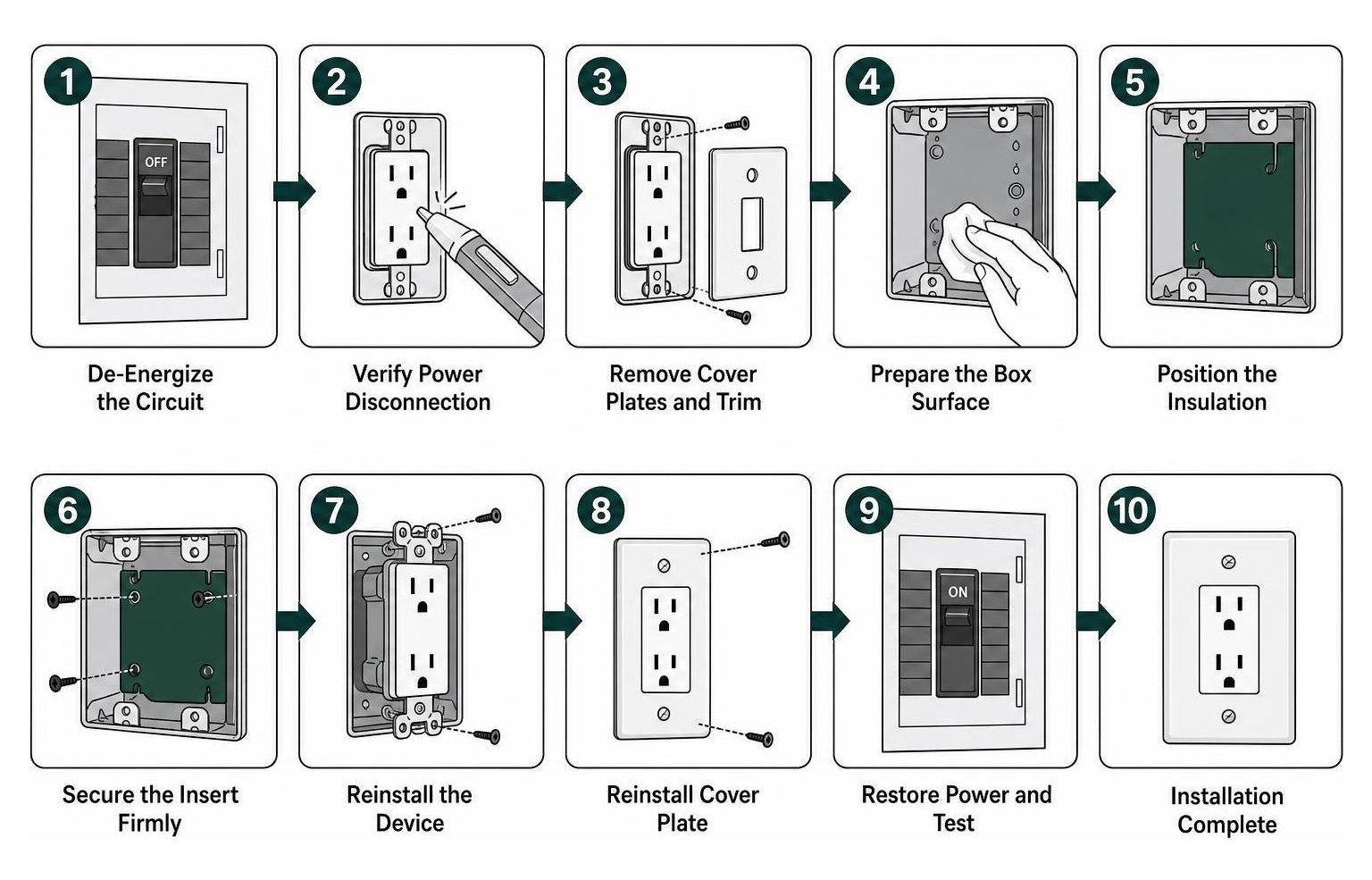
A professional installation typically includes the following safeguards:
- Circuit Verification: The electrician identifies the correct circuit, de-energizes it at the main service panel, and confirms zero voltage with a calibrated non-contact voltage tester before opening the outlet or switch.
- Wall Assembly Assessment: The electrician checks whether the wall is a fire-resistance-rated partition, a garage-to-home separation, or a multi-family demising wall. This determines whether a standard foam gasket is acceptable or whether a listed intumescent firestop insert is required.
- Box Preparation: For internal firestop inserts, the back interior wall of the metal box must be completely clean, dry, oil-free, and frost-free before the adhesive backing is applied.
- Product Placement: Draft gaskets are aligned over the receptacle faces and rest flush against the front drywall edge. Fire barrier inserts are routed around existing wiring conductors and pressed firmly against the rear wall of the metallic box.
- Cover Plate Reinstallation: The wall plate is realigned and secured without cracking the plastic faceplate.
- Power Restoration and Testing: The circuit is re-energized and the receptacle or switch is tested for proper operation.
Reviewing essential electrical safety rules before starting work ensures every task is completed safely and methodically. For detached garages, patio enclosures, or unconditioned workshops, winterizing outlets and boxes prevents moisture buildup and freezing damage during severe winter weather.
Preparation and Safe Handling for New and Retrofit Projects
One major advantage of modern intumescent electrical box inserts is their versatility across both new construction and existing retrofit applications. In older homes where drywall is already finished, cutting out sections of wallboard to apply exterior box putty wraps is messy, costly, and time-consuming.
Intumescent inserts fit directly through the front opening of existing single-gang or multi-gang metallic boxes. Their flexible, one-piece construction allows them to bend easily through the face opening.
To ensure strong adhesion, installers should work when ambient temperatures are between 32°F and 110°F (0°C to 43°C), with optimal adhesion occurring above 40°F (4°C). The peel-and-stick adhesive backing anchors the pad directly to the steel box interior, holding the insert firmly in place behind the receptacle without shifting over time.
Sizing and Compatibility for Electrical Box Foam Insulation
Selecting the correct insert size ensures complete coverage and code compliance across different electrical configurations:
- EBI-4 / EP44 Models: Sized at approximately 3.25 inches by 3.25 inches with a 3/16-inch thickness, engineered for standard 4-inch square metallic boxes with single- or double-gang plaster rings.
- EBI-5 / EP55 Models: Sized at approximately 3.75 inches by 3.75 inches, designed for deep 4-11/16-inch square metallic junction boxes and commercial utility enclosures.
These intumescent inserts are engineered specifically for steel and metallic electrical enclosures. The materials are chemically non-corrosive, non-conductive, and fully compatible with non-metallic sheathed cable (NM-B Romex), armored cable (AC/MC), and thermoplastic wire insulation without causing plasticizer migration or degradation.
Frequently Asked Questions About Electrical Box Insulation
Can electrical box foam inserts be installed after drywall is in place?
Yes. Unlike exterior putty pads that must wrap around the outside of the box before wallboard is hung, intumescent inserts feature integrated pre-cut slits and a flexible structure. Electricians easily slide them through the front face of existing metal boxes, routing wires through the cutouts and pressing the adhesive backing to the rear interior wall without opening drywall.
What is the shelf life and proper storage for intumescent inserts?
When stored indoors in dry, climate-controlled environments between 40°F (4°C) and 100°F (38°C), intumescent inserts have an unlimited shelf life. The solid intumescent polymer does not dry out, shrink, or lose chemical reactivity under stable ambient conditions.
What should you do if an intumescent insert is damaged or torn during inspection?
If an intumescent insert is simply torn or slit during wire pulling but all material remains intact inside the box, third-party listings allow it to remain in service. However, if any piece of the intumescent material is missing, cut away, or compromised, the entire insert must be removed and replaced with a new unit to preserve the UL fire-resistance listing.
Conclusion
Sealing wall openings improves energy efficiency and helps stabilize indoor temperatures year-round, especially during severe Central Indiana weather and spring storm seasons. However, maintaining fire-rated wall assemblies, sound barriers, and electrical code compliance requires matching the right materials to each application. While simple foam gaskets help eliminate minor room drafts, multi-family demising walls and fire-rated partitions demand tested, certified intumescent firestop solutions.
When planning home electrical improvements, understanding when to evaluate a DIY approach versus calling a professional protects your home from serious safety hazards. Grounded Solutions is a trusted local electrical contractor serving Central Indiana and southern Indianapolis communities, including Greenwood, Franklin, Whiteland, Southport, Beech Grove, and Mooresville. Our team is fully licensed, bonded, insured, and certified in Lutron Caséta and RadioRA 3 smart systems, delivering comprehensive expert electrical services and repairs with clear, upfront pricing.
Whether you need to eliminate drafts, install smart SPAN electrical panels and Lutron lighting controls for enhanced power reliability, upgrade whole-home surge protection, or ensure wall assemblies meet current fire codes, Grounded Solutions is ready to help. Contact Grounded Solutions today to schedule your professional electrical inspection and service consultation.