
The Ultimate Business Guide to Level 2 Commercial EV Chargers
Is Your Business Ready for the EV Revolution?
EV chargers for business are no longer a luxury — they are quickly becoming a must-have for commercial properties across Indianapolis and beyond. Whether you run a retail center in Whiteland, manage an office park in Beech Grove, or operate a fleet out of Franklin, your customers and employees are already driving electric vehicles. And they expect a place to charge.
Here is a quick look at the most important things to know before you invest:
| What You Need to Know | Quick Answer |
|---|---|
| Best charger type for most businesses | Level 2 (208-240V AC, 7–19.2 kW) |
| Best for fast public charging | DC Fast Charger (30–240 kW) |
| Typical hardware cost (Level 2) | $1,500 – $12,000 per unit |
| Typical installation cost | Varies widely; trenching runs ~$100 per linear foot |
| Can businesses earn revenue? | Yes — via pay-per-use, subscriptions, or advertising |
| Key software standard to look for | OCPP-compliant management system |
| Top brands to consider | ChargePoint, Wallbox, Leviton, Enphase, Tesla |
The shift is happening fast. More drivers are upgrading to electric vehicles every day, and they are choosing where to shop, eat, and work based on where they can charge. If your property does not offer that option, you risk losing those customers and employees to a competitor who does.
“Before long, there may be more EVs than internal combustion engine vehicles parked at workplaces during work hours.”
That is not a distant prediction — it is a reality many Indianapolis-area businesses are already starting to feel.
I’m Clay Hamilton, President of Grounded Solutions, and with over two decades of hands-on electrical experience, I have helped businesses across the Indianapolis area plan and install EV chargers for business that are safe, code-compliant, and built to scale. In this guide, I will walk you through everything you need to know to make a smart, confident decision for your property.
Why Installing EV Chargers for Business is a Strategic Move
As we navigate the middle of 2026, the transition to electric mobility is no longer a future projection — it is a live business environment. Implementing business ev charging solutions is a powerful way to enhance your commercial property value, meet corporate environmental goals, and satisfy environmental, social, and governance (ESG) compliance standards.
By offering charging on-site, you turn a simple parking spot into an active business asset. For commercial property managers and business owners in Central Indiana, this translates directly to increased asset value, higher tenant retention rates, and a distinct competitive edge in the local market.
Attracting High-Value Customers and Boosting Retail Dwell Time
For retail centers, restaurants, and entertainment venues, charging infrastructure is a proven customer acquisition tool. EV drivers actively plan their routes and outings around where they can plug in. Data indicates that EV drivers spend an average of 30% more time in-store while their vehicles charge, which directly correlates with higher average transaction values.
By listing your locations on public maps and directories like Charging stations for EV in Indianapolis, you place your business directly on the screens of local drivers. Whether it is a shopping destination like the Greenwood Mall – South | Greenwood, IN | EV Station or a highway-adjacent commercial travel hub like the Flying J Travel Center EV Charging Stations – Whiteland, providing reliable charging options ensures your business becomes a preferred destination rather than an afterthought.
Enhancing Employee Retention with Workplace ev chargers for business
At the workplace, providing charging capabilities is an incredibly high-value employee benefit. As more of your workforce transitions to driving electric vehicles, they will expect to have convenient charging options during work hours.
By utilizing corporate RFID cards or tailored mobile app integrations, you can manage access control easily. This allows you to offer free or subsidized charging to employees as a premium workplace perk, while still keeping the option open for visitors and clients to pay a standard public rate. This not only builds immense goodwill and commuter satisfaction but also positions your company as a modern, forward-thinking employer committed to sustainable business operations.
Technical Specifications: Level 2 vs. DC Fast Chargers
When selecting the right hardware for your property, it is critical to understand the technical and operational differences between Level 2 AC chargers and DC Fast Chargers (DCFC).
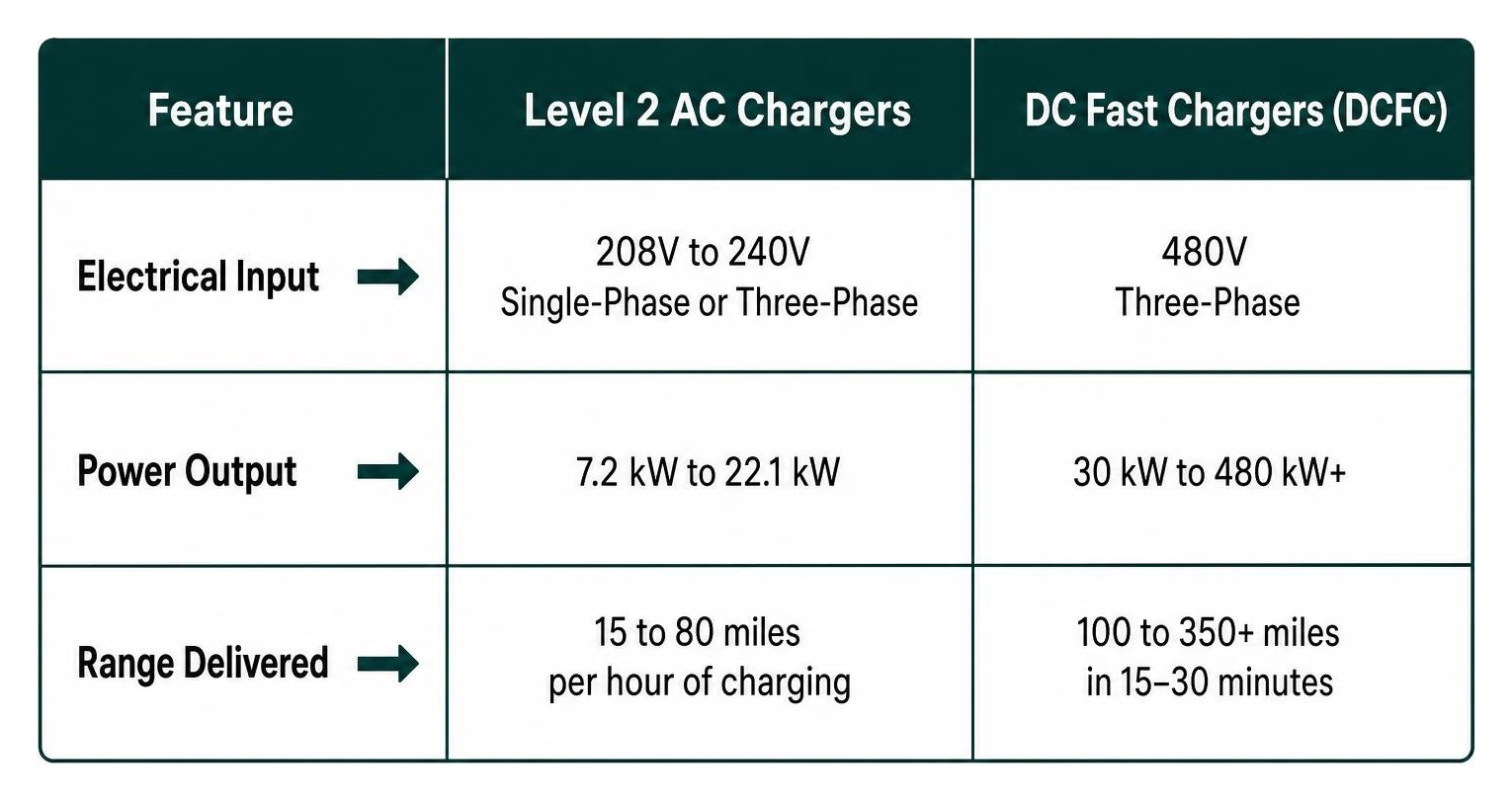
| Feature | Level 2 AC Chargers | DC Fast Chargers (DCFC) |
|---|---|---|
| Electrical Input | 208V to 240V Single-Phase or Three-Phase | 480V Three-Phase |
| Power Output | 7.2 kW to 22.1 kW | 30 kW to 480 kW+ |
| Range Delivered | 15 to 80 miles per hour of charging | 100 to 350+ miles in 15–30 minutes |
| Typical Dwell Time | 2 to 8 hours | 15 to 45 minutes |
| Best Applications | Workplaces, hotels, multi-family, retail parking | Fleet depots, highway corridors, travel plazas |
| Infrastructure Cost | Low to Moderate | High to Very High |
Power Output, Amperage, and Charging Speeds
Level 2 commercial electric vehicle charging stations typically operate on 208V or 240V AC power. The output of these chargers depends heavily on their amperage settings. While a standard 32 Amp station provides a respectable 7.6 kW of power, upgrading to 48 Amp (11.5 kW) or 80 Amp (19.2 kW to 22.1 kW) stations delivers significantly faster charging speeds.
For businesses where customers or employees dwell for two or more hours, high-amperage Level 2 chargers hit the absolute sweet spot. They provide ample range replenishment without requiring the massive infrastructure and utility upgrades associated with high-voltage DC fast charging systems.
Integrating Smart ev chargers for business with Building Power Systems
Modern commercial chargers do not operate in isolation; they must be carefully integrated with your building’s existing electrical ecosystem. Smart chargers, such as the IQ EV Charger 2 | EV Charging for Business | Enphase, are designed to communicate directly with local Energy Management Systems (EMS).
This connectivity allows us to design systems where your EV chargers work hand-in-hand with commercial solar panel contractors to utilize on-site renewable energy. By pairing solar generation, battery storage, and smart EV charging, your business can charge vehicles using clean, free energy generated directly on your roof, significantly reducing your reliance on the local utility grid.
Key Considerations for Commercial Installation and Grid Resilience

Installing commercial charging infrastructure requires careful planning, technical expertise, and a deep understanding of local building codes. Attempting to cut corners on a commercial ev charger installation can lead to expensive utility demand penalties, overloaded panels, and equipment damage.
Before purchasing any hardware, a comprehensive load analysis of your commercial facility’s electrical system must be performed. This ensures that your existing electrical panel and service transformer can safely handle the continuous electrical load of multiple high-power chargers.
Load Balancing and Avoiding Peak Demand Charges
One of the most significant operating expenses for commercial properties is utility demand charges — fees assessed based on the highest level of power your facility draws during a billing cycle. If ten vehicles plug in simultaneously at the end of a shift, it can create a massive power spike, driving your utility bills through the roof.
To prevent this, we utilize smart commercial electric upgrades grounded solutions impact on businesses and dynamic load optimization. By implementing smart load-balancing software, you can set a maximum allowable capacity for your EV chargers. The system then automatically and smoothly distributes the available power among all active charging ports. This allows you to install up to three times as many chargers on your existing electrical service without requiring a costly utility transformer upgrade.
Weatherproofing, Spring Storms, and Backup Power Integration
In Central Indiana, our commercial electrical systems must be tough enough to handle everything Mother Nature throws at them — from heavy winter snows to severe Spring storms and high-wind events. When we design and install outdoor charging systems, we prioritize rugged, weather-resistant hardware with NEMA 3R or NEMA 4 ratings and IK10 impact resistance to guard against vandalism and accidental collisions.
Furthermore, integrating a reliable backup generator for business and utilizing smart electrical panels like SPAN, alongside advanced Lutron systems, serves as the primary foundation for safety, reliability, and energy efficiency. As a Caséta and RadioRA 3 Certified contractor, Grounded Solutions can seamlessly integrate these smart technologies. During a storm-induced blackout, a smart SPAN panel and Lutron management system can automatically shed non-essential loads (like public EV chargers) to preserve backup generator power for critical systems, such as security, lighting, and refrigeration.
Comparing the Top Commercial EV Charger Brands
Choosing the right hardware manufacturer is critical for the long-term reliability and uptime of your charging network. Working with experienced ev charging station contractors ensures you select brands that offer robust equipment warranties, responsive technical support, and modular designs that simplify future maintenance.
Modular and Scalable Hardware Solutions
For businesses looking for a highly versatile and future-proof AC charging solution, the CP6000 Series AC Charger for Businesses | ChargePoint stands out as an industry leader. It features a modular architecture that makes physical repairs quick and cost-effective, minimizing station downtime.
Additionally, its universal Omni Port technology provides adapter-free charging compatibility for all electric vehicles on the road today — including Tesla models — without requiring separate, easily lost adapters.
Software, Access Control, and Monetization Models
If your goal is to generate direct revenue from your charging stations, the eM4 EV Charger – Scalable Business Solutions | Wallbox is an exceptional choice. It comes equipped with integrated MID-certified metering, which is essential for legally billing users based on exact kilowatt-hour (kWh) consumption.
By utilizing Open Charge Point Protocol (OCPP) compliant software, you avoid vendor lock-in. This gives you the complete freedom to choose and change your charging network provider or billing platform as your business needs evolve, allowing you to establish custom pricing tiers, subscription models, or automated payment processing effortlessly.
Frequently Asked Questions About Commercial EV Charging
How much does it cost to install a commercial Level 2 charger?
The total cost of installing a commercial Level 2 charging system varies depending on several site-specific factors, including the proximity of your parking spaces to your electrical panel, civil work requirements, and local permitting fees.
As a broad planning estimate, commercial Level 2 hardware typically ranges from $1,500 to $12,000 per charger, while professional installation costs can range from $3,000 to $15,000+ per port. If trenching through concrete or asphalt is required to run conduit, you should budget approximately $100 per linear foot. We always emphasize investing in a high-quality, professional installation over the lowest bid to ensure safety, code compliance, and long-term durability.
Can businesses generate revenue from EV charging stations?
Yes, absolutely! Businesses can monetize their EV chargers using several distinct pricing models:
- Pay-Per-Use: Charge drivers a flat connection fee, a rate per minute, or a fee per kilowatt-hour consumed.
- Subscription Models: Offer local residents or regular commuters unlimited or discounted charging for a set monthly fee.
- Retail Uplift: Provide free or discounted charging to customers who make a purchase, driving up average retail spend and dwell time.
- Digital Advertising: Utilize high-visibility digital screens on charger pedestals to run local advertisements, creating an additional passive income stream.
What electrical upgrades are required for commercial EV chargers?
To support multiple commercial Level 2 chargers, your property typically needs a 208V or 240V power source. In many commercial settings, utilizing three-phase power allows for more balanced electrical loads.
Depending on your facility’s current power usage, you may need a dedicated subpanel, upgraded commercial building wiring, or a larger utility transformer. Conducting a thorough professional load study prior to installation is the best way to determine exactly what upgrades are necessary for your specific building.
Conclusion
As we move forward through 2026, the demand for commercial EV charging will only continue to accelerate. Implementing ev chargers for business at your property is a powerful way to attract premium customers, retain top-tier talent, and future-proof your physical assets. However, because commercial electrical systems are complex and subject to heavy continuous loads, professional installation is absolutely paramount to ensure safety, reliability, and code compliance.
At Grounded Solutions, we are proud to be a family-owned and operated electrical contractor serving Central Indiana. Our team of fully licensed, bonded, and insured electricians specializes in delivering safe, high-quality commercial electrical work with transparent pricing. From initial site load assessments and utility coordination to hardware installation and ongoing maintenance, we provide complete, end-to-end expertise.
Whether your business is located in Indianapolis, Greenwood, Whiteland, Franklin, Southport, Mooresville, or any of our neighboring communities, we are here to help you get your EV charging project done right.
Are you ready to design a scalable, reliable EV charging solution for your commercial property? Contact Grounded Solutions today to schedule your professional commercial site assessment and take the first step toward powering the future of your business!