

Why Agricultural Barn Wiring Requires a Licensed Specialist
A barn wiring licensed specialist should assess the building before any new circuit, panel, motor, or outlet is installed. Agricultural buildings face moisture, manure gases, dust, rodents, long wire runs, and heavy equipment loads that standard residential wiring is not designed to handle.
A qualified electrician can help you:
- Classify dusty and corrosive areas under NEC Article 547
- Size feeders and motor circuits to prevent voltage drop and overheating
- Install proper grounding, bonding, GFCI protection, and weather-resistant enclosures
- Protect livestock from stray voltage and step-voltage hazards
- Plan reliable power for ventilation, lighting, water systems, milking equipment, and standby generators
Barn electrical work is about more than keeping lights on. A poorly protected connection, undersized conductor, or corroded panel can create fire, shock, equipment-failure, and animal-safety risks. This is especially important in Indiana barns where changing weather, washdown areas, and expanding farm equipment can quickly outgrow an older electrical system.
I am Clay Hamilton, President of Grounded Solutions, with more than 20 years of hands-on experience in electrical, mechanical, and infrastructure work. As a barn wiring licensed specialist, I focus on practical, code-conscious electrical solutions that help farm owners protect people, livestock, and daily operations.
When upgrading agricultural facilities with professional electrical contracting, choosing a trusted electrician electrical contractor ensures code compliance and long-term durability. Our team handles everything from main distribution panels to high-efficiency fluorescent to LED conversion tailored for farm environments.
Why Agricultural Facilities Demand a Barn Wiring Licensed Specialist
Farms and agricultural outbuildings present an aggressive environment for electrical infrastructure. Unlike climate-controlled residential homes in suburban neighborhoods, barns are exposed to airborne manure gases, high humidity, combustible organic dust, routine pressure-washing cycles, and intense temperature fluctuations. Ammonia vapors combined with moisture create an environment that quickly eats away at standard copper contacts, steel enclosures, and residential-grade breakers.
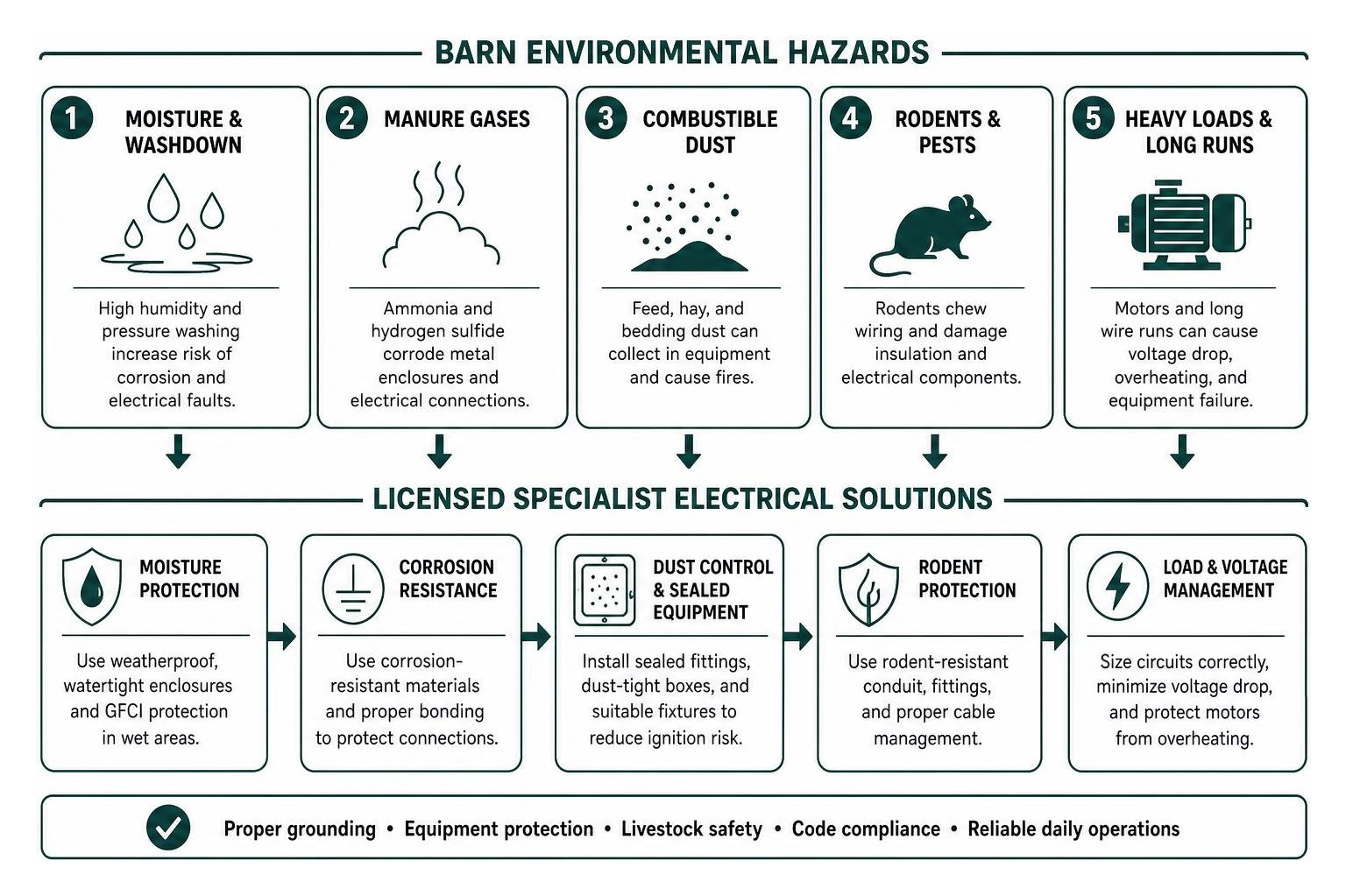
Agricultural buildings are prone to distinct hazards that standard residential practices cannot withstand:
- Corrosive Manure Gases: Livestock waste releases ammonia and hydrogen sulfide. When mixed with ambient moisture, these gases form corrosive airborne compounds that deteriorate ordinary metal panel enclosures, cause terminal screws to seize, and degrade copper connections.
- Combustible Dust Accumulation: Feed grinding, dry hay storage, and bedding materials release fine particulates that settle inside standard junction boxes and light fixtures. Without proper sealing, standard switches can produce minor internal arcs that ignite dust fires.
- High Humidity and Direct Washdown: Dairy milking parlors, swine nurseries, and processing sheds require high-pressure washdown routines. Water ingress into standard enclosures creates ground faults, nuisance tripping, and rapid corrosion.
- Severe Rodent Infestation: Mice, rats, and squirrels seek shelter in agricultural buildings. When addressing a wires and rats or mice chewing problem, unprotected non-metallic sheathed cable (Romex) is frequently stripped of its insulation, exposing bare energized conductors directly against dry wood framing.
- Physical Abrasion and Mechanical Stress: Equipment vibration, livestock rubbing against conduit, and tractor movement require rigid, impact-resistant mechanical containment.
NEC Article 547 Compliance vs. Residential Standards
The National Electrical Code (NEC) outlines specific mandates for agricultural environments under Article 547. Applying standard residential wiring methods to these spaces violates building safety codes and endangers your property.
The industry standards set by the Rural Electricity Resource Council and Midwest Rural Energy Council establish clear classifications for farm spaces:
- NEC 547.1(A) Dust-Prone Areas: Spaces containing dry feed handling, grain elevators, and hay storage where combustible dust can suspend in the air or accumulate on equipment. These areas require dust-ignitionproof or dust-tight enclosures, sealed fittings, and enclosed motors.
- NEC 547.1(B) Corrosive and Wet Environments: Livestock confinement areas, manure pits, milk houses, and wash bays where corrosive vapors and high humidity exist. These spaces mandate corrosion-proof non-metallic materials, watertight seals, and specialized drainage fittings.
Standard residential wiring methods rely on thin metal boxes, NM-B cable, and friction-fit fittings. In agricultural spaces, these installations can corrode through within a few seasons, resulting in open sparks, structural fires, or live equipment frames.
Rodent Resistance and Physical Conduit Protection
Mice and rats represent one of the leading causes of farm fires across central Indiana. Rodents are naturally driven to gnaw on electrical wiring insulation to control the growth of their incisors. Standard residential wiring hidden behind walls or run across exposed joists provides easy access for pests.
When executing professional electrical wiring and rewiring in agricultural structures, we eliminate exposed Romex. We route all branch circuits through heavy-duty Schedule 80 PVC, rigid non-metallic conduit (RNC), or appropriately sealed corrosion-resistant rigid metal conduit. Schedule 80 PVC features a substantially thicker wall than standard Schedule 40, providing structural protection against livestock impacts, moving machinery, and persistent rodent chewing. All entry points into panels and boxes are fitted with threaded hubs and airtight rubber gaskets to prevent pests from nesting inside warm electrical distribution gear.
Critical Infrastructure: Enclosures, Equipotential Planes, and Lightning Defense
Agricultural buildings require durable exterior and interior components. Standard indoor NEMA 1 enclosures allow humid, dust-filled, and corrosive air to freely circulate across circuit breakers and busbars. Within a livestock barn, this exposure leads to terminal failure and overheating.
Our team installs non-metallic NEMA 4X or NEMA 12 rated enclosures constructed from high-impact polycarbonate or fiberglass-reinforced polyester. Understanding the differences covered in our review of all about weatherproof electrical boxes helps illustrate why these enclosures matter on the farm. NEMA 4X equipment is corrosion-resistant, watertight, dust-tight, and impervious to ammonia fumes. Every toggle switch, outlet, and control button features silicone boots, gasketed spring-loaded covers, and external mounting tabs so the sealed housing remains uncompromised during installation.
Protecting Livestock with Equipotential Planes and Stray Voltage Mitigation
Dairy cattle, swine, and horses are far more sensitive to electrical potential than humans. While a human might barely detect a 1-to-2-volt electrical difference, dairy cows can perceive voltages below 0.5 volts.
When an animal touches a metal waterer, feeder, or stanchion while standing on a concrete floor with a different electrical potential, a small current flows through its body. This is known as stray voltage or neutral-to-earth voltage (NEV). Stray voltage causes sub-clinical shocks that result in severe herd health issues:
- Drastic reduction in daily water and feed intake
- Reluctance to enter the milking parlor or approach metal stalls
- Uneven milk letdown and increased milking times
- Elevated somatic cell counts (SCC) and higher rates of clinical mastitis
- Loss in daily milk production yields and slow animal weight gain
To eliminate this hazard, NEC Article 547 mandates the installation of an equipotential plane in concrete livestock confinement areas. An equipotential plane is an interconnected network of conductive elements embedded in the concrete floor, bonded directly to the electrical grounding system.
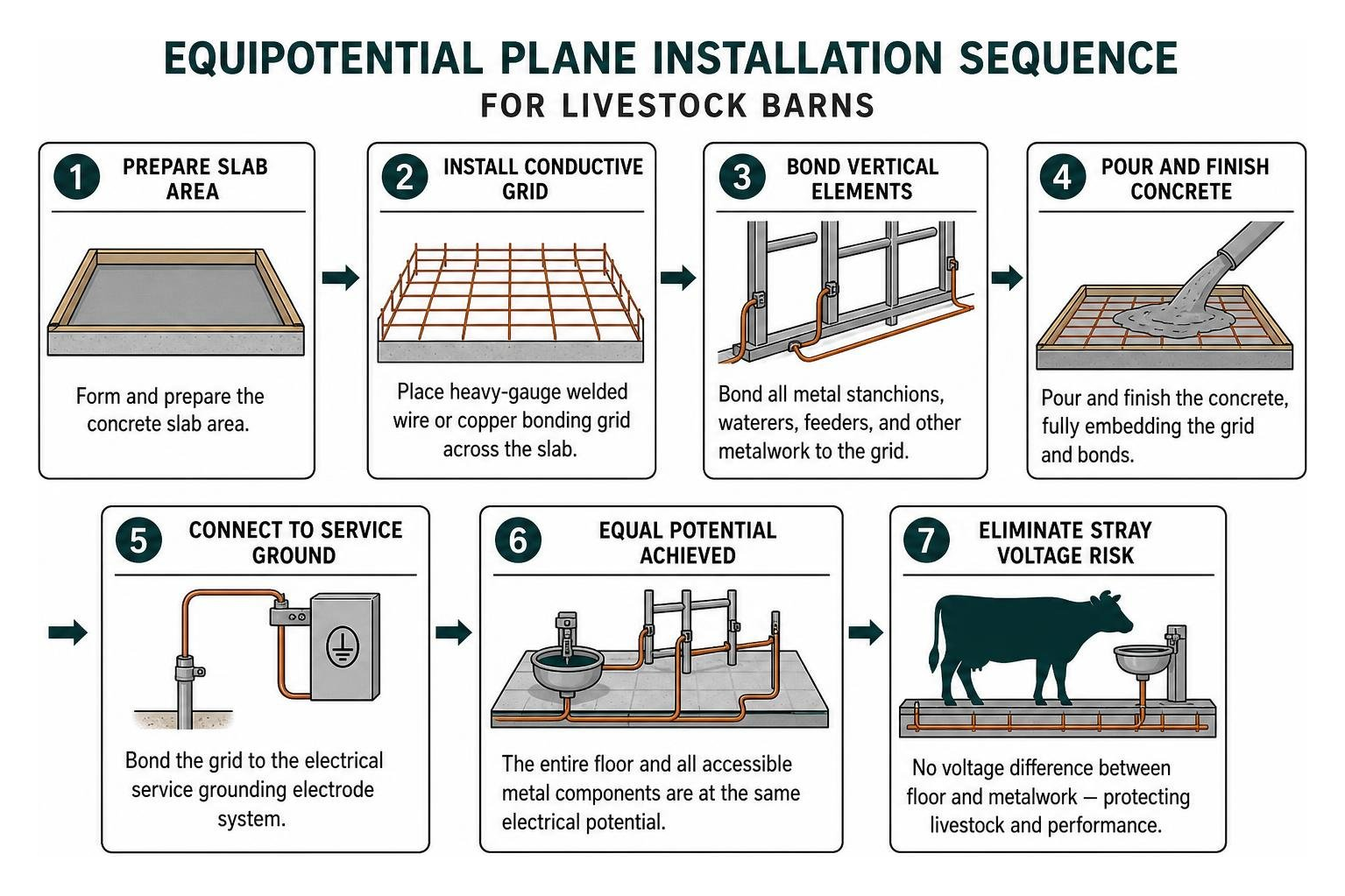
By embedding heavy-gauge welded wire reinforcement mesh or a dedicated copper bonding grid into the poured slab and bonding it directly to all structural metalwork, metal waterers, stanchions, and the service ground, the entire floor and all accessible metal components remain at the exact same electrical potential. This completely eliminates step-and-touch voltage differences, keeping animals comfortable and productive.
Whole-Farm Lightning Protection and Single-Point Grounding Networks
Indiana farms face severe Spring thunderstorms and midwestern weather events that bring lightning strikes and destructive utility surges. Barns, silos, and open outbuildings represent primary targets for lightning strikes due to their large physical footprints, metal roofs, and isolated positions across rural acreage.
A standard electrical grounding rod cannot handle the millions of volts and thousands of amperes delivered by a direct lightning discharge. Complete protection requires an integrated system compliant with NFPA 780 standards:
- Air Terminals (Lightning Rods): Copper or aluminum air terminals positioned along roof ridges, silo peaks, and roof edges to intercept strikes.
- Down Conductors: Heavy, smooth-weave bare copper cabling that routes the lightning discharge safely around the building structure rather than through structural lumber or wiring.
- Dedicated Grounding Array: Deep-driven copper ground rods and radial counterpoise loops placed in low-resistance earth around the structure perimeter.
- Single-Point Grounding Network: Tying the lightning protection system, the utility electrical service ground, and outbuilding subpanels into a unified single-point ground network. This prevents voltage from jumping between buildings during a strike.
- Multi-Stage Surge Protection: Heavy-duty Type 1 Surge Protective Devices (SPDs) installed at the main farm distribution pole or service entrance, paired with Type 2 SPDs inside barn subpanels to protect computerized feed controllers, automated milking computers, and variable-speed fan controllers.
Investing in an NFPA 780 certified lightning protection system safeguards property while qualifying the farm for valuable discounts on agricultural property insurance premiums.
Designing High-Capacity Electrical Circuits for Long-Distance Ag Loads

Modern agricultural operations rely on motorized equipment running for hours on end. Unlike typical residential loads that operate intermittently, farm machinery operates under demanding conditions that push standard electrical components to their limits.
When planning agricultural power distribution, loads fall under specific engineering rules:
- Continuous Loads: Equipment that runs continuously for 3 hours or more, such as tunnel ventilation fans, pit exhaust fans, feed augers, and dairy cooling systems. The NEC mandates that branch circuits, breakers, and feeders supplying continuous loads be sized for at least 125% of the continuous rating.
- Motor Inrush Current: Electric motors draw 5 to 7 times their full-load amperage (FLA) upon startup. Circuits must incorporate time-delay dual-element fuses or motor-duty circuit breakers that tolerate initial inrush without nuisance tripping while maintaining thermal overload protection.
- Three-Phase Power Distribution: For motors exceeding 7.5 to 10 horsepower, three-phase power provides higher operating efficiency, lower run amperages, and extended motor life compared to large single-phase motors.
Sizing Feeders and Voltage Drop Calculations by a Barn Wiring Licensed Specialist
Rural farm properties often require power to travel hundreds of feet from the main utility service drop or central meter pole to remote barns, livestock shelters, grain bins, and well pumps. Running long distances on undersized conductors leads to severe voltage drop.
Voltage drop creates immediate operational failures and hidden operating expenses:
- A 5% voltage drop causes a 10% loss of heat output in resistive heating elements (such as livestock water heaters and brooding lamps).
- A 5% voltage drop causes a 17% loss of light output from standard illumination sources.
- A 5% voltage drop causes a 5% increase in current draw to electric motors, generating a 25% increase in motor winding heat, which rapidly degrades motor insulation and leads to premature pump or fan burnout.
NEC guidelines recommend that voltage drop should never exceed 3% on any individual branch circuit, and the combined total voltage drop across both the feeder and the branch circuit must remain under 5% at maximum continuous load.
The following table illustrates why standard residential wire gauges cannot be used over typical agricultural distances:
| Circuit Load (Amps) | Circuit Voltage | Distance from Panel | Standard Gauge (Fails Voltage Drop) | Required Upsized Conductor | Resulting Voltage Drop % |
|---|---|---|---|---|---|
| 20 A (Outlets/Heaters) | 120 V | 150 ft | #12 AWG Copper (6.8% drop) | #8 AWG Copper | 2.7% |
| 30 A (Vent Fan Bank) | 240 V | 250 ft | #10 AWG Copper (4.3% drop) | #6 AWG Copper | 1.7% |
| 50 A (Manure Pump) | 240 V | 300 ft | #6 AWG Copper (4.9% drop) | #2 AWG Aluminum / #4 Cu | 2.2% |
| 100 A (Barn Subpanel) | 240 V | 400 ft | #3 AWG Copper (5.4% drop) | 2/0 AWG Aluminum / 1/0 Cu | 2.4% |
| 200 A (Main Barn Service) | 240 V | 500 ft | 4/0 AWG Al (7.8% drop) | 350 kcmil Aluminum | 2.6% |
Properly sizing underground feeders protects motor windings, prevents nuisance breaker trips, and lowers monthly energy bills across the farm.
Designing for Milking Parlors, Poultry Houses, and 16-Hour Production Lighting
Agricultural illumination requires deliberate engineering based on production biology and environmental resilience. In modern dairy operations, implementing long-day photoperiod lighting regimens has been proven to yield significant operational gains.
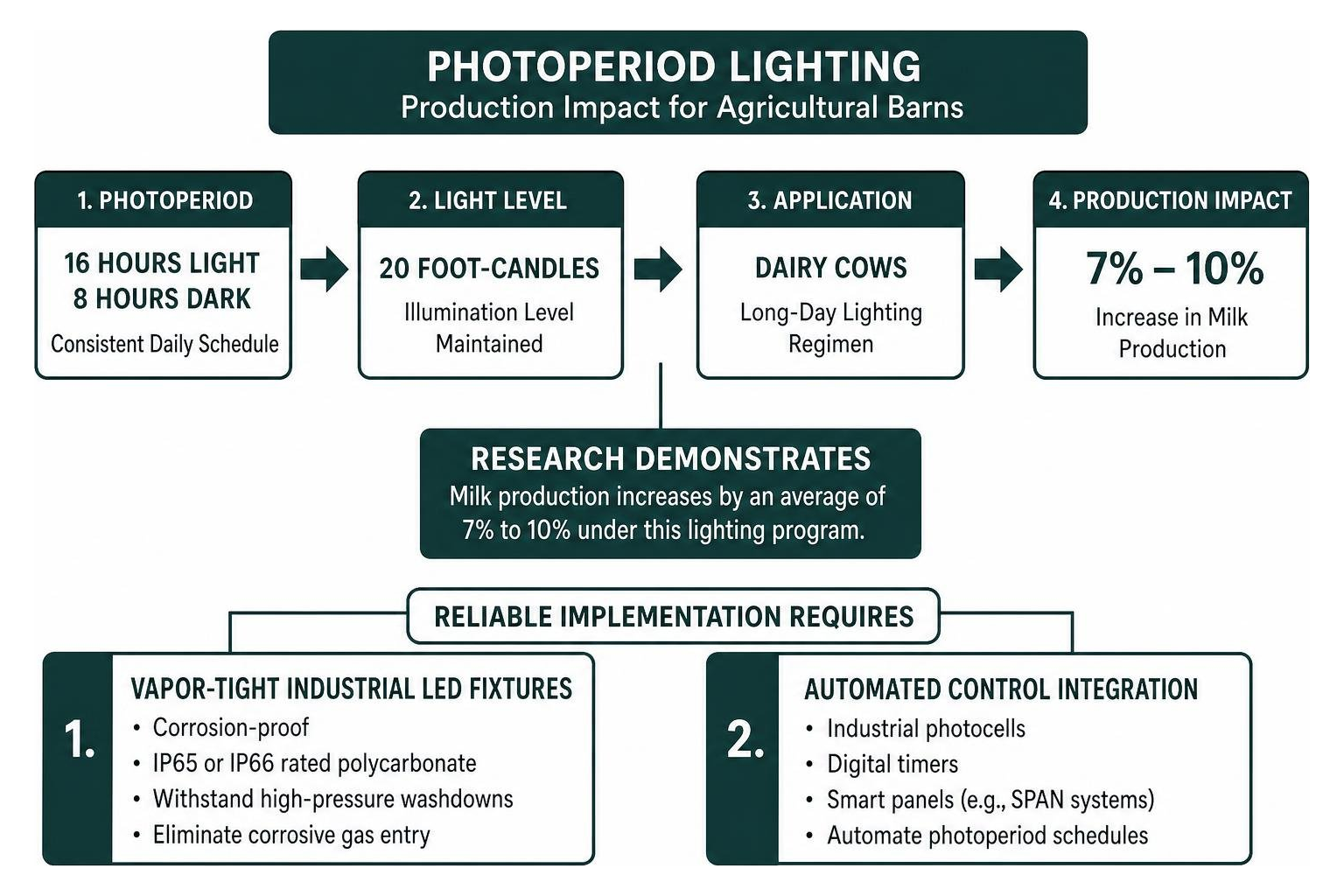
Research demonstrates that milk production increases by an average of 7% to 10% when dairy cows are provided with consistent illumination levels of 20 foot-candles maintained for 16 hours per day, followed by 8 hours of darkness.
To achieve this level of reliability, lighting designs require:
- Vapor-Tight Industrial LED Fixtures: Corrosion-proof, IP65 or IP66 rated polycarbonate fixtures that withstand high-pressure washdowns and eliminate corrosive gas entry.
- Automated Control Integration: Industrial photocells, digital timers, smart panels like SPAN systems, and Lutron lighting controls to automate photoperiod schedules without manual intervention. Grounded Solutions is Caséta and RadioRA 3 Certified, providing robust smart automation that operates flawlessly during severe weather and seasonal shifts.
- Dedicated Lighting Circuits: Lighting runs must be isolated on dedicated branch circuits, separate from high-draw motor loads, to prevent flickering during heavy motor start cycles.
- Class A GFCI Protection: All 125-volt, single-phase 15- and 20-amp receptacles and wet-location circuits must feature ground-fault circuit-interrupter protection to safeguard workers and livestock.
Reliable Standby Power and Code Compliance Strategies
Modern agricultural barns rely heavily on automated systems. If a severe spring storm knocks out utility power to a dairy barn or swine confinement facility, ventilation stops, cooling systems halt, and waste handling equipment fails. In an enclosed poultry house during summer, heat stress can lead to catastrophic animal losses within hours.
A comprehensive standby power system includes:
- Stationary Diesel, Propane, or PTO-Driven Standby Generators: Sized to support both steady-state loads and the combined starting inrush of all automated ventilation, water supply, and refrigeration systems.
- Automatic Transfer Switches (ATS): An electrically operated, mechanically held ATS that safely isolates the farm from the electrical utility grid within seconds of an outage, preventing dangerous backfeeding to utility line workers while restoring barn power.
- Emergency Circuit Prioritization: Grouping critical infrastructure (ventilation fans, well pumps, milk chillers, feeding systems) onto emergency subpanels to maximize generator fuel efficiency during extended grid outages.
- Smart Energy Management: Integrating smart distribution panels like SPAN enables farm operators to monitor individual circuit loads, shed non-essential loads dynamically during an emergency, and manage backup power directly from a tablet or smartphone.
How a Barn Wiring Licensed Specialist Eliminates Common Code Violations
Decades of unpermitted additions and temporary fixes create serious hazards in older barns. When we inspect and upgrade agricultural wiring, our team addresses dangerous code violations that put farm operations at risk.
Working with an expert team makes a major difference in safety. As detailed in our guide on why choosing a licensed electrical contractor matters, a specialized contractor ensures every aspect of the project conforms to national and local codes.
Common code violations we routinely correct include:
- Exposed Non-Metallic Sheathed Cable (Romex): Standard residential Romex run along barn framing where it is exposed to rodents, mechanical impacts, and corrosive air. We replace these runs with sealed Schedule 80 PVC conduit and wet-rated THHN/THWN-2 conductors.
- Open or Inappropriate Junction Boxes: Unsealed steel junction boxes missing covers or stuffed with wire nuts. We upgrade all connection points to gasketed non-metallic enclosures with IP66 watertight cable glands.
- Improper Grounding and Neutral Bonding at Subpanels: Bonding neutral and ground conductors together inside a remote barn subpanel creates ground loops and circulates stray voltage through the earth. We ensure neutrals and equipment grounding conductors are isolated at all subpanels, with a dedicated four-wire feeder system and local grounding electrode network.
- Undersized or Missing Equipment Grounding Conductors: Relying on conduit alone for grounding in high-moisture agricultural environments is unsafe because conduit connections can loosen or corrode. We pull an insulated green copper equipment grounding conductor through every raceway.
- Missing GFCI and Weather-Resistant Receptacles: Standard indoor outlets used in wet areas are replaced with weather-resistant (WR) GFCI receptacles housed within while-in-use extra-duty bubble covers.
Routine Inspections and Ag-Insurance Compliance
Agricultural insurance providers have significantly raised their standards for barn electrical systems due to the high frequency of farm fires caused by outdated wiring, overloaded panels, and lightning strikes.
Ensuring your property is serviced by a fully licensed, bonded, and insured electrician guarantees that all modifications, upgrades, and panel installations comply with local code requirements and qualify for insurance verification:
- Infrared Thermal Imaging Audits: We use advanced thermal cameras to scan panels, motor disconnects, and heavy feeders under full load. This non-invasive diagnostic identifies hot spots, loose connections, and imbalanced phases long before they cause component failure or electrical fires.
- Grounding Electrode Resistance Testing: Measuring ground resistance with specialized meters verifies that grounding rods, equipotential planes, and lightning mitigation systems provide low-impedance paths to dissipate surges safely.
- Annual Preventive Maintenance Protocols: Inspecting gasket seals, tightening lugs to precise manufacturer torque specifications, cleaning dust accumulation from enclosures, and testing GFCI breakers ensures year-round operational safety.
Frequently Asked Questions About Agricultural Barn Wiring
Why are standard residential electrical boxes prohibited in livestock barns?
Standard residential steel and lightweight plastic electrical boxes are not airtight or watertight. In livestock barns, ammonia, manure moisture, and combustible organic dust freely penetrate residential boxes. The ammonia vapors corrode the steel framing and copper terminals, while dry dust accumulation creates an ignition hazard next to switching arcs.
NEC Article 547.5 specifically requires that all junction boxes, switch enclosures, and outlet housings installed in agricultural confinement or dust-prone areas be constructed of corrosion-resistant, non-metallic materials (such as high-impact PVC or fiberglass) and sealed with watertight neoprene gaskets.
How does stray voltage affect dairy cattle and livestock health?
Stray voltage, often caused by poor neutral grounding, damaged insulation, or the lack of an equipotential plane, creates small electrical differences between conductive metal fixtures (like feeders, waterers, or stanchions) and the concrete floor.
Because cattle have low body resistance and walk barefoot on damp, grounded concrete, even minor voltages between 0.5V and 2.0V deliver uncomfortable shocks. This causes stress, leading to lowered water intake, suppressed feed consumption, poor milk letdown, elevated somatic cell counts, and increased vulnerability to mastitis. Installing equipotential bonding grids eliminates these voltage gradients.
When is three-phase electrical power required for agricultural operations?
Three-phase electrical power is typically recommended or required whenever an agricultural operation operates electric motors of 7.5 to 10 horsepower or larger. Equipment like large grain drying fans, irrigation pumps, feed delivery augers, manure pumps, and bulk milk refrigeration systems benefit substantially from three-phase supply.
Three-phase motors draw less current per phase, run cooler, experience less startup vibration, and feature simpler, more durable motor designs without starting capacitors or centrifugal switches. If three-phase utility lines are unavailable at your road frontage, specialized phase converters or Variable Frequency Drives (VFDs) can be engineered to run three-phase equipment from a single-phase rural utility feed.
Ensure Your Farm’s Power, Safety, and Longevity
Protecting your farm’s infrastructure, your livestock investments, and your daily workflow starts with a safe, code-compliant electrical system built to withstand harsh agricultural conditions. Whether you need a comprehensive electrical evaluation of an existing historic barn, an equipotential plane installation for a new milking facility, or an upgraded subpanel to run modern equipment, our team delivers dependable solutions.
At Grounded Solutions, we provide full service electrical contracting across the greater Indianapolis region, with specialized focus on our southern agricultural communities including Beech Grove, Franklin, Whiteland, Bargersville, Trafalgar, Mooresville, and Southport. As a local, family-owned electrical contractor, we take pride in delivering honest recommendations, exceptional craftsmanship, and long-term reliability for Indiana farms.
Contact Grounded Solutions today to schedule your agricultural electrical safety inspection, panel upgrade, or barn rewiring project with our licensed team.