
Why Commercial LED Lighting Experts Matter for Your Facility
Before hiring a lighting provider, ask for a site assessment, a photometric layout, product cut sheets, and a clear plan for code compliance, controls, rebates, installation, and warranty support. Commercial LED lighting experts use these details to match fixtures to your space, prevent dark spots and glare, reduce wasted energy, and support a safer, more reliable upgrade.
This is more than swapping old bulbs for LEDs. A warehouse, retail space, parking lot, or office needs the right lumen output, beam spread, mounting height, color temperature, and control strategy. LEDs can use up to 80% less energy than traditional lighting, but those savings depend on a design that fits the building and how people use it. The U.S. Department of Energy provides detailed guidance on LED lighting efficiency and performance standards that inform commercial design decisions.
I am Clay Hamilton, President of Grounded Solutions, with more than two decades of hands-on experience in electrical and mechanical systems, maintenance, repair, and project leadership. That background helps me explain what businesses should expect from commercial LED lighting experts, from the first layout to long-term electrical safety and support.
Glossary for commercial LED lighting experts:
The Strategic Role of Commercial LED Lighting Experts
Upgrading commercial illumination is not merely a matter of buying fixtures off the shelf and wiring them into place. A successful project requires a deep understanding of lumen delivery, spatial geometry, power quality, and structural layout. When facilities transition away from legacy high-intensity discharge (HID), fluorescent, or metal-halide lamps, the entire electrical dynamic shifts. Commercial lighting professionals assess the existing electrical infrastructure, examine voltage stability, evaluate panel capacities, and determine the exact illumination levels required for every task performed under your roof.
Every facility has unique demands. A high-ceiling manufacturing plant in Franklin requires an entirely different approach to light distribution than an office suite in Southport or a car dealership lot in Mooresville. Choosing the right engineering partner ensures that your facility achieves balanced illumination without over-consuming energy or overburdening branch circuits. Comprehensive commercial electrical services from retrofits to retail account for incoming service sizes, emergency backup battery integration, and automated controls that tie directly into building management systems.
Commercial LED Lighting Experts vs. General Electricians
While a licensed general electrician can safely connect wires and mount fixtures, a specialized commercial lighting expert approaches the building through the lens of optical engineering and illumination physics. General electrical contractors often rely on simple one-for-one fixture replacements. This approach frequently results in uneven illumination, severe glare, over-lighted zones, or shadowy corridors that violate safety standards.
Specialists focus on footcandle targets, beam angles, optical diffusion, and glare ratings to design an environment tailored to human productivity and safety. They calculate unified glare ratings (UGR) to prevent worker eye fatigue and select specialized distribution lenses (such as Type III or Type V optics) for parking lots and perimeter walkways.
| Service Factor | Commercial LED Lighting Specialist | General Electrician |
|---|---|---|
| Design Methodology | 3D Photometric simulations and point-by-point footcandle engineering | 1-to-1 fixture replacement based on existing junction box locations |
| Energy & Controls | Daylight harvesting, occupancy matrixing, task tuning, and smart network integration | Basic switch, photocell, or local wall-box sensor installation |
| Optical Engineering | Precise beam angles, optical distribution curves, UGR control, and CCT matching | Standard broad-beam fixtures without specialized optical lenses |
| Rebate Administration | Full utility filing, DLC Premium optimization, and incentive management | Customer handles utility applications and paperwork independently |
| Infrastructure Review | Harmonic distortion, surge suppression, line voltage drops, and panel loads | Basic circuit continuity and breaker sizing |
Essential Qualifications and Safety Certifications
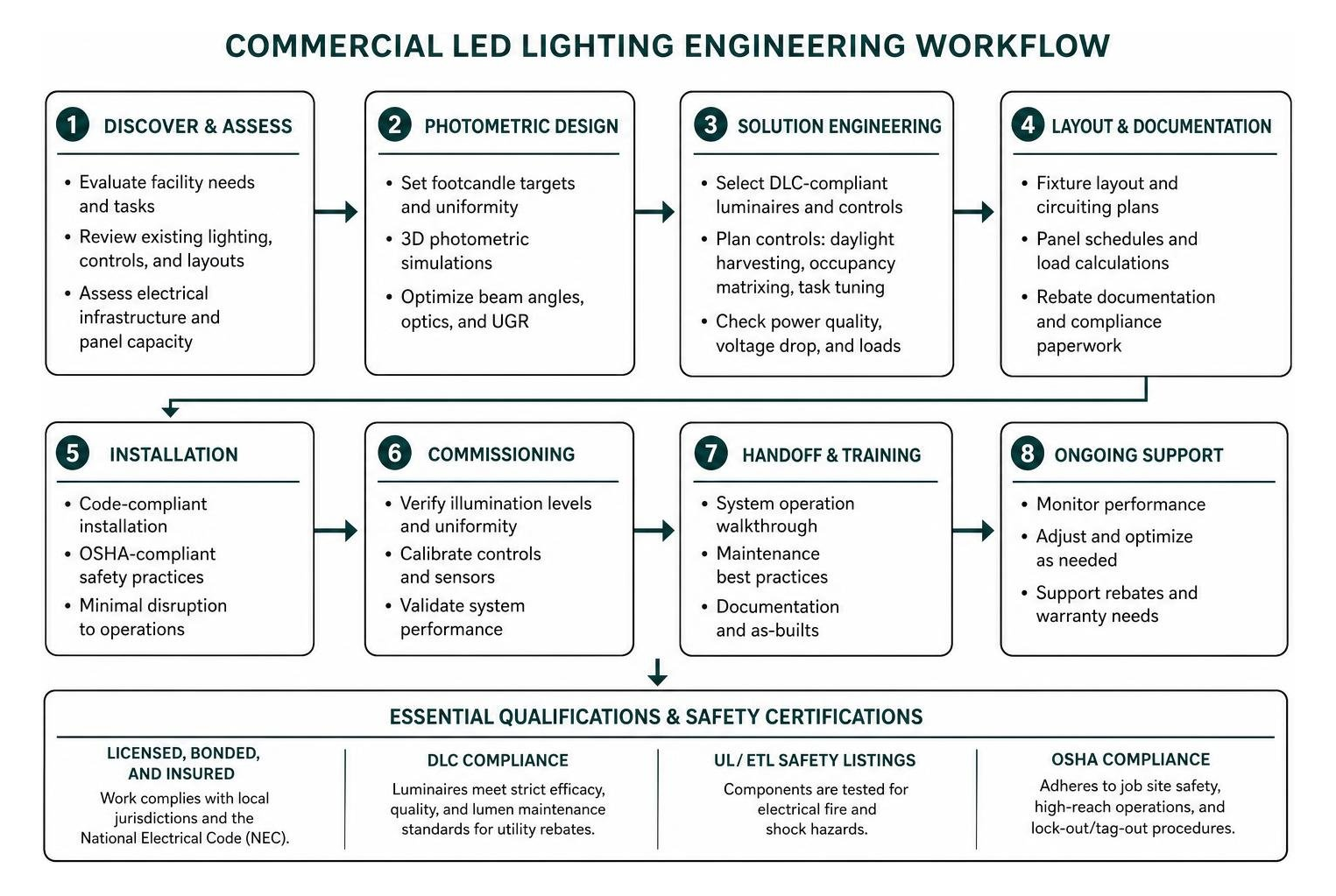
Commercial lighting systems operate under demanding conditions, often running 12 to 24 hours a day in challenging industrial and commercial environments. To guarantee safety, code compliance, and performance longevity, business owners must verify that their lighting partner holds the proper technical and safety credentials:
- Licensed, Bonded, and Insured Electrical Contractor: Verifies that all work complies with local jurisdiction amendments and the National Electrical Code (NEC).
- DesignLights Consortium (DLC) Compliance: Ensures specified luminaires meet strict efficacy, quality, and lumen maintenance standards required for utility rebates.
- UL / ETL Safety Listings: Confirms that luminaires, internal drivers, and retrofit components have passed rigorous testing for electrical fire and shock hazards.
- OSHA Compliance: Demonstrates adherence to job site safety standards, high-reach lift operations, and lock-out/tag-out safety procedures during installation.
The Step-by-Step Engineering Process: From Photometrics to Layouts
A proper commercial lighting retrofit or new build follows a disciplined engineering workflow. Guesswork has no place in commercial facilities where employee safety, task visibility, and operating expenses are on the line.
Photometric Studies and 3D Lighting Simulations
The foundation of every commercial lighting project is the photometric study. By utilizing digital IES (Illuminating Engineering Society) data files supplied by luminaire manufacturers, lighting engineers build a 3D computational model of your facility. This digital twin incorporates ceiling heights, wall reflectances, structural obstructions, shelving racking, and exterior property boundaries.
Through this process, the engineering team performs point-by-point calculations to determine the exact horizontal and vertical footcandle levels delivered across every square foot of the work area. This eliminates dark, shadowed pockets between high warehouse storage racks and prevents over-lighting open floor areas, which wastes capital and electricity. Furthermore, for outdoor facilities across Johnson County and Marion County, photometrics prevent light trespass into neighboring residential properties, ensuring compliance with strict municipal dark-sky and spill-light ordinances. Custom lighting layouts turn theoretical savings into measurable visual performance, as seen in modern custom lighting design strategies.
Specifying Commercial Luminaires and Smart Controls
Once the photometric model establishes the required lumen packages and optical spreads, the focus shifts to fixture specification and automated control strategies. Commercial-grade luminaires differ substantially from residential or light-duty fixtures. They feature robust extruded aluminum heat sinks, premium solid-state drivers, and high-impact polycarbonate or tempered glass lenses built to withstand mechanical vibration and ambient heat.
Automated controls and smart infrastructure optimize performance and reliability:
- Daylight Harvesting: Integrated photosensors automatically dim perimeter or skylight-adjacent fixtures when natural sunlight provides adequate footcandles.
- Occupancy and Vacancy Sensors: High-bay passive infrared (PIR) or microwave sensors reduce illumination levels in unoccupied warehouse aisles or storage zones.
- Smart Energy Management & SPAN Panels: Pairing commercial lighting circuits with intelligent SPAN panels allows real-time load management, helping facilities maintain power to vital safety lighting during Spring storms and grid interruptions.
- Lutron Smart Systems: Grounded Solutions is Caséta and RadioRA 3 Certified, delivering precision architectural dimming, scene setting, and centralized lighting automation across commercial spaces.
- Scheduled Astronomical Timers: Automatically adjust exterior building packs and pole lights based on seasonal sunset and sunrise times.
Maximizing Energy Efficiency, Utility Rebates, and ROI
Modern solid-state LED systems use up to 80% less energy than outdated metal-halide and fluorescent systems while delivering superior, crisp brightness. Commercial LED retrofits can reduce lighting power demand significantly, lowering operating expenses and delivering rapid financial returns.
Reviewing a comprehensive energy efficient lighting guide provides clear insight into how modern solid-state drivers maximize efficiency across large footprints.
How Commercial LED Lighting Experts Calculate True ROI
A complete financial return model encompasses more than basic kilowatt-hour (kWh) reductions. When our team models a commercial lighting conversion for a facility in Beech Grove or Whiteland, we incorporate several critical financial variables:
- Direct Energy Reduction: Calculating the delta between old ballast/lamp wattage and new LED system wattage multiplied by operating hours and local utility rates.
- Maintenance and Re-lamping Elimination: Commercial LED fixtures deliver operating lifespans of 50,000 to 100,000 hours, which equates to over 15 to 25 years of standard operation. This eliminates bucket truck rentals, lift leases, replacement ballasts, and ongoing maintenance labor.
- HVAC Load Offset: Traditional HID and fluorescent fixtures convert up to 80% of their consumed energy into waste heat. Switching to cool-running LEDs reduces ambient heat gain, cutting commercial air conditioning loads during hot summer months.
- Peak Demand Reduction: Lowering total electrical demand reduces peak power surcharges levied by commercial utility providers.
Navigating Local Codes, DLC Standards, and Rebate Programs
Navigating commercial utility incentive programs can be complex. Energy providers require specific documentation to issue rebate checks for lighting retrofits. This includes pre-approval inspections, proof of DesignLights Consortium (DLC) Premium listing, existing equipment inventories, and post-installation energy verification.
Working with an experienced contractor ensures that all fixtures meet the latest ASHRAE 90.1 and International Energy Conservation Code (IECC) lighting power density (LPD) maximums. By selecting high-efficacy fixtures that qualify for tier-one rebates, businesses can offset a substantial portion of upfront project costs.
Avoiding Common Commercial Lighting Mistakes
Commercial lighting upgrades involve significant investments in property infrastructure. Without professional guidance, building owners often run into preventable pitfalls that undermine system reliability and employee comfort.
Addressing Glare, Color Rendering, and Lumen Depreciation
A frequent misstep in commercial spaces is prioritizing raw lumen output over optical control and color quality. Excessively bright, unshielded LED chips produce harsh direct glare, creating visual discomfort and headaches for employees working on computer screens or assembly lines.
Specialists resolve this by specifying luminaires with high Color Rendering Index (CRI 80+ or 90+) ratings, ensuring colors appear accurate and vibrant. This is essential for retail showrooms, print facilities, and precision manufacturing. Furthermore, commercial engineers evaluate L70 and L90 lumen depreciation metrics, which define the operational hours a fixture will run before its light output drops to 70% or 90% of its initial rating. Specifying fixtures with robust thermal management ensures drivers and diodes do not overheat, preventing premature lumen drop-off or color shifting.
Ensuring Proper Electrical Infrastructure and Warranty Protection
Connecting new solid-state lighting to deteriorating or unstable building wiring can lead to early driver failures. LED drivers contain sensitive electronics that are vulnerable to transient voltage spikes, severe weather events, and harmonic distortion caused by large industrial motors or heavy machinery.
A complete lighting installation begins with a thorough evaluation of commercial building wiring to identify loose neutral connections, undersized conductors, or unbalanced panel loads. Incorporating dedicated Type 1 or Type 2 surge protective devices (SPDs) shields entire lighting branch circuits against lightning strikes and power grid switching transients, protecting manufacturer warranties that span up to 10 years.
Frequently Asked Questions About Commercial LED Lighting
What is the average payback period for a commercial LED retrofit?
For most commercial and industrial properties operating 10 to 24 hours daily, the average return on investment occurs within 12 to 24 months. When substantial utility rebates are combined with 70% to 80% direct power reductions and the total elimination of maintenance costs, the project quickly pays for itself through monthly operational savings.
Why is a photometric lighting design study necessary before installation?
A photometric study takes the guesswork out of lighting placement. It calculates the exact footcandle levels across work surfaces, aisleways, and exterior lots before a single hole is drilled. This prevents over-lighting, under-lighting, uneven hot spots, and dark zones, ensuring compliance with OSHA and municipal lighting ordinances.
How do DLC listings affect commercial utility rebate eligibility?
The DesignLights Consortium (DLC) Qualified Products List (QPL) serves as the benchmark for energy efficiency and performance in commercial lighting. Most utility companies require luminaires to be DLC Standard or DLC Premium certified to qualify for financial rebates. Selecting non-listed fixtures can result in the complete denial of utility incentive funds.
Conclusion
Upgrading your commercial facility to modern solid-state LED technology is one of the most effective ways to lower operational overhead, enhance workplace safety, and elevate the overall aesthetic of your property. Achieving those results requires a dedicated design strategy built on accurate photometrics, robust electrical engineering, and professional installation.
At Grounded Solutions, we provide turnkey commercial electrical and lighting services tailored to your building’s exact operational needs across Indianapolis, Franklin, Whiteland, Beech Grove, Mooresville, Southport, and surrounding communities. As a Caséta and RadioRA 3 Certified electrical contractor specializing in SPAN panel installations, Lutron systems, and high-efficiency lighting, our licensed team delivers safe, reliable, and energy-efficient results designed to withstand severe weather events.
Contact Grounded Solutions today to schedule your comprehensive facility lighting assessment and discover how our professional commercial LED lighting services can transform your operations.