
How to Fix Outlet Reset Problems in 5 Easy Steps
Understanding Common Outlet Reset Problems and Lockout Mechanics
To resolve common outlet reset problems, systematically unplug all connected appliances along the circuit, firmly reset any tripped or center-positioned service panel breakers, check for tripped upstream master GFCIs, and firmly press the RESET button until it clicks. If the button offers zero resistance, pops back out immediately, or refuses to latch, the receptacle has entered an intentional safety state known as reset lockout. According to the Leviton GFCI Lockout Overview, modern self-testing GFCI devices incorporate an internal safety mechanism that physically prevents the device from resetting if it cannot establish complete, active protection.
Modern electrical codes exist to protect your family and property from electrical shocks and destructive fires. Ground Fault Circuit Interrupters (GFCI) actively monitor the balance of electrical current moving between hot and neutral conductors. If the device detects an imbalance as small as 4 to 6 milliamperes—current leaking through moisture, damaged cords, or a person—it severs power in less than a tenth of a second.
Understanding how these devices function explains why simply forcing the button will not solve the issue. Most residential receptacles have an operational lifespan of 10 to 15 years. Over that time, exposure to power surges, repeated mechanical trips, ambient humidity, and temperature fluctuations will eventually degrade internal electronics.
What Causes GFCI Reset Lockout?
When dealing with persistent outlet reset problems, the device is usually responding to one of four core conditions:
- A Continuous Ground Fault: If an appliance with compromised insulation is plugged into the receptacle—or into any standard outlet wired downstream from it—the GFCI detects an active fault path and immediately locks out power.
- Reversed Line and Load Terminals: During installation or replacement, the incoming power feed (Line) and the downstream circuit feed (Load) must be attached to specific terminals. If these are reversed, modern safety interlocks will lock out the receptacle completely, preventing power from flowing through an improperly protected circuit.
- Loss of Incoming Panel Voltage: A GFCI receptacle requires active 120-volt incoming electricity to energize its internal sensing solenoid. If the upstream circuit breaker has tripped or a wire has disconnected, the reset button cannot mechanically latch.
- Internal Component Failure: When the internal monitoring sensors, resistors, or solenoids reach the end of their operational lifespan, the receptacle enters permanent lockout mode to prevent delivering unmonitored, hazardous power.
Why Buttons Feel Loose or Won’t Click
A common complaint we hear from homeowners across Marion County and Johnson County is that the reset button feels “mushy,” “loose,” or offers zero resistance when pressed.
Inside every modern GFCI is an electromagnetic latching mechanism. When you press the reset button, you are not simply pushing a mechanical toggle like a light switch; you are engaging a spring-loaded contact that requires an electromagnetic charge to hold it in place. If no incoming electricity reaches the device—or if the internal solenoid is burnt out—the mechanical latch has nothing to catch on.
When an outlet stopped working and offers no physical resistance at the reset button, forcing or hammering the plastic faceplate will only crack the housing and expose live wiring. Instead, the failure points directly to an open electrical supply, a silent breaker trip, or terminal degradation that requires diagnostic evaluation.
Identifying Dead Receptacles: 5 Key Diagnostic Factors
When addressing non-responsive outlets in your home, professional electricians evaluate specific circuit conditions rather than guessing. Electrical current flows through dedicated branch paths, meaning an issue in one room frequently disrupts fixtures and outlets in adjacent spaces.

Understanding Diagnostic Checks for Outlet Reset Problems
To determine why power has dropped out and safely resolve the failure, we look at five specific diagnostic factors:
- Connected Appliance Loads: High-draw appliances such as space heaters, hair dryers, microwave ovens, or portable air conditioners can overload branch circuits or create transient ground faults. Unplugging every device along the entire branch isolates external appliance failures from structural wiring issues.
- Service Panel Breaker Position: Circuit breakers do not always visibly slam to the “OFF” position when they trip. Many modern thermal-magnetic breakers sit in an intermediate center position, requiring a complete manual cycle (switching firmly to OFF, then firmly to ON) to restore line voltage.
- Status Indicator LEDs: Modern code-compliant GFCI receptacles include diagnostic LED lights on their faceplates. A solid green light indicates normal operation, whereas a blinking red light, solid red light, or no illumination at all signals an internal fault, reversed wiring, or complete power loss.
- Reset Button Mechanical Resistance: Testing the physical tactile response of the TEST and RESET buttons reveals whether the device is receiving active line voltage and whether its internal mechanical springs remain intact.
- Circuit Continuity and Upstream Links: If a standard receptacle with no buttons loses power, tracing the circuit back to find upstream master receptacles or junction connections reveals where current has been interrupted.
Homeowners can easily learn how to reset a gfci outlet in seconds by systematically checking these five factors before assuming the device itself is destroyed.
Resetting Outlets Without a Visible Reset Button
It surprises many homeowners in neighborhoods like Southport and Mooresville to learn that a standard, two-plug receptacle in a hallway, bedroom, or living room can suddenly die because of a tripped GFCI located in a completely different room.
In residential construction, electricians frequently “daisy-chain” multiple standard outlets to the LOAD side of a single master GFCI receptacle. This design provides code-compliant ground fault shock protection to multiple locations without requiring expensive specialty receptacles at every single wall box.
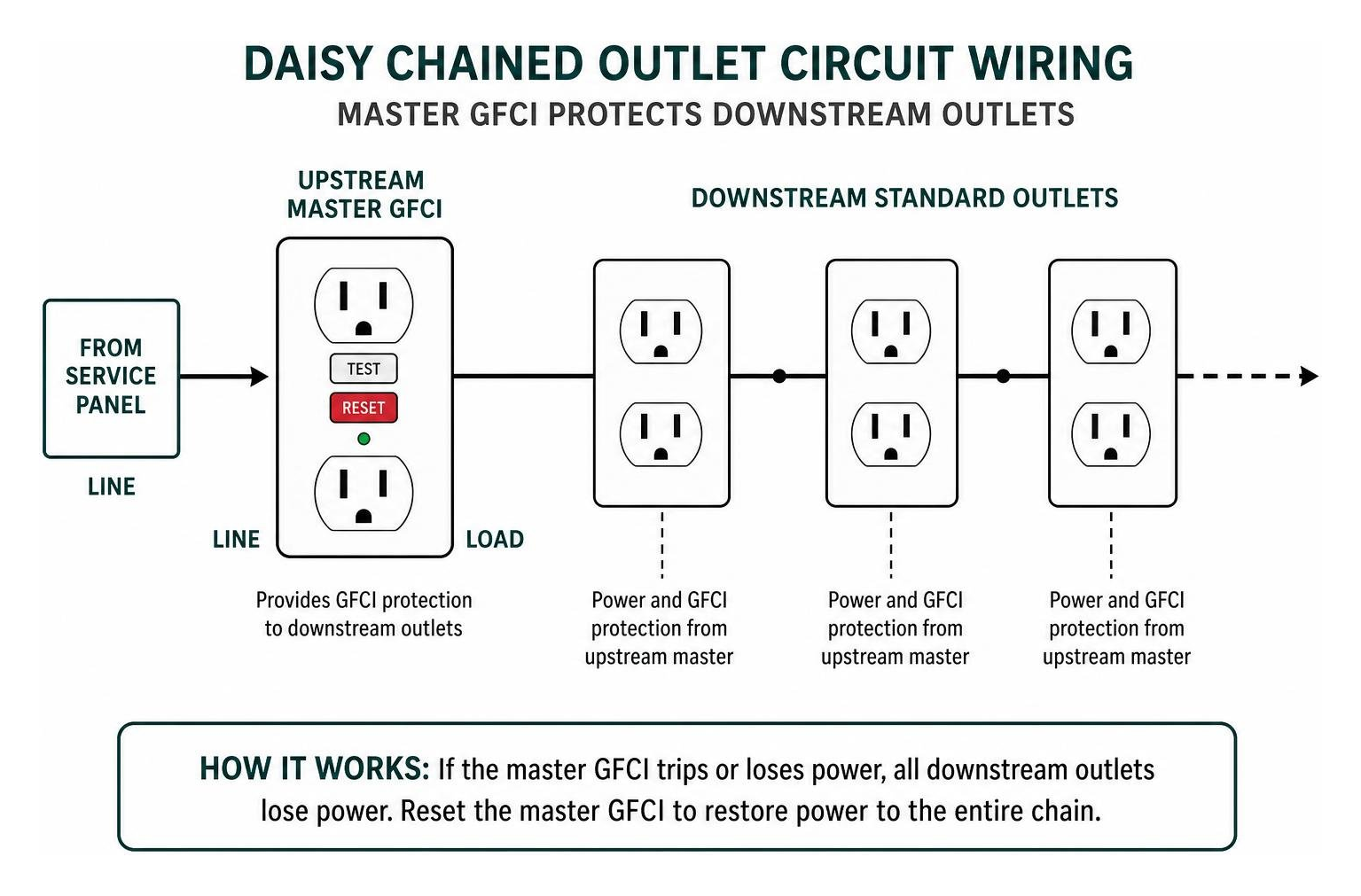
Common master-slave wiring configurations include:
- A GFCI in the garage protecting outdoor patio receptacles, soffit outlets, and exterior walkway lighting.
- A GFCI in an upstairs primary bathroom protecting the powder room receptacle on the main floor.
- A GFCI on a kitchen island protecting standard countertop receptacles along an adjacent wall.
- A GFCI in the basement mechanical room protecting crawlspace or sump pump utility outlets.
If a standard outlet stops delivering power, inspect all high-moisture zones—kitchens, bathrooms, garages, basements, and exterior walls—for a tripped master GFCI. Learning how to fix a gfci that keeps tripping starts by locating which master device governs that specific branch run.
Breaker Tripping vs. Receptacle Failure: Pinpointing the Root Cause
When power vanishes from a wall receptacle, identifying whether the failure originated at the main breaker panel, within the outlet itself, or along the internal branch wiring prevents unnecessary component replacements.

A common issue during troubleshooting is the “silent breaker trip.” When an overcurrent event occurs, the internal thermal-magnetic bar flips, disconnecting power, but mechanical friction inside older panels can keep the external plastic handle looking almost straight. Knowing how to tell if a breaker is bad involves checking for physical handle tension and using proper testing gear to verify busbar voltage.
Professional diagnostics usually separate outlet reset problems into three broad categories before any device is replaced:
| Symptom | Likely Source | Why It Matters |
|---|---|---|
| Breaker handle rests between ON and OFF | Tripped breaker or overloaded branch circuit | Restoring power without identifying the overload can lead to repeat trips and overheated wiring. |
| GFCI has power but will not latch | Faulty GFCI, downstream leakage, or line-load issue | The device may be intentionally refusing to energize an unsafe circuit. |
| Multiple rooms lose power at once | Upstream connection, AFCI/GFCI device, or branch wiring fault | A single failed splice or protected master device can disable several receptacles. |
Furthermore, homes built after 2008 in the USA are required to feature AFCI protection across living areas and bedrooms. AFCI breakers are engineered to detect dangerous electrical arcing – sparking behind baseboards, loose wire nuts, or cords pinched by heavy furniture. Reading a homeowners guide to arc fault protection helps differentiate between standard ground faults (moisture and shock risks) and arc faults (fire prevention triggers).
Why Outlets Fail to Reset After a Power Outage
Severe central Indiana weather, such as heavy spring storms and summer thunderheads, frequently causes neighborhood-wide electrical outages. When utility power abruptly snaps back on, thousands of homes experience instantaneous voltage spikes and severe inrush currents.
These sudden electrical rushes cause multiple sensitive protection devices to trip simultaneously:
- Dual-function AFCI/GFCI breakers may trip instantly to protect home electronics from transient line noise.
- Aging GFCI receptacles can experience internal surge damage, destroying the tiny silicon rectifiers inside their self-test circuits.
- Multiple high-draw appliances (refrigerators, HVAC compressors, sump pumps) attempting to start up simultaneously can immediately overload branch circuits, sending breakers directly into the tripped center position.
If your home’s outlets refuse to deliver power following a utility outage, never force breakers or buttons. Systematically cycle the panel breakers from full OFF to ON, disconnect heavy motor loads, and allow the system to stabilize.
Weather and Moisture-Related Outlet Reset Problems
Spring storms in areas like Franklin, Whiteland, and Beech Grove bring driving rains, high humidity, and damp crawlspaces. Water is an exceptional conductor of electricity, and even slight condensation inside an exterior receptacle box creates a conductive path between hot conductors and the grounded metal box.

Outdoor outlets are legally required to feature Weather-Resistant (WR) ratings and heavy-duty, gasket-sealed “while-in-use” bubble covers. When gaskets degrade, ultraviolet light cracks the plastic housing, or yard sprinklers spray directly into the box, moisture triggers the GFCI’s ground fault circuit immediately.
The outlet will refuse to reset until every drop of moisture evaporates and the conductive path is eliminated. If an outdoor or garage outlet trips every time it rains, replacing the assembly with a modern, sealed WR-rated GFCI enclosure is the only permanent, safe solution.
When to Replace a Damaged Receptacle and Call a Professional
While basic visual inspections and checking circuit breakers are straightforward, residential electrical systems carry 120 to 240 volts of lethal energy. Attempting invasive repairs or ignoring visible failure signs poses severe electrocution and structural fire hazards.
You should immediately stop resetting an outlet and call a licensed professional if you observe any of the following warning signs:
- Scorch Marks or Discoloration: Brown, yellow, or black burn marks on the receptacle faceplate indicate dangerous arcing and excessive terminal heat.
- Burning Plastic or Fishy Odors: A distinct, pungent odor near an electrical box indicates melting wire insulation or overheating structural polymers.
- Audible Buzzing, Sizzling, or Popping: Crackling noises point to loose backstab connections or loose terminal screws sparking inside the wall cavity.
- Instant Breaker Re-Tripping: If a circuit breaker snaps off with a loud pop the exact millisecond you flip it on—especially with nothing plugged in—a dead short circuit exists in the permanent wiring.
- Loose Blade Retention: If cords fall out of the wall on their own or feel loose when inserted, the internal brass contact fingers are worn out, creating high electrical resistance and fire hazards.
Upgrading aged or damaged electrical components protects your home’s value and ensures complete compliance with National Electrical Code (NEC) standards. When dealing with outdated wiring or worn-out branch devices, scheduling professional gfci and afci upgrades in indianapolis ensures your living spaces meet modern safety criteria.
If you suspect hidden wiring damage, open neutrals, or persistent faults, contact Grounded Solutions for comprehensive electrical repairs and safety inspections.
Smart Home Integration and Lighting Control Solutions
As homes throughout central Indiana modernize, electrical safety and convenience extend beyond standard wall receptacles. Modernizing your home’s electrical infrastructure often involves integrating intelligent energy management and lighting controls that offer superior safety and reliability over mechanical switches.
When planning an automated home upgrade, selecting the right hardware and certified installation team is critical. Grounded Solutions is Lutron Caséta and RadioRA 3 Certified, providing custom-tailored lighting automation, smart dimming, and whole-home power management.
When choosing a Lutron installer, homeowners should seek certified specialists who understand how low-voltage communication systems interface with existing residential branch circuits. Improperly configured smart switches or automated dimmers installed on shared-neutral circuits can cause severe nuisance tripping on AFCI and GFCI breakers.
By integrating certified smart switches, intelligent SPAN electrical panels, and advanced surge management, our team ensures that your lighting controls and branch receptacles operate in complete harmony—protecting sensitive electronics from weather events, grid surges, and power interruptions.
Frequently Asked Questions About Outlet Reset Failures
Why won’t my GFCI outlet reset if the breaker isn’t tripped?
A GFCI outlet requires active 120-volt incoming electricity from the service panel to energize its internal solenoid latch. If a breaker has suffered a “silent trip” (resting in the middle position without looking fully off), if an upstream wire connection has loosened, or if an open neutral exists along the circuit, no voltage reaches the receptacle. Without incoming power, the internal mechanical latch cannot catch, causing the reset button to feel loose and non-responsive. Additionally, if the device has reached the end of its 10-to-15-year operational lifespan, it enters permanent reset lockout mode.
How do professionals identify a downstream ground fault?
Licensed electricians diagnose downstream ground faults through a systematic process of circuit isolation:
- De-energizing the branch circuit at the main panel and verifying zero voltage using calibrated multimeters.
- Disconnecting the downstream circuit conductors from the LOAD terminals of the master GFCI receptacle.
- Re-energizing the isolated GFCI. If the device resets and holds power while disconnected from the LOAD line, the GFCI itself is fully functional.
- Testing downstream cables using insulation resistance testers (megohmeters) and inspecting each daisy-chained junction box to locate pinched wires, damaged insulation, water intrusion, or faulty secondary receptacles.
How much does it cost to fix or replace a faulty outlet?
The cost for professional electrical repairs depends on the complexity of the circuit and whether underlying wiring damage exists. In the United States, professional replacement of a single standard or GFCI receptacle typically ranges from $100 to $250, which covers professional diagnostic evaluation, code-compliant commercial-grade hardware, and labor.
If troubleshooting reveals deeper electrical problems—such as burnt conductors, damaged junction boxes, open neutrals inside wall cavities, or broken branch wiring—professional wiring repairs generally range from $150 to $500. Investing in professional electrical service ensures that installations are fully permitted, code-compliant, and covered by insurance, delivering lasting safety and value far beyond temporary quick fixes.
Conclusion
A malfunctioning electrical receptacle should never be treated as a minor inconvenience to be forced or ignored. When an outlet refuses to reset, its internal safety engineering is actively working to prevent electrical shocks, arc flash hazards, and structural house fires. Whether caused by sudden spring storms, moisture intrusion, overloaded branch circuits, or aging mechanical components, understanding how reset lockout operates empowers homeowners to make safe, informed decisions.
At Grounded Solutions, we take pride in serving our neighbors across the greater Indianapolis area, including Beech Grove, Franklin, Whiteland, Southport, and Mooresville. As a local, family-owned, licensed, bonded, and insured electrical contractor, our team is committed to delivering transparent pricing, impeccable workmanship, and long-term electrical safety for your home or business.
If you are dealing with persistent outlet reset problems, dead receptacles, or electrical panel complications, do not leave your home’s safety to chance. Contact the master electricians at Grounded Solutions today to schedule your comprehensive electrical inspection and repair service!