
Claim Commercial LED Lighting Rebates Before Your Upgrade
Commercial LED lighting rebates can reduce the upfront expense of qualified lighting upgrades. To improve your chance of approval, start by checking your electric utility’s current program before equipment is ordered or installed. Then choose eligible LED fixtures and controls, document the existing lighting, and keep itemized invoices and product specification sheets.
Many programs support interior and exterior upgrades, including high-bay fixtures, LED tubes, wall packs, parking-lot lighting, occupancy sensors, and daylight controls. Rebates may be set per fixture, per watt reduced, or by projected annual energy savings. Programs and funding limits change often, so early planning matters.
For Indianapolis-area businesses, a well-planned retrofit can lower lighting energy use while helping make the project easier to justify. Adding smart controls can also increase available incentives and ongoing savings.
I am Clay Hamilton, President of Grounded Solutions, with more than two decades of hands-on experience in electrical and mechanical systems, maintenance, and facility upgrades. I help commercial property owners understand practical electrical improvements, including how commercial LED lighting rebates can support a safer, more efficient lighting plan.
Commercial LED lighting rebates vocab to learn:
Understanding Commercial LED Lighting Rebates and Incentive Structures
Lighting can account for more than 40% of a commercial facility’s total electricity consumption. Outdated high-intensity discharge (HID) lamps, metal halides, and legacy fluorescent tubes run up monthly utility expenditures while generating excess heat that strains HVAC systems. In 2026, utility rebate programs have evolved to offer aggressive incentives to offset the upfront capital expenditure of retrofits, with the average rebate per LED product increasing by 17% over recent program cycles.
Utility providers structure these financial incentives around two core metrics: annualized kilowatt-hour (kWh) energy savings and total kilowatt (kW) peak demand reduction. By shrinking the electrical load of commercial facilities, utilities avoid grid congestion and delay the construction of expensive new generation infrastructure. For commercial facilities across Central Indiana, capturing these funds accelerates return on investment (ROI), often compressing payback periods from several years down to a matter of months.
Program funding is allocated annually through public utility commission filings and operates on strict budget cycles. Once a program year’s allocated funds are claimed, utilities may close applications or reduce incentive tiers until the next funding cycle. Navigating these incentives requires understanding the three primary rebate structures: prescriptive, custom, and midstream incentives.
To plan your project effectively, explore our energy-efficient lighting upgrades for insight on optimizing efficiency gains across commercial layouts.
| Rebate Type | Program Structure | Typical Incentive Basis | Pre-Approval Needed? | Processing Timeline | Project Cost Coverage |
|---|---|---|---|---|---|
| Prescriptive | Standardized, catalog-based per-unit incentives | Fixed dollar amount per fixture, lamp, or sensor | Only over set dollar thresholds (e.g., $10k–$20k) | 4 to 12 weeks | Up to 70%–100% of project cost |
| Custom | Calculated savings for non-standard facilities | $0.08 to $0.40 per annualized kWh saved | Always required before purchasing or installing | 3 to 9 months | Typically 20% to 50% (up to 70%) |
| Midstream | Instant discount at authorized point of sale | Point-of-purchase price markdown | Handled directly by qualified distributor | Immediate at invoice | Varies by component |
Prescriptive Commercial LED Lighting Rebates
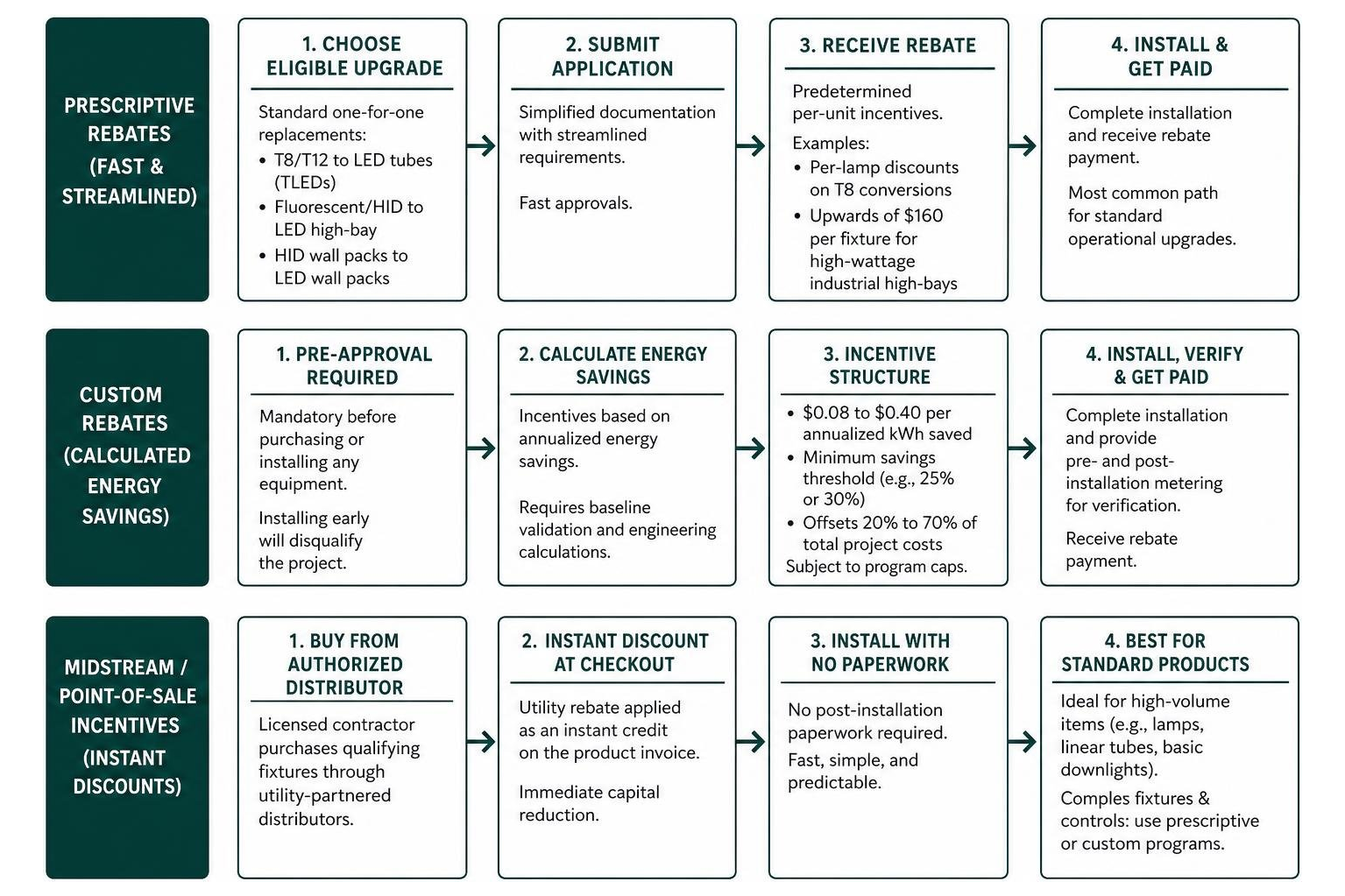
Prescriptive rebates are standardized, menu-driven incentives that provide a fixed dollar amount for each approved lighting measure replaced on a one-for-one basis. These programs are designed for straightforward retrofit projects where the energy savings can be reliably estimated based on pre-calculated utility formulas.
Typical prescriptive measures include:
- Upgrading low-wattage 4-foot and 8-foot fluorescent T8/T12 lamps to linear LED equivalents (TLEDs)
- Replacing interior fluorescent troffers and high-intensity discharge (HID) luminaires with LED high-bay luminaires
- Upgrading exterior building-mounted HID luminaires to efficient LED wall packs
Prescriptive programs offer streamlined documentation and predictable payouts. For example, local programs often provide predetermined per-unit incentives ranging from modest per-lamp discounts on T8 conversions to upwards of $160 per fixture for high-wattage industrial high-bay LED replacements. Prescriptive projects offer fast approvals, making them the most common avenue for facility managers seeking reliable funding for standard operational upgrades.
Custom Rebates and Calculated Energy Savings
When a facility’s lighting design falls outside standardized one-for-one replacement schedules, custom rebate programs provide tailored funding based on total calculated energy reductions. Custom programs are ideal for comprehensive architectural redesigns, manufacturing plants with non-standard operating shifts (such as 24/7 continuous operations), or projects that pair major fixture reductions with sophisticated network controls.
Under a custom framework, incentives are calculated directly against annualized energy savings:
- Incentive rates generally range from $0.08 to $0.40 per annualized kWh saved.
- Many custom programs require that the facility achieve a minimum energy savings threshold, such as a 25% or 30% reduction below the existing baseline.
- Custom incentives can offset 20% to 70% of total project costs, subject to utility-specific program caps.
Because custom incentives require extensive baseline validation, detailed engineering calculations, and rigorous pre- and post-installation metering, pre-approval is mandatory. Installing any equipment before receiving a formal grant agreement or reservation notice will immediately disqualify the project from receiving custom funds.
Midstream and Point-of-Sale Utility Incentives
Midstream incentives eliminate traditional post-installation paperwork by applying utility discounts directly at the point of sale. Under this framework, electrical distributors partner directly with utility administrators. When a licensed electrical contractor purchases qualifying commercial fixtures through an authorized distributor, the rebate is applied as an instant credit on the product invoice.
Midstream programs provide several distinct advantages:
- Instant capital reduction without waiting weeks for a check to arrive in the mail.
- Zero administrative paperwork friction for the facility manager.
- Predictable upfront fixture pricing that simplifies project budgeting.
While midstream incentives provide immediate relief, they are generally restricted to standard, high-volume products such as screw-in lamps, standard linear tubes, and basic downlights. Complex commercial high-bays, integrated controls, and specialized architectural luminaires usually yield higher financial returns when routed through formal prescriptive or custom utility filings.
Eligibility Criteria and Technical Standards for Facility Upgrades

Utility providers enforce strict eligibility requirements to ensure that ratepayer-funded programs deliver verifiable, long-term grid demand reductions. Failing to verify every technical detail before ordering luminaires can lead to full rebate denials. To ensure your facility’s electrical infrastructure is safely ready for modern solid-state luminaires, review our guide to commercial building wiring standards.
How to Qualify for Commercial LED Lighting Rebates
To claim utility rebates, commercial facilities must meet several foundational administrative and operational criteria:
- Active Commercial Account: The project site must be an active commercial, industrial, or institutional customer in good standing on a qualifying commercial rate schedule.
- Minimum Operating Hours: Most commercial programs mandate that the retrofitted space operates a minimum of 1,500 to 2,000 hours per year. Fixtures in rarely occupied storage closets may not qualify for prescriptive incentives.
- Minimum Wattage Reduction: The proposed LED system must typically achieve at least a 30% reduction in total fixture wattage compared to the baseline lighting system.
- Pre-Approval Thresholds: While smaller prescriptive projects may allow post-installation filing within 60 to 90 days, projects exceeding specific financial caps (often $10,000 to $20,000 in incentives) mandate formal utility pre-approval prior to product procurement.
DesignLights Consortium (DLC) and ENERGY STAR Compliance
The technical cornerstone of nearly all commercial lighting incentive programs across the United States is the DesignLights Consortium (DLC). The DLC is an independent non-profit organization that maintains rigorous energy efficiency, optical quality, and operational reliability standards for commercial solid-state lighting.
For a luminaire or retrofit kit to qualify for rebates, it must appear on the active DLC Qualified Products List (QPL):
- DLC Standard vs. DLC Premium: While DLC Standard qualification satisfies baseline program rules, many forward-thinking utility programs offer higher per-fixture incentives or boosted per-kWh rates for fixtures meeting DLC Premium efficacy and lumen maintenance metrics.
- ENERGY STAR Certification: For select light-commercial and downlighting categories, ENERGY STAR ratings serve as the required qualification standard.
- Electrical Standards: Qualifying products must carry UL or ETL safety listings, maintain a minimum power factor of 0.90, and feature a comprehensive manufacturer warranty of five years or greater.
Verifying the exact model number on the DLC database is essential. A single missing suffix letter denoting an internal driver revision or lens option can render a fixture technically unlisted in the eyes of a utility automated review system.
Eligible Equipment: Fixture Replacements vs. LED Retrofit Kits
Commercial lighting programs cover both complete new luminaire installations and engineered retrofit kits, provided the products meet strict safety and listing specifications:
- Complete Luminaire Replacements: Replacing the entire housing, optical assembly, and driver with a ground-up solid-state LED fixture delivers the highest efficacy, best thermal management, and longest operational life. Complete fixtures regularly secure the highest prescriptive rebate amounts.
- Engineered Retrofit Kits: When existing fixture housings are structurally sound or architecturally unique, UL-classified retrofit kits allow facility managers to replace internal sockets, reflectors, and ballasts with dedicated LED light engines and drivers without tearing out the ceiling grid.
- Linear LED Tubes (TLEDs): While plug-and-play Type A tubes (which operate on existing fluorescent ballasts) are occasionally supported, utilities strongly favor ballast-bypass Type B or remote-driver Type C TLED systems. Removing the aging fluorescent ballast eliminates parasitic power draw, lowers future maintenance, and ensures long-term electrical reliability.
Qualifying Lighting Controls and Smart Systems
Installing standalone LED luminaires cuts electrical load significantly, but integrating automated controls multiplies those savings. Modern utility rebate programs heavily subsidize intelligent controls, frequently offering dedicated per-sensor rebates or doubling the calculated per-kWh savings incentive.
Key qualifying control technologies include:
- Luminaire Level Lighting Controls (LLLC): Fixtures featuring integrated wireless sensors and controllers embedded directly into each luminaire during manufacturing. LLLC systems monitor occupancy, ambient daylight, and energy consumption right at the light source, qualifying for top-tier utility bonuses.
- Networked Lighting Controls (NLC): Centrally managed, addressable digital systems that allow facility managers to configure zones, set time-based schedules, implement high-end trim (tuning maximum output), and monitor facility data through digital dashboards.
- Daylight Harvesting and Bi-Level Controls: Continuous dimming systems that automatically throttle fixture output when natural sunlight enters through windows or skylights, as well as bi-level exterior motion controls that drop parking lot luminaires to low power during empty late-night hours.
When implementing advanced lighting automation and architectural control systems, working with a certified professional is critical. Rather than navigating complex wireless protocols and proprietary commission tools alone, facility owners should partner with certified specialists. Grounded Solutions is Lutron Caséta and RadioRA 3 Certified, ensuring your commercial control infrastructure is expertly engineered, cleanly zoned, and fully integrated for maximum rebate capture and operational reliability.
Step-by-Step Application Process and Timeline Management
Securing utility rebates requires systematic management from initial audit through final fund disbursement. A single procedural misstep, such as purchasing fixtures before pre-approval, can permanently invalidate tens of thousands of dollars in funding. Our team provides turn-key commercial electrical retrofit services that handle both the physical electrical installation and the precise documentation required by program administrators.
Energy Audits and Pre-Approval Requirements
A successful rebate strategy begins with a comprehensive baseline facility assessment. An energy audit documents every existing luminaire, lamp type, input wattage, ballast factor, operating schedule, and physical room dimension across the facility.
Once the replacement lighting design is finalized:
- Pre-Approval Submission: The project scope workbook, energy savings calculations, and proposed manufacturer specification sheets are submitted to the utility program portal.
- Pre-Inspection Protocol: For projects exceeding standard financial thresholds, the utility may dispatch an independent field inspector to verify existing lighting conditions and confirm baseline wattages.
- Fund Reservation Agreement: Upon approving the submission, the utility issues a formal reservation letter or grant agreement. This document locks in allocated rebate funding for a specified window, typically 90 to 120 days, giving our certified electrical team the green light to procure materials and safely execute the installation.
Required Documentation and Application Submission
To move your commercial lighting rebate from approved reservation to final check disbursement, compile a comprehensive documentation package:
- Completed Utility Measure Selection Form: Completed application forms detailing exact measure codes, room locations, and baseline-versus-new equipment schedules.
- Itemized Purchase Invoices: Clean, paid invoices clearly listing individual manufacturer model numbers, exact quantities purchased, unit pricing, labor charges, and payment verification.
- Manufacturer Cut Sheets: Official technical specification sheets for every installed luminaire, retrofit kit, and control sensor, highlighting DLC/ENERGY STAR certification IDs.
- IRS Form W-9: A signed, current W-9 form matching the exact corporate entity and tax ID listed on the utility billing account.
- Pre- and Post-Installation Photographs: Clear, high-resolution photos documenting the old lighting layout and the newly installed, fully operating LED fixtures and wall controls.
Avoiding Common Pitfalls That Delay Payouts
Rebate application delays and rejections stem almost entirely from preventable administrative errors. Facility managers can safeguard their capital by steering clear of these common pitfalls:
- Purchasing Equipment Prior to Pre-Approval: On custom or high-dollar prescriptive projects, placing purchase orders before receiving an official reservation notice is the number one cause of immediate program disqualification.
- Specifying Non-DLC Listed Equipment: Assuming a fixture is qualified because a supplier brochure claims it is “high-efficiency” is a costly mistake. If the exact, full model number string does not appear on the active DLC Qualified Products List, the utility will deny the claim.
- Mismatched Invoices and Model Numbers: Invoices that list generic descriptions (e.g., “LED High Bay 150W”) rather than the manufacturer’s exact part number will trigger immediate audit rejection.
- Inaccurate Operating Hours: Overstating annual operating hours to inflate calculated savings during custom reviews invites scrutiny. If utility field auditors discover mismatched facility operational schedules, entire applications can be revoked.
- Unlicensed Installation Work: Utility terms routinely require that commercial equipment be installed by licensed electrical contractors in compliance with the National Electrical Code (NEC) and local building standards. Unlicensed work risks safety, voids manufacturer warranties, and forfeits rebate payouts.
Stacking Incentives: Utility Rebates, 179D Tax Deductions, and Special Programs
Utility rebates are only one component of a comprehensive commercial recapitalization strategy. Savvy facility managers combine local utility rebates with federal energy tax incentives to dramatically offset total project costs.
Combining Utility Rebates with Federal 179D Tax Deductions
Under Section 179D of the Internal Revenue Code, expanded permanently under the Inflation Reduction Act, commercial building owners can claim substantial tax deductions for energy-efficient interior lighting retrofits:
- Deduction Thresholds: Depending on prevailing wage requirements and the percentage of energy reduction achieved beyond ASHRAE 90.1 baseline standards, the Section 179D deduction provides significant tax deductions per square foot of conditioned commercial space.
- Basis Adjustment Rules: When stacking incentives, the commercial building owner must adjust their tax depreciable basis. The cash rebate received from the utility is deducted from the total capital improvement cost before calculating the final 179D deduction.
- Coordination with Tax Professionals: Capturing Section 179D deductions requires a certified third-party energy modeling study and professional engineering sign-off. When planned in tandem with our certified installation team, facility managers maximize immediate utility cash-back while unlocking substantial federal tax relief.
Targeted Incentives for Small Businesses, Schools, and Multifamily Properties
In addition to standard commercial rebate schedules, many utility providers maintain specialized carve-outs designed to support specific community sectors:
- Small Business Direct Install (SBDI) Programs: Aimed at small commercial customers with peak demands under 100 kW or 200 kW. These programs often provide enhanced incentive rates, covering up to 80% to 100% of prescriptive retrofit costs, and frequently offer zero-interest on-bill financing options to eliminate capital hurdles.
- Educational Facility Grants: Public and private K-12 schools and university campuses frequently qualify for dedicated utility bonus pools, offering elevated per-fixture incentives to support educational infrastructure upgrades.
- Multifamily Common-Area Programs: Dedicated incentive tracks targeting common-area interior hallways, exterior breezeways, parking garages, and clubhouse lighting in multifamily residential developments, significantly lowering property management operating costs.
Frequently Asked Questions About Commercial Lighting Rebates
How long does it take to receive a rebate payout after installation?
For standard prescriptive rebate applications with complete documentation, processing and check disbursement typically take 4 to 12 weeks following final project approval.
Custom rebate projects, which require rigorous post-installation engineering reviews, data logging, or on-site measurement and verification (M&V) inspections, generally take between 3 and 9 months for final fund disbursement. Payouts are typically issued as a direct corporate check or applied as a credit on the facility’s active commercial electric utility account.
Can exterior and parking lot lighting qualify for rebates?
Yes. Commercial exterior lighting is heavily subsidized by utility rebate programs because outdoor fixtures operate continuously throughout the night, driving substantial kilowatt-hour consumption.
Eligible exterior lighting categories include:
- Exterior perimeter LED wall packs
- Pole-mounted parking lot and roadway luminaires
- Recessed parking canopy and parking garage fixtures
- Commercial dusk-to-dawn security floodlights
To qualify, exterior fixtures must meet DLC standards and feature built-in controls, such as photocells for dusk-to-dawn switching or bi-level occupancy sensors that step down fixture output during low-traffic overnight hours.
How do facility managers locate local utility rebate programs?
Facility managers can identify available lighting incentives through several established avenues:
- Utility Provider Portals: Check the commercial business solutions section of your local electric utility provider’s website.
- DSIRE Database: Consult the Database of State Incentives for Renewables & Efficiency, which tracks federal, state, and utility energy efficiency programs across the country.
- Grounded Solutions Energy Assessments: Partner directly with Grounded Solutions, as our team actively tracks local utility program rules, filing requirements, and funding cycles across Central Indiana to maximize your financial return.
Partner with Grounded Solutions for Commercial Lighting Upgrades
Maximizing commercial lighting incentives requires a balanced strategy: selecting DLC-qualified solid-state equipment, engineering intelligent automated controls, executing safe electrical retrofits, and managing utility paperwork to prevent funding loss.
At Grounded Solutions, we provide turn-key commercial electrical services across Central Indiana. We handle every phase of your project:
- Comprehensive on-site commercial lighting audits
- Precise baseline energy and demand reduction calculations
- Turn-key utility rebate pre-approval filing and documentation management
- Clean, code-compliant commercial installation by licensed, bonded, and insured electricians
- Expert commissioning of advanced lighting controls as a certified Lutron installer
Whether you operate a corporate office in Indianapolis, a logistics warehouse in Mooresville, or a commercial retail center in Greenwood, Beech Grove, Franklin, Whiteland, or Southport, our family-owned team delivers safe, high-quality, and cost-effective electrical solutions.
Contact Grounded Solutions today to schedule your comprehensive facility lighting assessment, capture your available utility rebates, and transform your commercial facility with our turn-key commercial LED lighting installation services.