
Smart Energy Saving Lighting Systems Slash Operating Costs
How an Energy Saving Lighting System Cuts Electricity Use
An energy saving lighting system uses efficient LED lights and controls that reduce light when it is not needed. For a home, start by replacing the bulbs you use most with LEDs. For a business, add occupancy sensors, schedules, or daylight controls where lights often stay on in empty or sunlit spaces. Choose the right brightness for each area so you save energy without making the space hard to use.
I’m Clay Hamilton, president of Grounded Solutions, with more than 20 years of hands-on experience in electrical and mechanical systems. That experience guides my approach to each energy saving lighting system, starting with safe wiring and a clear plan for how the space is used.
Simple energy saving lighting system glossary:
Core Technologies Powering Modern Energy-Efficient Lighting
Lighting accounts for roughly 15% of electricity consumption in an average home and nearly 21% of annual electrical operating costs in commercial buildings. In legacy architectures, traditional incandescent lamps wasted up to 90% of their consumed energy as heat, radiating thermal energy rather than producing visible illumination. Modern solid-state lighting changes this dynamic by moving away from delicate filaments and gas discharge tubes toward high-efficacy semiconductor diodes.
Solid-state lighting relies on advanced thermal dissipation structures, such as aluminum heat sinks, to channel heat away from the diode junction. This thermal management protects the phosphor coating, preserves color fidelity, and keeps luminaire efficacy high over decades of operation. In commercial environments, upgrading from older magnetic ballasts (which often consumed 15% of total lamp wattage just to regulate current) to solid-state drivers or high-frequency electronic ballasts eliminates substantial parasitic power losses.
| Lighting Technology | Typical Lifespan (Hours) | Typical Wattage (800 Lumens) | Heat Generation Ratio | Estimated Annual Household Savings |
|---|---|---|---|---|
| Incandescent | 1,000 | 60W | 90% Heat, 10% Light | Baseline ($0) |
| Compact Fluorescent (CFL) | 8,000 – 10,000 | 13W – 15W | 30% Heat, 70% Light | ~$150 / year |
| Solid-State LED | 25,000 – 50,000+ | 8W – 10W | 10% Heat, 90% Light | ~$225 / year |
LED vs. Legacy Lighting: Efficiency, Lifespan, and Operating Cost
The difference between solid-state luminaires and legacy fixtures centers on lumen maintenance and operating longevity. Unlike incandescent or halogen bulbs that fail abruptly, quality LEDs follow an L70 rating standard. This metric defines the point at which the fixture still delivers 70% of its initial light output, which typically occurs after 25,000 to 50,000 operating hours.
For commercial and warehouse spaces in central Indiana communities such as Whiteland and Franklin, replacing fluorescent with led fixtures immediately cuts circuit load in half while eliminating the hum and flicker of aging components. Residential properties experience similar benefits when property owners replace halogen with led lamps in high-use areas like kitchens and living rooms. Because these upgrades reduce running wattage by up to 90% compared to incandescents and 50% compared to CFLs, property owners can reliably save money on electricity bill cycles year after year.
Lumens, Kelvin, and Fixture Design for Maximum Luminaire Output
Designing an efficient installation requires matching the right lumen output with appropriate color temperatures measured on the Kelvin scale. Warmer color profiles (2700K to 3000K) create comfortable living areas, while neutral to cool white profiles (3500K to 5000K) enhance visual acuity across office workstations, production floors, and task areas.
Optimized fixture design pairs these color profiles with precision optical reflectors to direct light exactly where occupants need it. Rather than flooding an entire room with high-wattage ambient overheads, focused architectural elements like dedicated undercabinet lights illuminate countertops and workbenches with minimal power draw. Pairing these low-voltage fixtures with the best led dimmer switch no buzz ensures smooth, silent dimming while preventing electromagnetic interference on residential circuits.
Advanced Controls in an Energy Saving Lighting System
High-efficiency fixtures provide baseline savings, but intelligent controls multiply those efficiency gains. Independent field studies on the Energy Savings Potential of Networked Lighting Control show that pairing solid-state fixtures with networked sensors reduces lighting energy consumption by up to 75% to 85% compared to manual, non-dimmed legacy setups.
Daylight Harvesting and Occupancy Sensing Strategies
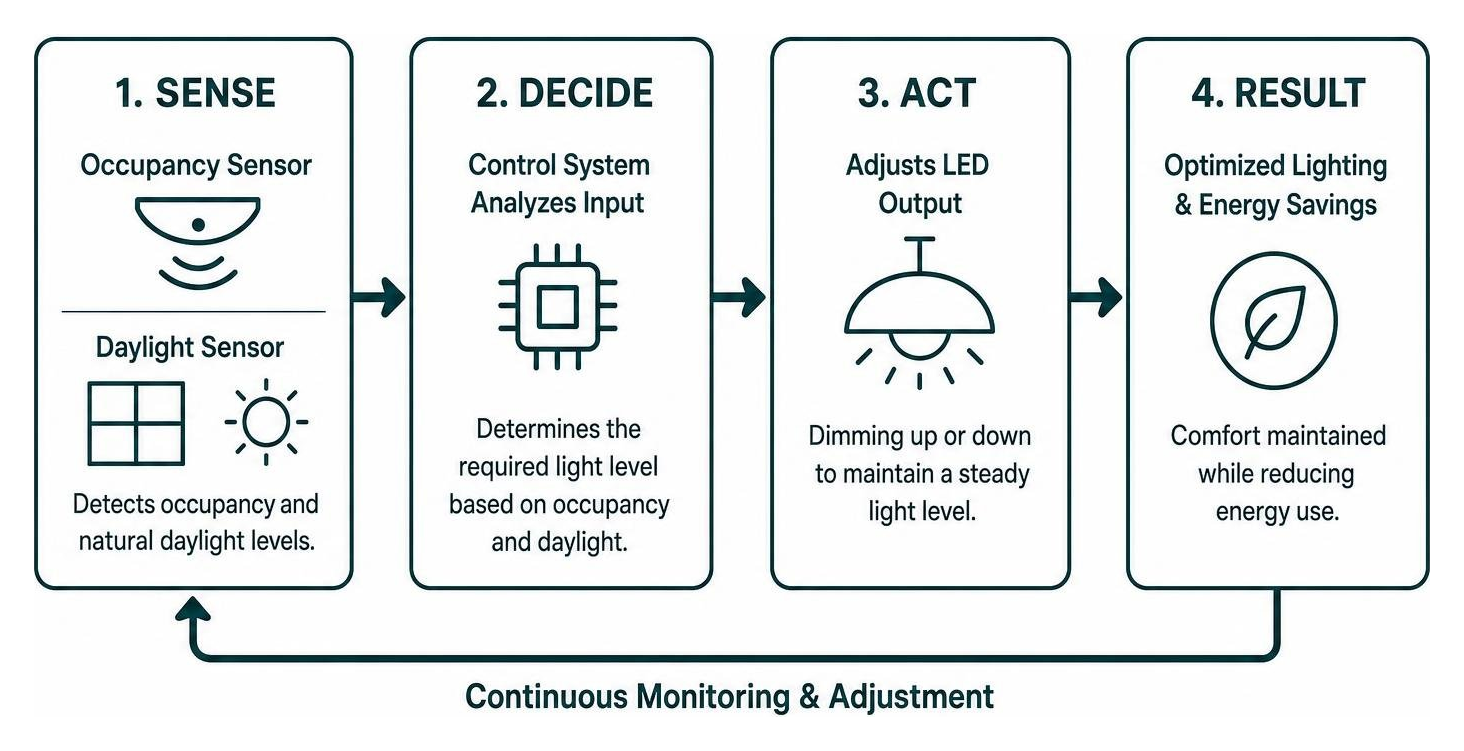
Automated control strategies rely on precision sensors to adjust artificial light output in real time based on natural conditions and room occupancy:
- Daylight Harvesting Systems (DHS): Continuous photocell calibration detects incoming sunlight through windows and skylights, dimming electric luminaires to maintain a steady light level. This strategy yields direct energy savings of 20% to 60%.
- Passive Infrared (PIR) and Ultrasonic Sensing: PIR sensors detect moving heat signatures while ultrasonic units monitor acoustic wave shifts to identify subtle hand movements.
- Real Occupancy Control Strategy (ROCS): Rather than relying on rigid time clocks, real-time presence detection reduces lighting energy by 20% to 50% by turning off or dimming zones as soon as occupants leave.
- Vacancy Modes and Dwell-Time Optimization: Requiring manual turn-on alongside automated shutoff prevents accidental activation, while programmed dwell times ensure spaces like restrooms and conference halls stay lit only while in active use.
High-End Trim Tuning, Task Lighting, and Demand Response
Many facilities over-illuminate their interior spaces by 20% to 30% right out of the box. High-end trim tuning, also known as institutional tuning, sets maximum output ceilings at 70% to 80% of rated luminaire capacity. Because the human eye adapts quickly to subtle differences in light intensity, occupants enjoy full visual comfort while the facility trims 10% to 30% from its lighting load.
Combining tuned ambient fixtures with targeted task lighting allows occupants to illuminate specific work zones on demand, unlocking up to 50% savings over uniform overhead lighting. For large commercial facilities, connecting these controls to automated demand response programs allows the system to shed non-critical lighting loads by 10% to 40% during peak grid events. Homeowners can track similar load profiles using a modern power usage monitor installed directly inside the main breaker panel, or pair automated lighting with a smart electrical panel to optimize circuits during storm outages.
Architectural Integration: Smart Controls and Building Management Systems
Modern lighting architectures eliminate the need for complex, rigid conduit runs by adopting distributed intelligence. In a distributed layout, each luminaire or control pack operates its own microprocessor, creating a resilient local mesh. This design ensures that if one component goes offline, the rest of the facility maintains full operational control without a single point of failure.
Smart Home Automation and Lutron Certified Controls
In residential settings and executive suites across Greenwood, Southport, and Franklin, smart home automation elevates energy efficiency and safety. Grounded Solutions is Caséta and RadioRA 3 Certified, delivering professional Lutron lighting system installations that blend architectural beauty with intelligent energy reduction. Lutron automated dimmers, daylight sensors, and scheduled scenes ensure your home uses only the electricity it needs while enhancing security during Central Indiana storm seasons.
Designing an Energy Saving Lighting System for Commercial and Industrial Facilities
Commercial environments require robust infrastructure to handle diverse operating profiles. In high bay warehouses, retail complexes, and municipal spaces across southern Marion County and Johnson County, Grounded Solutions designs tailored commercial power systems using commercial electrical services from retrofits to retail standards.
We help facility managers establish clear zone partitioning, grouping perimeter fixtures, interior task areas, and emergency pathways into distinct logical circuits. Whether planning a custom lighting design for an executive suite in Greenwood or managing white box construction electric buildouts in Mooresville, professional zoning delivers balanced light levels while preventing wasted energy across vacant square footage.
IoT Protocols, BACnet Integration, and Plug-Load Management
In modern facilities, lighting systems connect directly with broad building automation frameworks:
- Open Communication Protocols: Systems built on DALI-2 and analog 0-10V architectures provide granular, fixture-level addressing and smooth dimming curves.
- BACnet and BMS Interoperability: Lighting gateways communicate with central Building Management Systems over BACnet/IP, sharing occupancy data to adjust ventilation and cooling setpoints automatically.
- Automated Motorized Shading: Coordinating electric light dimming with automated window blinds balances daylight harvesting while lowering solar heat gain and HVAC cooling loads by 10% to 20%.
- Controlled Plug Loads: Extending occupancy controls to dedicated wall receptacles shuts down monitors, task lamps, and printers when rooms are empty, trimming plug-load energy use by 15% to 50%.
Planning and Upgrading to an Energy Saving Lighting System
A successful lighting upgrade starts with a comprehensive facility audit. Our licensed electricians establish your baseline wattage, calculate existing lighting power density, inspect branch circuit wiring, and identify over-illuminated spaces. Detailed audit reports help ensure your project complies with guidance on Improving Energy Efficiency across both small residential circuits and complex commercial footprints.
Navigating ENERGY STAR, DLC Standards, and Building Energy Codes
To qualify for utility incentives and satisfy regional energy codes, hardware selections must meet strict performance benchmarks. Residential products should carry ENERGY STAR certification, while commercial and industrial luminaires require listing on the DesignLights Consortium (DLC) Qualified Products List.
These certifications ensure compliance with ASHRAE 90.1, the International Energy Conservation Code (IECC), and Title 24 efficiency standards. When facility managers plan capital retrofits, selecting DLC-listed components is the primary step toward maximizing commercial led lighting rebates a facility managers strategy to offset project costs and accelerate capital recovery.
Overcoming Retrofit Challenges, Ballast Compatibility, and ROI Payback
A common challenge during commercial conversions is determining how to handle legacy fluorescent ballasts. Plug-and-play Type A LED tubes work with existing ballasts, but aging electronic or magnetic ballasts still introduce parasitic power loss and remain prone to failure.
Our team often recommends Type B ballast-bypass installations. Our electricians remove the legacy ballast entirely, wire the line voltage directly to non-shunted lampholders, and eliminate internal failure points. If your existing electrical service is near capacity or challenged by spring weather events, Grounded Solutions can install intelligent SPAN panels or upgrade electrical panel equipment to provide total circuit control and surge resilience. By streamlining hardware and bypassing older components, we help property owners achieve making the fluorescent to led conversion the easy way with minimal business disruption.
Frequently Asked Questions About Energy-Efficient Lighting Systems
What is the typical payback period for upgrading to an energy-saving lighting setup?
Most commercial and industrial LED retrofits achieve complete payback within one to three years, depending on daily operating hours and local utility rates. When facilities combine solid-state fixtures with networked occupancy controls and utility rebates, the reduction in kilowatt-hour consumption and maintenance costs offsets upfront capital expenses quickly. Residential bulb and fixture upgrades often show positive returns in less than 12 months.
How does daylight harvesting differ from continuous dimming controls?
Continuous dimming refers to the physical ability of an LED driver to adjust its light output smoothly from 100% down to 1% or 0% without step-flicker. Daylight harvesting is the automated control strategy that uses continuous dimming alongside closed-loop photosensors. The sensors read ambient daylight levels through windows and adjust the electric luminaire output up or down to keep total room brightness balanced throughout the day.
Can smart lighting controls integrate directly with existing HVAC and BMS networks?
Yes. Commercial smart lighting gateways communicate directly with Building Management Systems (BMS) through open protocols like BACnet/IP. This interoperability allows the BMS to use real-time occupancy data from lighting sensors to adjust HVAC temperature setpoints and fresh-air dampers in vacant zones, reducing total facility operating costs.
Conclusion
Upgrading to an intelligent energy saving lighting system reduces operating expenses, enhances workplace visual comfort, and lowers long-term maintenance costs. Whether you are retrofitting a high bay warehouse in Beech Grove, outfitting an office in Southport, or upgrading your family home in Whiteland or Franklin, Grounded Solutions delivers expert design and clean, safe installation.
As a local, family-owned electrical contractor, we provide transparent pricing and reliable service across central Indiana. Contact our licensed electricians today to schedule your lighting audit and explore our professional LED lighting services to start lowering your operating costs.