
Start Electrical Repairs With Safety and Clear Diagnosis
For safe Electrical Repairs, start by identifying the symptom, not by taking anything apart. Note which outlets, lights, or appliances lost power; check for a tripped breaker or GFCI outlet; and stop using any device or circuit that feels warm, smells burnt, buzzes, sparks, or flickers. Repeated breaker trips, dead outlets, loose plugs, and damaged wiring need professional diagnosis rather than a quick workaround. When handling complex power delivery networks, safety must always come first to prevent severe shock, arc flash incidents, or catastrophic structural fires.
Many power problems come from overloaded circuits or worn devices. A 15-amp circuit should generally stay at or below 1,440 watts of continuous load, while a 20-amp circuit should stay at or below 1,920 watts. Knowing these limits helps Indianapolis-area homeowners and businesses recognize when an issue may be a load problem versus a wiring or panel concern. When severe weather hits Central Indiana, these load constraints become even more critical as sump pumps, refrigeration systems, and HVAC equipment run simultaneously against volatile grid conditions. During turbulent Spring storms, lightning strikes, line surges, and sudden grid dropouts place immense electrical stress on residential infrastructure, frequently turning minor latent wiring faults into immediate hazards.
I’m Clay Hamilton, President of Grounded Solutions, with more than 20 years of hands-on experience in electrical and mechanical wiring, maintenance, and Electrical Repairs. This guide explains what to watch for and when to bring in qualified help for properties in Indianapolis, Beech Grove, Franklin, Whiteland, Southport, Mooresville, Greenwood, and nearby communities across Marion County and Johnson County. Our certified team delivers uncompromising artistry and modern smart management systems to keep your home protected in every season.
Essential Home Electrical Repairs: Troubleshooting Common Power Problems
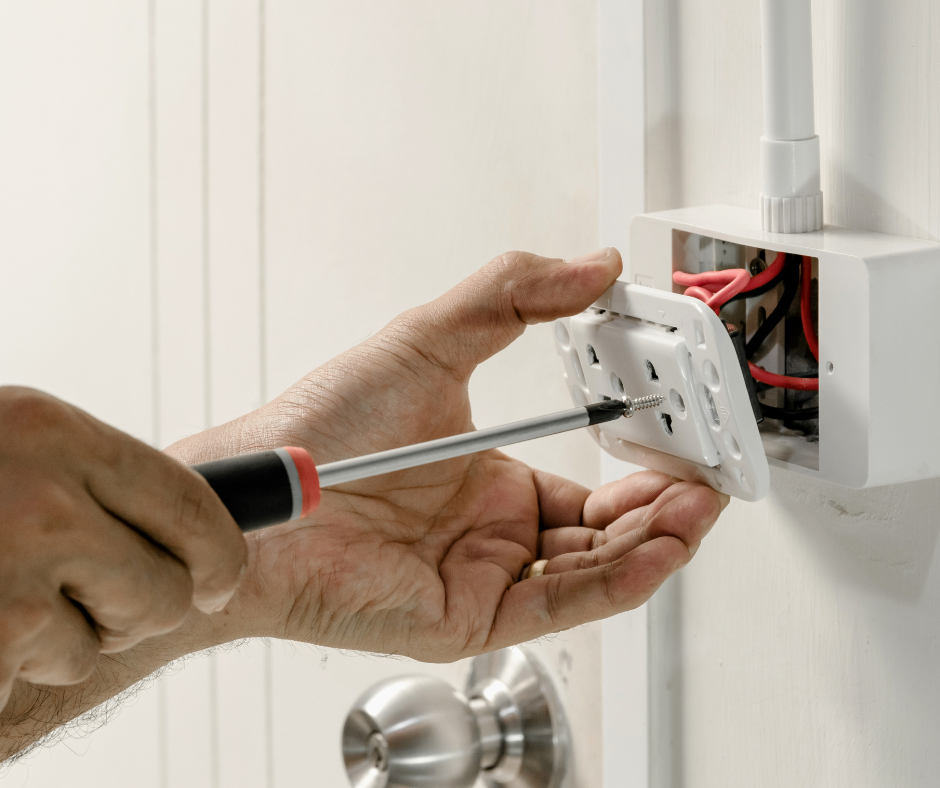
Understanding your electrical system begins with learning how power flows from the utility connection at the meter base into your distribution panel and across individual branch lines. When a sudden issue leaves a room in the dark or shuts down appliances across Central Indiana, finding the root cause requires a systematic approach. Residential electrical systems rely on continuous loops of alternating current regulated by overcurrent protective devices, grounding electrodes, and bonding jumpers designed to carry fault currents safely to earth.
Severe weather often acts as a catalyst for hidden electrical weaknesses. During intense Spring storms in Johnson County and Marion County, moisture, rapid voltage fluctuations, and high winds putting pressure on outdoor overhead drops expose vulnerabilities in home distribution systems. Saturated soil can compromise buried service laterals, while driving rain easily infiltrates unsealed weatherheads or aging meter enclosures, causing sudden line-to-ground faults. Tree branches whipping against overhead service drops create physical strain that loosens service entrance conductors, leading to dangerous open-neutral situations. Knowing how to assess these components safely prevents accidental damage and ensures hazards are corrected quickly by qualified technicians.
Diagnosing Dead Outlets and Malfunctioning Wall Switches
When a light switch fails to respond or a plug no longer supplies power, the underlying failure usually stems from mechanical fatigue, thermal stress, or an upstream trip. Receptacles contain brass contact blades that loosen over years of use. If a plug slips out of a wall socket with little resistance, internal contact points have relaxed. This loose fit creates high electrical resistance, generating heat behind the drywall every time an appliance runs.
Another common point of failure is “backstabbed” push-in wire terminals located on the rear of inexpensive builder-grade outlets. Over seasonal temperature swings, standard copper conductors expand and contract, loosening spring-clip connections. When you discover a dead wall receptacle, the break in current may originate from an entirely different box located upstream on the same branch circuit. If the terminal screw or push-in connector on that upstream device develops micro-arcing, all downstream receptacles lose voltage despite showing no visible damage themselves.
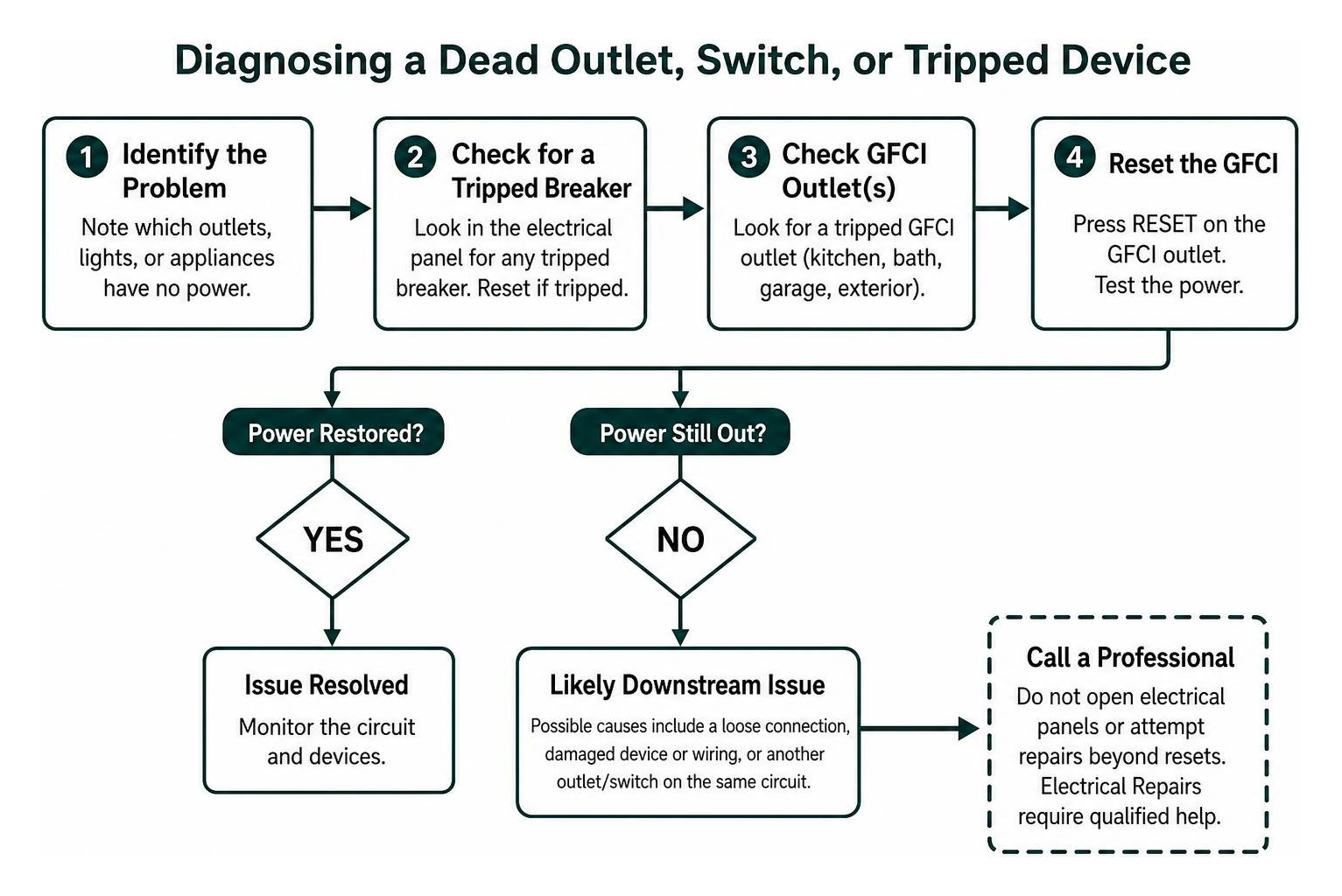
In areas exposed to dampness or moisture, such as kitchens, bathrooms, garages, basements, and exterior patios, ground-fault circuit interrupters monitor current balance between the ungrounded (hot) and grounded (neutral) conductors. A ground fault differential as tiny as 4 to 6 milliamperes causes the internal sensing coil to trigger a mechanical solenoid, interrupting power in less than one-fortieth of a second. Knowing how to reset a GFCI outlet in seconds lets you distinguish between a temporary nuisance event and an underlying hardware breakdown.
Recognizing Electrical Issues vs. Calling Pros for Electrical Repairs
While diagnosing symptoms is valuable, hands-on structural interventions demand rigorous adherence to local codes and safety standards. Operating inside live distribution panels, running concealed cables, or servicing main disconnects introduces severe arc flash hazards and electrocution risks. High-amperage utility feeds entering residential service equipment carry massive available fault currents capable of vaporizing metal components instantly during an accidental short circuit.
Working with a licensed, bonded, and insured electrician ensures every repair adheres to National Electrical Code mandates and local municipality guidelines throughout Southport, Mooresville, Beech Grove, and Franklin. Qualified technicians verify box cubic-inch volume ratings, calculate thermal dissipation limits, match correct wire gauges to overcurrent devices, ensure proper equipment grounding conductors, and secure necessary building permits from local inspection authorities.
If simple resets fail and you find yourself constantly troubleshooting a GFCI that keeps tripping, downstream degradation, ground faults within walls, or moisture intrusion into weather-resistant (WR) exterior boxes may be the true culprits. Exterior outlets require code-compliant in-use “while-in-use” bubble covers to prevent wind-driven rain from bypassing rubber gaskets during spring downpours. Rather than taking chances with ungrounded infrastructure, professional assessment by Grounded Solutions restores complete system reliability safely.
Modern automated controls also demand specialized handling. Homeowners upgrading lighting controls should select a Lutron installer with verified technical training rather than standard handymen. As a Caséta and RadioRA 3 Certified contractor, Grounded Solutions designs and integrates smart switches, dimmers, and energy management platforms to balance modern comfort with electrical load protection. Our technicians program adaptive phase dimming, verify neutral connection requirements, and ensure smart components integrate seamlessly with whole-home surge suppression to protect sensitive microprocessor equipment from weather-induced voltage transients.
Managing Circuit Loads and Restoring Power Safely
Electrical distribution systems operate on strict mathematical limits determined by wire gauge and overcurrent protection ratings. Exceeding continuous design limits causes circuit breakers to heat up and trip.
| Circuit Rating | Maximum Total Wattage | 80% Continuous Limit (NEC Standard) | Common Dedicated & Branch Applications |
|---|---|---|---|
| 15-Amp Circuit (14 AWG Wire) | 1,800 Watts | 1,440 Watts | General bedroom lighting, living room receptacles, basic electronics |
| 20-Amp Circuit (12 AWG Wire) | 2,400 Watts | 1,920 Watts | Kitchen countertop small appliances, bathroom receptacles, garage utility |
| 30-Amp Circuit (10 AWG Wire) | 3,600 Watts | 2,880 Watts | Electric water heaters, central air handler blowers, clothes dryers |
| 50-Amp Circuit (6 AWG Wire) | 12,000 Watts (at 240V) | 9,600 Watts | Level 2 electric vehicle chargers, modern electric ranges |
Calculating Continuous Load Limits on 15-Amp and 20-Amp Lines
The National Electrical Code defines a continuous load as any draw running continuously for three hours or longer. Under standard safety provisions, circuits should never be loaded beyond 80 percent of their maximum rated capacity for continuous operation. This safety margin prevents thermal fatigue on breaker bi-metallic strips and avoids conductor insulation breakdown over decades of use.
A 15-amp branch line operating at 120 volts delivers a nominal ceiling of 1,800 watts (15A × 120V = 1,800W). Applying the 80 percent continuous threshold reduces this operational limit to 1,440 watts. A 20-amp branch line wired with 12 AWG copper delivers 2,400 watts total capacity, translating to a continuous ceiling of 1,920 watts. When high-wattage resistive devices like space heaters, hair dryers, or countertop toaster ovens run simultaneously with baseline electronics, total amperage quickly surpasses breaker thresholds.
When large motorized appliances power on, inductive startup draws spike significantly above baseline operational current. For example, a refrigerator or compressor can pull up to 15 amps during startup before settling into an operational draw of roughly 4 amps. If a compressor shares a branch line with portable space heaters or entertainment hubs, this startup surge trips the overcurrent mechanism.
Tracking usage with an in-panel energy monitor helps prevent unexpected overloads. If an inductive load such as a mini fridge motor startup surge regularly cuts power to an entire line, our team can install a dedicated circuit to protect sensitive electronics elsewhere in the home. Dedicated circuits isolate heavy inductive loads directly to the main bus bar, preventing nuisance tripping across sensitive branch lines.
Step-by-Step Power Restoration After a Breaker Trip or Blackout
When severe seasonal thunderstorms hit Central Indiana, power outages and branch circuit trips become frequent. Restoring power requires methodical isolation of branch circuits to prevent dangerous surges into sensitive home electronics.
When restoring power after a sudden outage, begin by unplugging sensitive electronics and heavy appliances to avoid simultaneous inrush currents when utility voltage returns. Locate your service panel, open the panel door, and identify which breaker handle has shifted away from the fully closed position. Standard residential circuit breakers trip into a center resting position between ON and OFF rather than snapping completely off. To reset the device, push the handle firmly toward the extreme OFF position until an audible click confirms internal spring engagement, then push the handle smoothly to the ON position.
If an individual switch handle feels loose, fails to latch firmly into the ON position, displays scorching along its mounting clip, or trips instantly with no downstream loads attached, you need to understand how to tell if a breaker is bad. Internal bi-metallic strips and magnetic trip coils degrade after repeatedly interrupting heavy fault currents.
During extended power interruptions, having an organized emergency blackout kit is essential. Keep heavy-duty LED flashlights, fresh battery supplies, non-contact voltage testers, spare multi-meter leads, and a clearly labeled directory of your electrical panel easily accessible near your utility area.
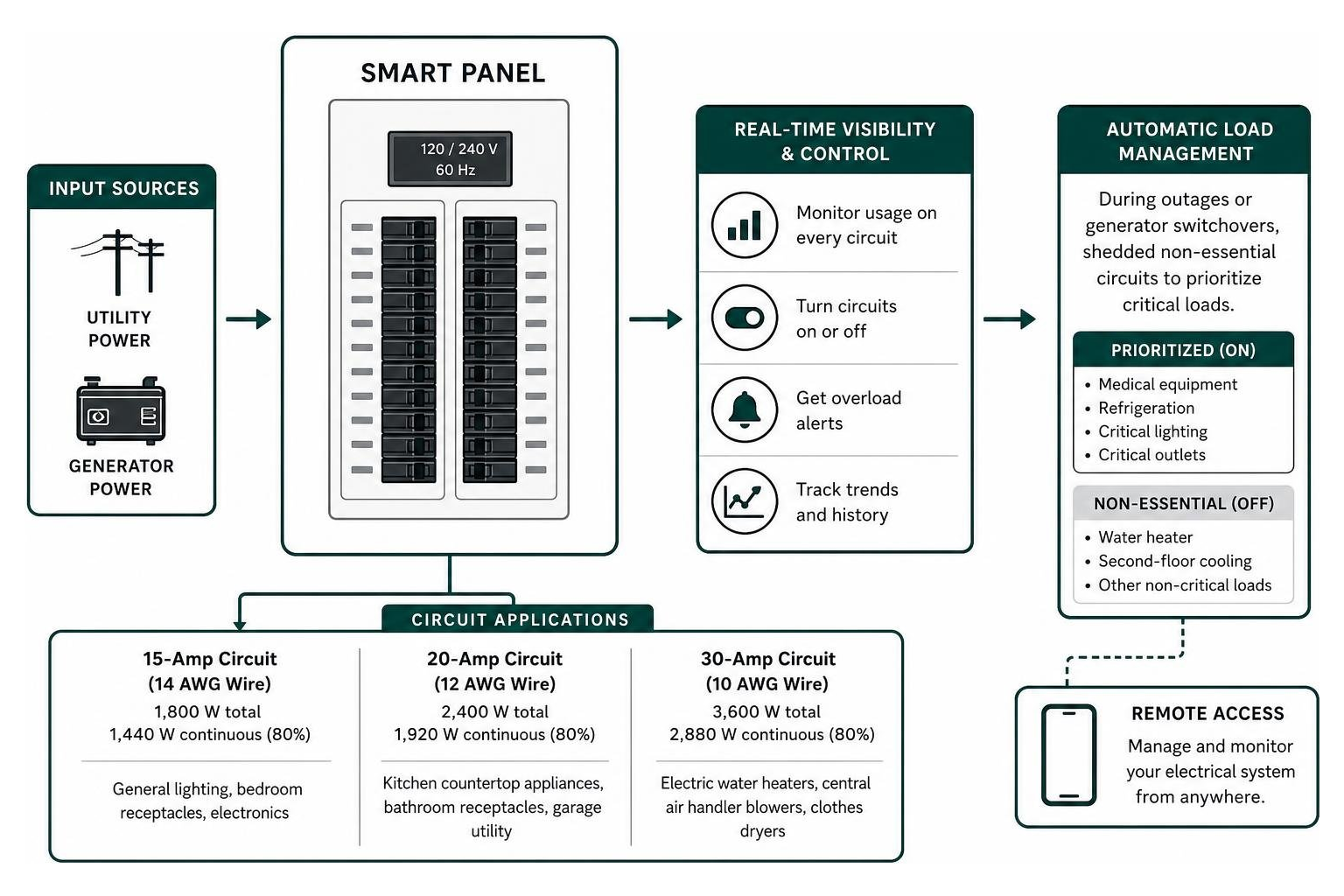
To protect your home against recurring utility interruptions, modern intelligent systems like SPAN smart electrical panels provide advanced load management. SPAN panels give homeowners real-time digital monitoring and granular control over every branch circuit directly from a mobile dashboard. During grid drops or generator switchovers, a smart panel automatically sheds non-essential zones, like water heaters or second-floor cooling, to keep critical circuits, medical equipment, and refrigeration running seamlessly. Pairing a smart panel with Type 1 and Type 2 whole-home surge protective devices (SPDs) safeguards modern microprocessor-driven appliances from lightning-induced voltage spikes during spring storm seasons, establishing unmatched electrical reliability and safety for your entire residence.
Identifying Dangerous Outdated Wiring and Emergency Electrical Hazards
Historic and mid-century properties in Indianapolis, Franklin, Whiteland, and surrounding areas often contain original wiring materials never designed to carry modern electrical demands. Over decades of service, legacy insulation materials dry out, crumble, and leave energized copper conductors exposed within walls and ceiling cavities. Environmental factors such as basement humidity, attic heat cycles, and pest activity accelerate the deterioration of these vintage systems, making proactive inspection and remediation essential for home preservation.
Signs You Need Professional Electrical Repairs for Outdated Wiring
Homes built prior to the 1940s frequently contain knob-and-tube wiring. This ungrounded system routes individual hot and neutral conductors through porcelain tubes inserted into wooden framing studs, suspended across open spans on ceramic knobs. When modern thermal insulation is blown into attics or walls around knob-and-tube runs, conductors can no longer dissipate heat into open air, creating a severe fire hazard. Knob-and-tube wiring also lacks an equipment grounding conductor, leaving modern three-prong devices unprotected against fault currents.
Mid-century structures built between the mid-1960s and mid-1970s often feature solid aluminum branch wiring. Aluminum expands and contracts at significantly higher rates than copper when carrying current due to its higher coefficient of thermal expansion. This constant thermal movement loosens screw connections, leading to wire oxidation and localized arcing behind standard switch and receptacle plates. Aluminum oxide creates significant electrical resistance, causing connections to glow red-hot under standard appliance loads.
Recognizing how bad wiring can cause a fire is vital for safeguarding your property. Integrating dual-function Arc Fault Circuit Interrupter (AFCI) and GFCI breakers detects microscopic sparking along aged wiring harnesses before building materials can ignite. If legacy branch runs show severe thermal cracking or lack equipment grounding conductors, scheduling a comprehensive whole home electrical rewiring replaces vulnerable lines with modern, grounded Romex cabling, establishing safe power delivery throughout your household.
Recognizing Critical Electrical Emergencies and Choosing a Contractor
Certain electrical symptoms represent acute hazards that require immediate disconnection and prompt emergency response:
- Persistent, acrid burning odors resembling melting plastic or fish near switches, fixtures, or distribution enclosures.
- Continuous buzzing, humming, or visible sparking originating from the main panelboard or meter base.
- Wall switch cover plates or outlet faces that feel hot to the touch or display brown scorch marks.
- Flickering or dimming lights throughout an entire property during heavy wind gusts, pointing to a compromised neutral or loose overhead drop.
- Tingling sensations or minor shocks felt when touching metal appliance chassis or plumbing fixtures.
- Rodent damage, frayed sheathing, or exposed conductors in attic spaces, crawlspaces, or unfinished basements.
When these warning signs appear, cut power to the affected area at the main disconnect switch and arrange fast emergency electrical services right away. Addressing structural panel overloads or outdated service drops by deciding to upgrade your electrical panel to a modern 200-amp distribution system gives your property the clean, uninterrupted capacity needed for EV charging, heat pumps, and home automation. Entrusting these critical upgrades to Grounded Solutions ensures complete compliance with the latest safety standards.
Frequently Asked Questions About Residential Power Issues
How do I know if an outlet or switch requires replacement?
An outlet or switch needs replacement if plugs fit loosely, faceplates feel warm, you hear buzzing or crackling when toggling switches, or you notice scorch marks. Internal mechanical components experience physical wear over time. If a switch fails to toggle cleanly with an audible snap or lights flicker intermittently when an outlet is nudged, internal contacts have worn down and must be replaced. Loose contacts generate localized resistance and high thermal stress, which can melt internal casing materials. Modern tamper-resistant (TR) and weather-resistant (WR) receptacles ensure code compliance and protect against foreign object insertion and outdoor environmental moisture. Grounded Solutions replaces compromised devices with heavy-duty commercial-grade hardware for enduring reliability.
What should I do when a circuit breaker continues to trip repeatedly?
If a breaker trips repeatedly, immediately unplug all connected appliances, lamps, and electronics from that branch line. Reset the breaker fully to the OFF position and then push it back to the ON position. If it trips again immediately with zero load attached, the issue is likely a direct short circuit, ground fault, or failing breaker mechanism requiring professional diagnostics. If it stays on, reconnect your devices one at a time to identify an appliance overload or motor failure. Never force a breaker handle to stay in the ON position or replace an existing breaker with a higher-amperage unit without verifying conductor gauge, as doing so removes critical thermal overload protection and introduces severe fire hazards.
How do I safely restore power after a localized breaker trip?
To safely restore power after a localized trip, first turn off the switches and unplug high-draw equipment connected to that circuit. Open your electrical panel door, locate the switch resting in the center position between ON and OFF, push the toggle firmly toward the “OFF” wall until you feel and hear a definite click, and then switch it cleanly into the “ON” position. Once power is restored to the line, turn on your lights and reconnect individual appliances sequentially. If the breaker trips immediately upon resetting or shows signs of discoloration around the bus clip, contact Grounded Solutions for prompt diagnostic testing and repair.
Why do lights flicker during high winds and spring storms?
Lights flickering throughout an entire home during high wind events usually indicate a loose or failing utility neutral conductor at the weatherhead or transformer connection. Wind causes overhead service lines to sway, momentarily breaking neutral continuity. A floating or compromised neutral creates severe voltage imbalances, sending elevated voltage to some circuits while dropping voltage on others, potentially destroying connected electronics. If flickering is confined to a single room, the cause is typically a loose terminal splice inside a ceiling junction box or branch circuit receptacle. Professional inspection by Grounded Solutions pinpoints whether the utility connection or internal branch wiring requires repair.
Conclusion
Maintaining a secure, dependable home electrical system requires vigilance, load awareness, and timely maintenance. Addressing worn receptacles, recognizing the signs of deteriorating legacy wiring, and planning panel capacity upgrades protects your household from electrical hazards and keeps your appliances running smoothly through every season. From sudden Spring storm power surges in Johnson County to routine branch circuit upgrades in Marion County, maintaining code-compliant electrical infrastructure is fundamental to home safety.
For complete residential electrical services, panel modernization, SPAN smart panel integration, whole-home surge suppression, and code-compliant installations throughout Indianapolis, Beech Grove, Franklin, Whiteland, Southport, Mooresville, and surrounding Central Indiana communities, rely on the experienced team at Grounded Solutions. As a Caséta and RadioRA 3 Certified installer, we deliver transparent pricing and reliable artistry backed by full licensing, bonding, and insurance. Contact Grounded Solutions today to schedule your comprehensive safety inspection or residential service upgrade, and explore our comprehensive residential electrical repairs to keep your property running safely and efficiently.