
Why You Should Hire an EV Charging Station Installer
Do not treat an EV charger like a simple appliance plug-in. A qualified EV charging station installer should first check your electrical panel capacity, install the correct dedicated circuit, secure required permits, and test the charger after installation. This is especially important for Level 2 chargers, which use a 240-volt circuit and place a long, continuous demand on your electrical system.
A professional installation helps protect your home or business from overloaded circuits, loose connections, nuisance breaker trips, and fire risks. It also helps ensure the work follows the National Electrical Code and local requirements in Indianapolis, Beech Grove, Franklin, Whiteland, Southport, and Mooresville.
I am Clay Hamilton, President of Grounded Solutions, with more than 20 years of hands-on experience in electrical, mechanical, and infrastructure work. As an EV charging station installer professional, I focus on safe, reliable electrical solutions that help property owners charge with confidence.
EV charging station installer vocab explained:
The Hidden Electrical Hazards and Pitfalls of DIY EV Charger Setups
Attempting to handle high-voltage electrical installations without licensed professional training exposes your home, property, and family to severe hazards. An electric vehicle charger is not comparable to plugging in a standard household appliance like a toaster or television. When an electric vehicle is plugged in, it pulls a high amount of electrical current continuously for hours at a time. This continuous load demand places unprecedented thermal stress on every component of your home’s electrical infrastructure, from the main service panel and circuit breakers down to the wiring lugs and receptacle terminals.
One of the most dangerous oversights made during amateur installations is failing to account for the National Electrical Code (NEC) 80 percent rule for continuous loads. Under the NEC, any load that draws maximum current for three hours or more is classified as a continuous load. Electrical circuits serving continuous loads must be sized so that the steady-state current does not exceed 80 percent of the circuit’s total ampacity rating. For instance, if you install a 48-amp Level 2 charger, it cannot be run on a standard 50-amp circuit; it strictly demands a dedicated 60-amp circuit with appropriately rated heavy-gauge conductors. When an uncertified individual ignores this rule, the continuous draw can cause chronic overheating, insulation breakdown, breaker nuisance tripping, and catastrophic electrical fires.
Furthermore, improper wire gauge selection and excessive voltage drop pose massive structural risks. Running undersized copper or aluminum wiring over long distances between the panel and the garage leads to elevated electrical resistance. This resistance generates dangerous heat inside walls and conduits, which can trigger thermal runaway within junction boxes.
Beyond immediate physical dangers, unpermitted DIY electrical work carries devastating financial consequences. If an improperly installed charging system causes property damage or fire, standard homeowner insurance policies often invalidate claims due to unpermitted, uninspected work. In addition, vehicle and charging equipment manufacturers will promptly void your product warranties if equipment failure is traced back to improper voltages, phase imbalances, or amateur wiring. Investing in a safe EV home charger installation performed by licensed professionals eliminates these risks entirely, protecting your assets and maintaining structural safety.
Why Hiring a Certified EV Charging Station Installer Is Essential
Hiring a licensed, fully bonded, and insured electrical contractor guarantees that your charging setup meets rigorous national, state, and municipal safety standards. Professional electricians do not simply connect colored wires; we engineer dedicated electrical circuits tailored specifically to the duty cycle of your equipment, following NEC Article 625—the governing electrical standard for electric vehicle power transfer systems.
Precision workmanship is vital down to the smallest mechanical detail. For example, terminal lugs must be torqued precisely to manufacturer-specified inch-pounds using calibrated torque tools. Loose electrical connections create high-resistance contact points that generate severe heat, melt plastic components, and degrade electrical performance over time. Our team applies exact mechanical torque, verified wiring methods, and specialized overcurrent protection on every job. Adhering to rigorous certified EV charger installation standards ensures your system operates flawlessly under peak demands.
| Feature / Risk Factor | DIY / Uncertified Setup | Professional Licensed Installation |
|---|---|---|
| Circuit Capacity Assessment | Guessed or overlooked; high risk of main panel overloading | Scientific load calculation based on whole-home electrical profile |
| NEC Article 625 Compliance | Rarely achieved; code violations common | Fully compliant with dedicated breakers, disconnects, and ground paths |
| Terminal Torque Specs | Hand-tightened; prone to loose arcing connections | Torqued with calibrated tools to exact manufacturer specifications |
| Permitting & Inspections | Skipped; leads to unpermitted work and code fines | Complete municipal permitting, plan review, and final inspection sign-off |
| Property Insurance Validity | Claims potentially denied if fire results from unpermitted work | 100% compliant documentation protecting insurance coverage |
| Manufacturer Warranty Protection | Voided upon improper electrical installation | Fully protected with certified installation paperwork |
When property owners prioritize safety and reliability, working with certified EV installers provides total peace of mind that every connection has been engineered for continuous performance.
Understanding Level 1, Level 2, and Level 3 Infrastructure
Understanding the distinct electrical requirements of each charging tier is essential when selecting equipment for your residential or commercial property.
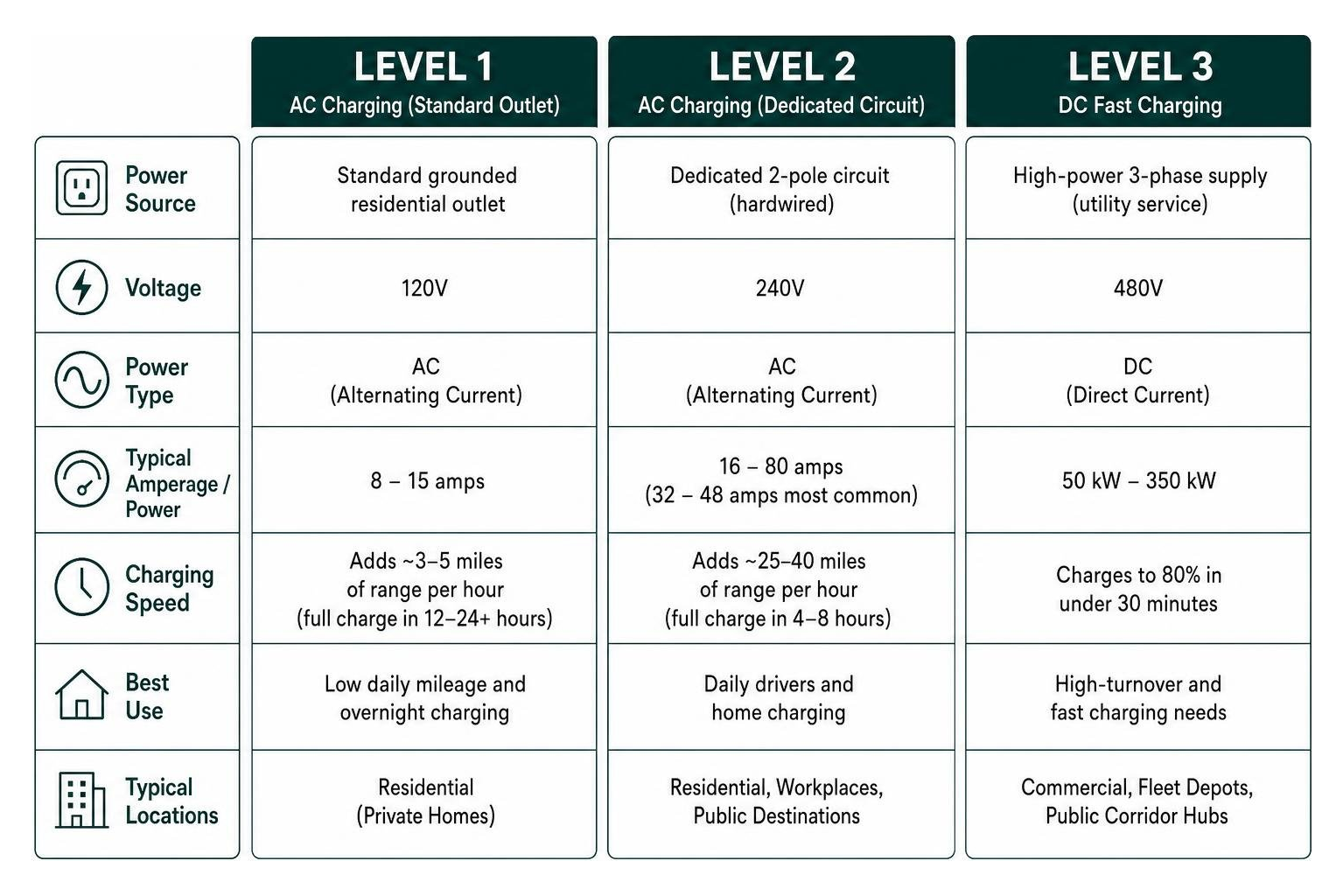
- Level 1 Charging: Operates on standard 120-volt alternating current (AC) residential circuits, typically drawing 8 to 15 amps from a standard grounded outlet. Because Level 1 delivers modest charging speeds—adding roughly 3 to 5 miles of driving range per hour of charging—it requires 12 to 24 hours or more to fully recharge an empty battery pack. While Level 1 uses standard infrastructure, it does not support high-mileage daily driving demands and does not qualify for utility efficiency rebates.
- Level 2 Charging: Operates on a dedicated 240-volt AC circuit drawing between 16 and 80 amps (with 32-amp to 48-amp setups being the most common). Level 2 systems replenish batteries rapidly, delivering approximately 25 to 40 miles of range per hour of charging, fully recharging most vehicles in 4 to 8 hours. Selecting a premium Level 2 home charger requires a dedicated 2-pole circuit breaker, commercial-grade wiring, and meticulous load evaluation.
- Level 3 (DC Fast Charging): Designed primarily for commercial depots, fleet operations, and public corridor hubs. These systems operate on 480-volt, 3-phase alternating current and convert AC power directly to high-voltage direct current (DC) inside the station cabinet. Delivering power levels from 50 kW up to 350 kW, Level 3 can recharge an EV battery to 80 percent in under 30 minutes. Deploying this equipment demands utility transformer coordination, heavy industrial switchgear, and dedicated commercial EV charging infrastructure.
How a Professional EV Charging Station Installer Evaluates Load Capacity
Before installing any charging hardware, a licensed electrical contractor performs a detailed electrical load calculation. Many older homes throughout central Indiana feature legacy 100-amp or 150-amp electrical panels. When modern electrical appliances—such as central air conditioning systems, electric heat pumps, water heaters, and electric ranges—are operating simultaneously, adding a 40-amp or 50-amp continuous EV load can quickly push the service panel beyond its safe operational threshold.
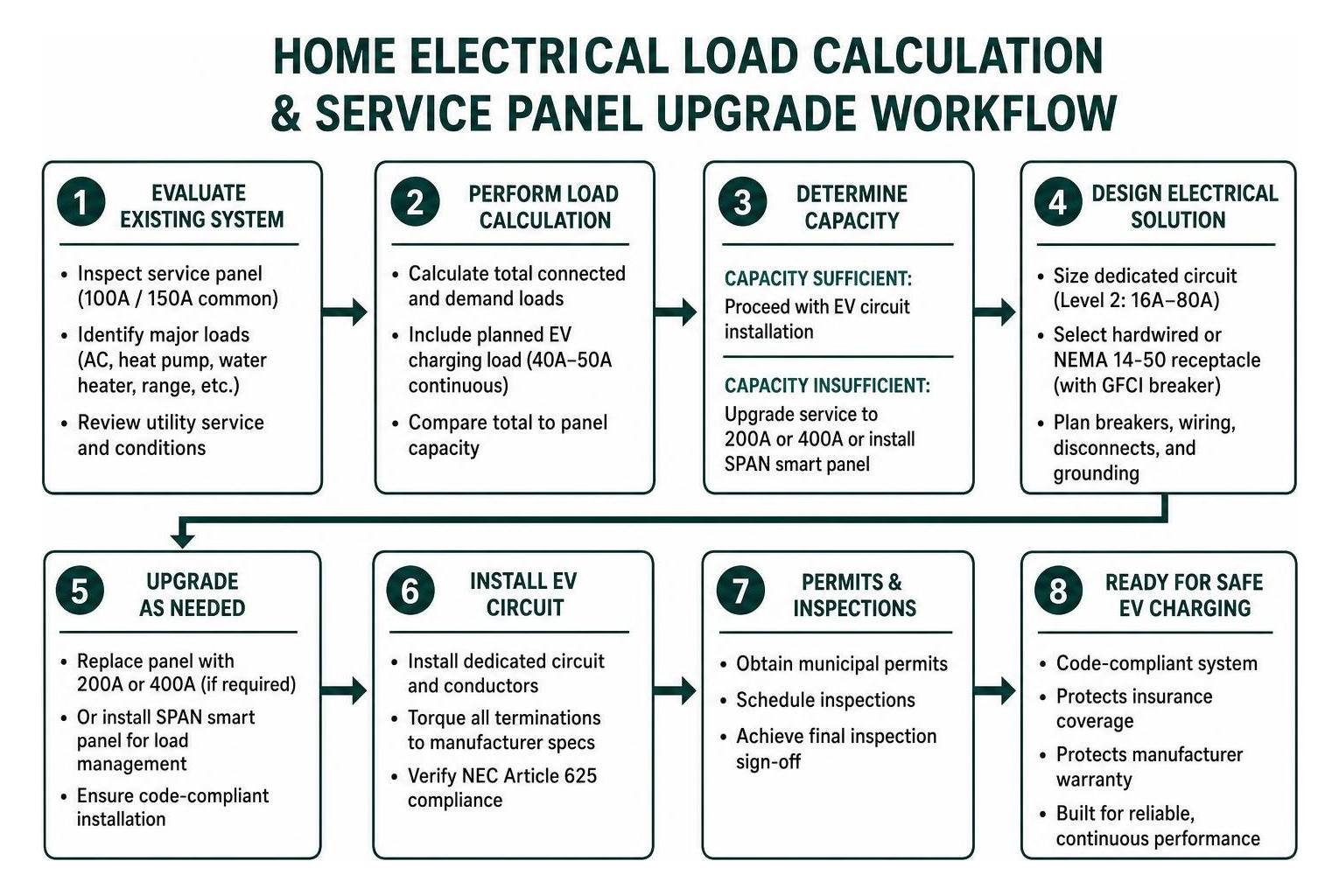
During severe spring storms and erratic weather events across Indiana, localized power fluctuations, grid surges, and branch drops put immense strain on electrical distribution systems. If your main panel is already operating near capacity, sudden surges can trigger widespread circuit failures. When an electrical assessment reveals insufficient capacity, we upgrade your property to a modern 200-amp or 400-amp service panel or integrate an advanced SPAN smart panel system. A SPAN smart panel dynamically tracks whole-home consumption and intelligently curtails discretionary circuits during peak demand or outages, ensuring home safety and maximizing EV charging efficiency without overtaxing your utility drop.
Professional installers also evaluate whether a hardwired connection or a NEMA 14-50 receptacle is optimal for your installation. While a NEMA 14-50 plug offers portability, it introduces extra mechanical connection points and legally requires an upstream Ground Fault Circuit Interrupter (GFCI) breaker under modern NEC updates. Pairing an upstream GFCI breaker with an EV charger that contains its own built-in ground-fault diagnostic circuitry frequently causes nuisance tripping. Hardwiring the charging unit creates a direct, robust connection that eliminates false trips, supports higher continuous amperage (up to 48 amps continuous on a 60-amp circuit), and provides unmatched reliability.
Navigating Permits, Rebates, and Code Compliance
Executing a compliant EV charger installation involves navigating municipal building department regulations, obtaining electrical permits, and scheduling mandatory field inspections. Attempting unpermitted electrical modifications not only violates local building ordinances in central Indiana but also complicates future property sales and exposes owners to stop-work orders or fines.
When Grounded Solutions manages your project, we handle the complete administrative and technical process:
- Submitting technical wiring schematics and load calculations to local building authorities.
- Pulling all necessary electrical permits before breaking ground or pulling wire.
- Coordinating with the local utility provider if a meter base upgrade, drop relocation, or transformer check is required.
- Performing rigorous continuity, polarity, voltage drop, and ground-fault testing using precision digital multimeters and load bank analyzers.
- Coordinating the final municipal inspection to secure an official certificate of compliance.
Our structured process is detailed throughout our professional EV charger installation overview.
Beyond regulatory compliance, utilizing a licensed contractor is a mandatory prerequisite for claiming major financial incentives. The federal Section 30C Alternative Fuel Vehicle Refueling Property Credit offers substantial tax credits for eligible residential and commercial hardware and installation costs. Additionally, regional utility programs offer dedicated rebates and advantageous time-of-use (TOU) charging rates that lower your ongoing energy costs. These incentive programs require paid itemized invoices from licensed, certified electrical contractors alongside official building permit sign-offs. DIY installations simply do not qualify.
Residential vs. Commercial and Multi-Family Charging Requirements
The engineering considerations for electric vehicle infrastructure diverge significantly when transitioning from single-family residential garages to multi-family communities and commercial properties.
- Multi-Family Dwellings (Apartments, Condos, HOAs): Multi-family installations demand careful architectural planning, Homeowners Association (HOA) board approvals, tenant billing software integration, and load sharing capabilities. Dedicated subpanel distribution, individual submetering, and smart energy management platforms allow multiple residents to charge simultaneously without exceeding building transformer limits.
- Commercial Properties and Workplaces: Commercial sites require robust bollards, weather-resistant outdoor enclosures, commercial-grade surge protection, and strict adherence to Americans with Disabilities Act (ADA) accessibility guidelines. ADA compliance mandates specific parking stall dimensions, clear path-of-travel clearances, and operable charging cord heights to accommodate all drivers.
- Fleet Electrification: Fleet applications require customized high-amperage switchgear, 3-phase utility service planning, and intelligent schedule-based charging management to ensure commercial delivery vans and service vehicles are fully charged before shift start times.
Developing long-term, scalable business EV charging solutions demands the expertise of seasoned electrical contractors who understand commercial load profiles and utility interconnection processes.
Choosing Grounded Solutions for Your Property
Selecting Grounded Solutions to manage your high-voltage infrastructure is the single most important decision in your electrification journey. Rather than risking safety with unverified handymen or attempting dangerous electrical tasks yourself, partner directly with our established, licensed team for transparent service, technical precision, and verified credentials.
Grounded Solutions holds full electrical contractor licensing, comprehensive general liability insurance, and advanced certifications from leading equipment manufacturers. For automated home energy management, smart lighting, and motorized control systems, Grounded Solutions is proud to be Caséta and RadioRA 3 Certified by Lutron, giving you seamless control over your property’s entire energy footprint.
Our team at Grounded Solutions brings decades of specialized experience across central Indiana and southern suburbs like Beech Grove, Franklin, Whiteland, Southport, and Mooresville. We review your existing electrical infrastructure, install dedicated heavy-duty wiring, handle all permitting logistics, and conduct comprehensive post-installation testing. Understanding how to pick the best licensed EV installer in Indianapolis empowers property owners to make confident, safety-first investments. Following installation, we also provide ongoing support and routine electric vehicle charging point maintenance to keep your infrastructure running safely for decades.
Frequently Asked Questions About EV Charger Installation
Can I install a Level 2 EV charger myself if I already have a 240V outlet?
Installing a Level 2 EV charger is not as simple as plugging into an existing 240V receptacle, such as an old clothes dryer outlet. Residential dryer outlets (such as older 3-prong NEMA 10-30 receptacles) lack dedicated neutral or grounding configurations required by modern equipment and are not built for continuous multi-hour loads. Furthermore, standard builder-grade 240V outlets are constructed with light-duty internal components designed for intermittent appliance cycles; under sustained 32-amp or 40-amp EV loads, they can overheat, melt, or cause electrical fires. A licensed electrician must evaluate the circuit breaker sizing, verify the wire gauge, perform a panel load calculation, and install a continuous-duty, commercial-grade receptacle or hardwire the station directly to code.
What permits and inspections are legally required for an EV charging station?
In Indianapolis and surrounding municipalities, installing a new 240-volt dedicated circuit or Level 2/Level 3 charging station legally requires an electrical permit issued by the local building authority. The permitting process involves submitting load calculations, equipment specifications, and panel diagrams. Once installation is complete, a certified municipal electrical inspector must conduct a final inspection to verify proper grounding, correct wire sizing, breaker protection, torque compliance, and strict adherence to the National Electrical Code before the circuit is officially energized and signed off.
How does professional installation help me qualify for tax credits and utility rebates?
State, federal, and utility incentive programs require verified proof of professional installation to prevent unsafe, unpermitted setups from connecting to the electric grid. To claim the federal Section 30C tax credit or qualify for local utility equipment rebates and discounted EV time-of-use rate programs, applicants must submit an itemized invoice from a fully licensed, insured electrical contractor, along with permit numbers and official inspection sign-off sheets. DIY installations are ineligible for these rebates and tax incentives.
Conclusion
Installing an electric vehicle charging station is a major infrastructure upgrade that requires professional electrical engineering, meticulous code compliance, and precision workmanship. Attempting to bypass these essential safety protocols with DIY installations introduces unacceptable hazards, including electrical panel overloads, home fire risks, voided equipment warranties, and denied insurance claims.
At Grounded Solutions, we are proud to be central Indiana’s trusted, family-owned electrical contractor. Fully licensed, bonded, and insured, our expert electricians deliver turnkey residential and commercial charging installations throughout Indianapolis, Beech Grove, Franklin, Whiteland, Southport, Mooresville, Greenwood, Carmel, Fishers, and surrounding areas. From comprehensive panel capacity audits and SPAN smart panel integrations to dedicated high-voltage circuit wiring, permitting, and final inspection sign-offs, we ensure your charging infrastructure is safe, dependable, and built to last.
Contact Grounded Solutions today to schedule your comprehensive on-site electrical assessment and experience the peace of mind that comes with professional full-service electrical contracting.